Teh Rene Ning, Sumbele Irene Ule Ngole, Nkeudem Gillian Asoba, Sandie Sorelle Mekachie, Sama Sharon Odmia, Metuge Samuel, Kimbi Helen Kuokuo
Department of Zoology and Animal Physiology, University of Buea, Buea, Cameroon.
Department of Social Economy and Family Management, Higher Technical Teachers' Training College, University of Buea, Kumba, Cameroon.
Trop Med Health. 2022 Oct 24;50(1):79. doi: 10.1186/s41182-022-00469-6.
Anaemia, anisocytosis, malnutrition (especially stunting) are common health problems in developing countries with children being the most vulnerable. These conditions have negative impacts on human performance, growth and development, and can further be complicated if comorbidity exists within a holoendemic stratum with strong and perennial malaria parasite transmission such as the Mount Cameroon area. The study aimed at determining the prevalence and severity malnutrition, anaemia and anisocytosis in children ≤ 5 years, living in the conflict hit malaria perennial transmission zone of the Mount Cameroon area.
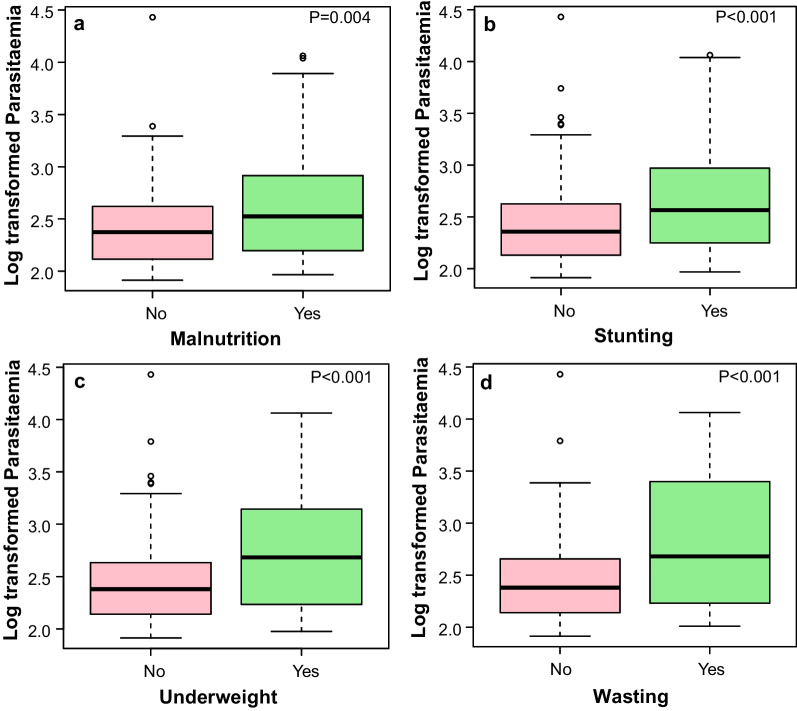
A cross-sectional community-based survey involving 628 children ≤ 5 years was conducted. Malaria parasitaemia was confirmed by Giemsa-stained microscopy and the density was log transformed. Haemoglobin (Hb), mean cell volume and red blood cell distribution width were estimated using an auto-haematology analyser and defined according to WHO standards. Anthropometric indices were analysed and compared with WHO growth reference standards using WHO Anthro software.
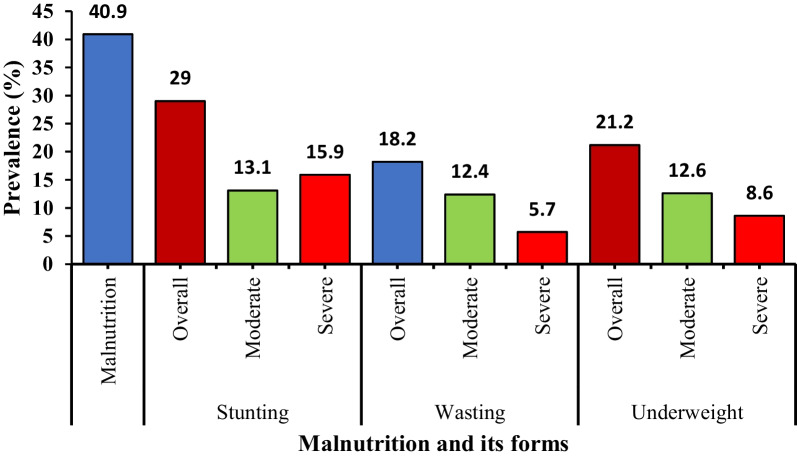
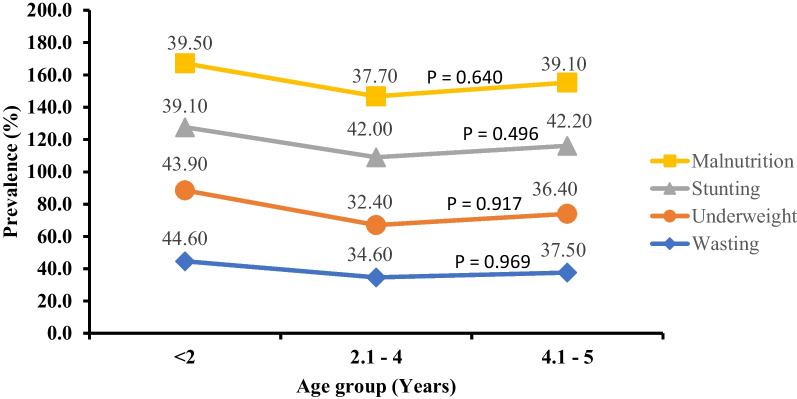
Plasmodium infection, anaemia, microcytic anaemia, anisocytosis and stunting were prevalent in 36.0, 72.8, 30.1, 54.1 and 29.0% of the children, respectively. The ≤ 24 months children were more moderately stunted (14.7%), with higher prevalence of microcytic anaemia (38.8%) and anisocytosis (68.8%) (P < 0.002 and P < 0.001, respectively) when compared with the older children. The mean Hb level in the study population was 10.04 g/dL with children ≤ 24 months having the least mean haemoglobin level (9.69 g/dL) when compared with their older counterparts at P < 0.001. The odds of having anisocytosis were highest among children who were malnourished (OR = 4.66, P = 0.005), those infected with malaria parasites (OR = 1.85, P = 0.007), and whose parents had a primary (OR = 3.51, P = 0.002) and secondary levels of education (OR = 2.69, P = 0.017).
Malaria, anaemia, anisocytosis and undernutrition still remain severe public health concerns among children ≤ 60 months in the Mount Cameroon area. This therefore emphasizes the need for the implementation of consistent policies, programmes and activities to avoid malaria, anaemia, anisocytosis and stunting in the paediatric age group.
贫血、红细胞大小不均、营养不良(尤其是发育迟缓)是发展中国家常见的健康问题,儿童最为脆弱。这些状况会对人类的表现、生长和发育产生负面影响,并且如果在喀麦隆山区这种疟疾寄生虫传播强烈且常年存在的高度流行地区存在合并症,情况会更加复杂。该研究旨在确定喀麦隆山区受冲突影响的疟疾常年传播区中5岁及以下儿童营养不良、贫血和红细胞大小不均的患病率及严重程度。
开展了一项基于社区的横断面调查,涉及628名5岁及以下儿童。通过吉姆萨染色显微镜检查确认疟原虫血症,并对密度进行对数转换。使用自动血液分析仪估算血红蛋白(Hb)、平均红细胞体积和红细胞分布宽度,并根据世界卫生组织标准进行定义。使用WHO Anthro软件分析人体测量指标,并与世界卫生组织生长参考标准进行比较。
疟原虫感染、贫血、小细胞性贫血、红细胞大小不均和发育迟缓在儿童中的患病率分别为36.0%、72.8%、30.1%、54.1%和29.0%。与年龄较大的儿童相比,24个月及以下的儿童发育迟缓更为严重(14.7%),小细胞性贫血(38.8%)和红细胞大小不均(68.8%)的患病率更高(分别为P < 0.002和P < 0.001)。研究人群的平均Hb水平为10.04 g/dL,24个月及以下的儿童平均血红蛋白水平最低(9.69 g/dL),与年龄较大的儿童相比,P < 0.001。红细胞大小不均的几率在营养不良的儿童中最高(OR = 4.66,P = 0.005),感染疟原虫的儿童中(OR = 1.85,P = 0.007),以及父母具有小学(OR = 3.51,P = 0.002)和中学教育水平的儿童中(OR = 2.69,P = 0.017)。
疟疾、贫血、红细胞大小不均和营养不良仍然是喀麦隆山区60个月及以下儿童严重的公共卫生问题。因此,这强调了需要实施一致的政策、计划和活动,以避免儿童年龄组出现疟疾、贫血、红细胞大小不均和发育迟缓。