Epidemiology and Biostatistics Unit, Institut de Recherche Expérimentale et Clinique, Université catholique de Louvain, Box: B1.30.13, Brussels, Belgium.
National Malaria Control Program, Ministry of Public Health, Yaoundé, Cameroon.
Sci Rep. 2021 Jun 1;11(1):11408. doi: 10.1038/s41598-021-90997-8.
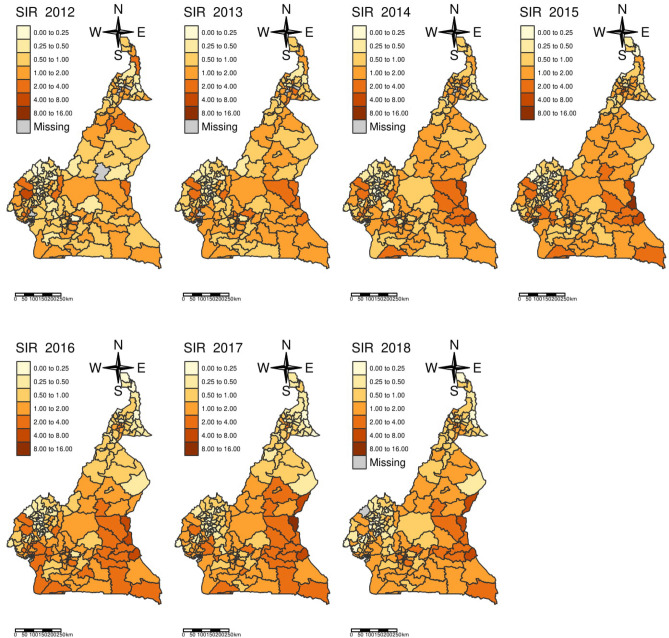
The current study aims to provide a fine-scale spatiotemporal estimate of malaria incidence among Cameroonian under-5, and to determine its associated environmental factors, to set up preventive interventions that are adapted to each health district of Cameroon. Routine data on symptomatic malaria in children under-5 collected in health facilities, between 2012 and 2018 were used. The trend of malaria cases was assessed by the Mann-Kendall (M-K) test. A time series decomposition was applied to malaria incidence to extract the seasonal component. Malaria risk was estimated by the standardised incidence ratio (SIR) and smoothed by a hierarchical Bayesian spatiotemporal model. In total, 4,052,216 cases of malaria were diagnosed between 2012 and 2018. There was a gradual increase per year, from 369,178 in 2012 to 652,661 in 2018. After adjusting the data for completeness, the national incidence ranged from 489‰ in 2012 to 603‰ in 2018, with an upward trend (M-K test p-value < 0.001). At the regional level, an upward trend was observed in Adamaoua, Centre without Yaoundé, East, and South regions. There was a positive spatial autocorrelation of the number of malaria incident-cases per district per year as suggested by the Moran's I test (statistic range between 0.11 and 0.53). The crude SIR showed a heterogeneous malaria risk with values ranging from 0.00 to 8.90, meaning that some health districts have a risk 8.9 times higher than the national annual level. The incidence and risk of malaria among under-5 in Cameroon are heterogeneous and vary significantly across health districts and seasons. It is crucial to adapt malaria prevention measures to the specificities of each health district, in order to reduce its burden in health districts where the trend is upward.
本研究旨在为喀麦隆五岁以下儿童疟疾发病率提供精细的时空估计,并确定其相关环境因素,以便为喀麦隆的每个卫生区制定适应的预防措施。使用了 2012 年至 2018 年期间在卫生机构中收集的五岁以下儿童有症状疟疾的常规数据。通过曼恩-肯德尔(M-K)检验评估疟疾病例的趋势。应用时间序列分解法提取疟疾发病率的季节性成分。通过标准化发病率比(SIR)估计疟疾风险,并通过分层贝叶斯时空模型进行平滑处理。2012 年至 2018 年期间共诊断出 4052216 例疟疾。每年的病例数逐渐增加,从 2012 年的 369178 例增加到 2018 年的 652661 例。在对数据进行完整性调整后,全国发病率从 2012 年的 489‰上升到 2018 年的 603‰,呈上升趋势(M-K 检验 P 值<0.001)。在区域层面上,阿达马瓦、没有雅温得的中心、东部和南部地区的发病率呈上升趋势。Moran's I 检验(统计范围在 0.11 到 0.53 之间)表明,每年每个区疟疾发病病例数呈正空间自相关。原始 SIR 显示疟疾风险具有异质性,值范围从 0.00 到 8.90,这意味着一些卫生区的风险比全国年度水平高 8.9 倍。喀麦隆五岁以下儿童的疟疾发病率和风险存在异质性,在卫生区和季节之间差异显著。根据每个卫生区的特点,调整疟疾预防措施至关重要,以降低上升趋势地区的疟疾负担。