MD-PhD Program, Yale School of Medicine, New Haven, Connecticut.
Section of General Internal Medicine, Department of Medicine, Yale School of Medicine, New Haven, Connecticut.
JAMA Netw Open. 2022 Oct 3;5(10):e2238520. doi: 10.1001/jamanetworkopen.2022.38520.
Diverse research teams are critical to solving complex health problems and producing high-quality medical research.
To examine the associations of student sex and racial and ethnic identity with publication rates during medical school.
DESIGN, SETTING, AND PARTICIPANTS: This cohort study assessed individual-level data of US MD graduates from medical school who matriculated in academic years 2014 to 2015 and 2015 to 2016. Data were obtained from the Association of American Medical Colleges and analyzed from October 2021 to January 2022.
Outcomes of interest included students' self-reported participation in unique research experiences, number of publications, and computed publications per research experience. Poisson regressions were constructed to determine the association of sex and racial and ethnic identity with research outcomes using adjusted rate ratios (aRRs).
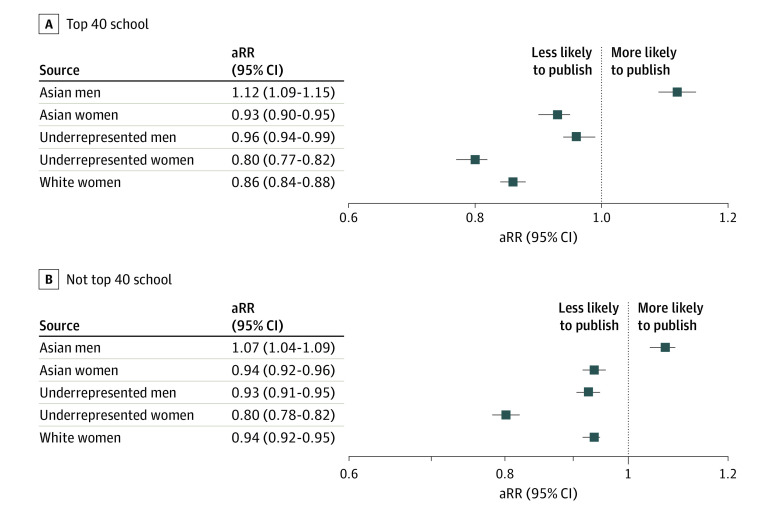
Among 31 474 graduates, 15 159 (48.2%) identified as women and 4344 (13.8%) identified as underrepresented in medicine by race and ethnicity (URIM; including American Indian, Alaska Native, Black, Hawaiian Native, Hispanic/Latinx, and Pacific Islander individuals). Students who attended National Institutes of Health (NIH) top 40 research-ranked schools reported higher number of research experiences and publication counts, resulting in a higher publication rate compared with students from non-top 40 schools (median [IQR] 1.60 [1.00-3.00] vs 1.25 [0.50-2.33]; P < .001). Women reported a higher number of research experiences than men but a significantly lower number of publications (top 40 schools: aRR, 0.89; 95% CI, 0.87-0.90; non-top 40 schools: aRR, 0.93; 95% CI, 0.92-0.95). This resulted in a significantly lower publication rate among women (top 40 schools: aRR, 0.85; 95% CI, 0.83-0.86; non-top 40 schools: aRR, 0.91; 95% CI, 0.90-0.92). Compared with White students, Asian students had higher publication rates at both NIH top 40 schools (aRR, 1.10; 95% CI, 1.08-1.12) and non-top 40 schools (aRR, 1.07; 95% CI, 1.05-1.08), while lower publication rates were reported among Black students (top 40 schools: aRR, 0.83; 95% CI, 0.80-0.86; non-top 40 schools: aRR, 0.88; 95% CI, 0.85-0.95) and Hispanic students attending non-top 40 schools (aRR, 0.93; 95% CI, 0.90-0.95).
These findings illustrate that inequities in the physician-scientist workforce began early in training and highlight key areas for intervention, such as funding support and mentorship training during undergraduate medical education, that may promote the future success of a diverse physician-scientist workforce.
多样化的研究团队对于解决复杂的健康问题和产生高质量的医学研究至关重要。
研究学生的性别以及种族和民族认同与医学生期间的出版率之间的关联。
设计、地点和参与者:本队列研究评估了美国医学博士毕业生的个体水平数据,这些毕业生在 2014 至 2015 学年和 2015 至 2016 学年入读医学院。数据来自美国医学院协会,从 2021 年 10 月到 2022 年 1 月进行分析。
感兴趣的结果包括学生自我报告的参与独特研究经验、出版物数量以及计算的每篇研究经验的出版物数量。使用调整后的比率比(ARR)构建泊松回归,以确定性别和种族和民族认同与研究结果之间的关联。
在 31474 名毕业生中,15159 名(48.2%)女性和 4344 名(13.8%)被认定为医学领域代表性不足的少数族裔(包括美国印第安人、阿拉斯加原住民、黑人、夏威夷原住民、西班牙裔/拉丁裔和太平洋岛民)。在 NIH 排名前 40 的研究型学校就读的学生报告了更多的研究经验和出版物数量,与非前 40 名学校的学生相比,出版率更高(中位数[IQR]:1.60[1.00-3.00]比 1.25[0.50-2.33];P<.001)。女性报告的研究经验数量多于男性,但出版物数量明显较少(前 40 名学校:ARR,0.89;95%CI,0.87-0.90;非前 40 名学校:ARR,0.93;95%CI,0.92-0.95)。这导致女性的出版率明显较低(前 40 名学校:ARR,0.85;95%CI,0.83-0.86;非前 40 名学校:ARR,0.91;95%CI,0.90-0.92)。与白人学生相比,亚洲学生在前 40 名 NIH 学校(ARR,1.10;95%CI,1.08-1.12)和非前 40 名学校(ARR,1.07;95%CI,1.05-1.08)的出版率更高,而黑人学生(前 40 名学校:ARR,0.83;95%CI,0.80-0.86;非前 40 名学校:ARR,0.88;95%CI,0.85-0.95)和非前 40 名学校的西班牙裔学生(ARR,0.93;95%CI,0.90-0.95)的出版率较低。
这些发现表明,医生-科学家劳动力中的不平等现象早在培训阶段就已经存在,并强调了关键的干预领域,例如在本科医学教育期间提供资金支持和指导培训,这可能会促进多元化医生-科学家劳动力的未来成功。