Centre for Ecological and Evolutionary Synthesis, Department of Biosciences, University of Oslo, 0316 Oslo, Norway.
Department of Environmental Archaeology and Human Paleoecology, Institute of Archaeology, Nicolaus Copernicus University, 87-100 Toruń, Poland.
Proc Natl Acad Sci U S A. 2022 Nov 8;119(45):e2208703119. doi: 10.1073/pnas.2208703119. Epub 2022 Oct 25.
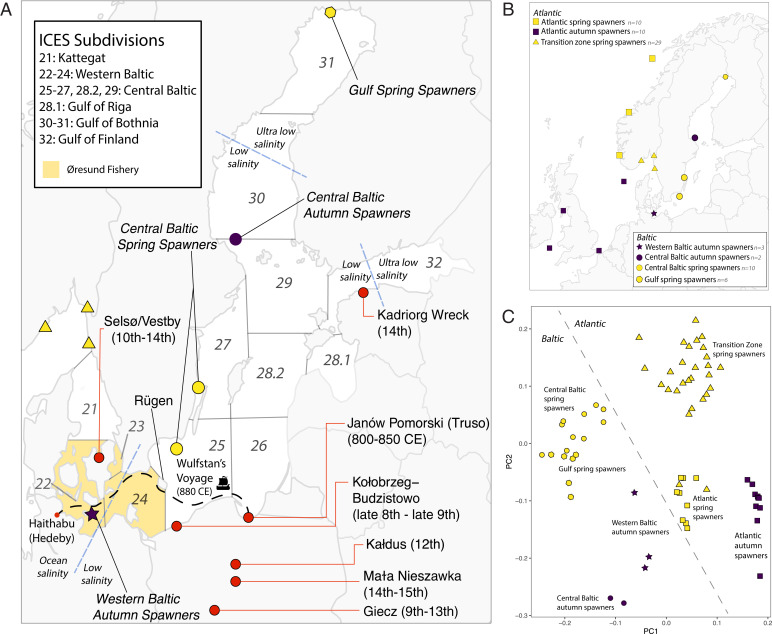
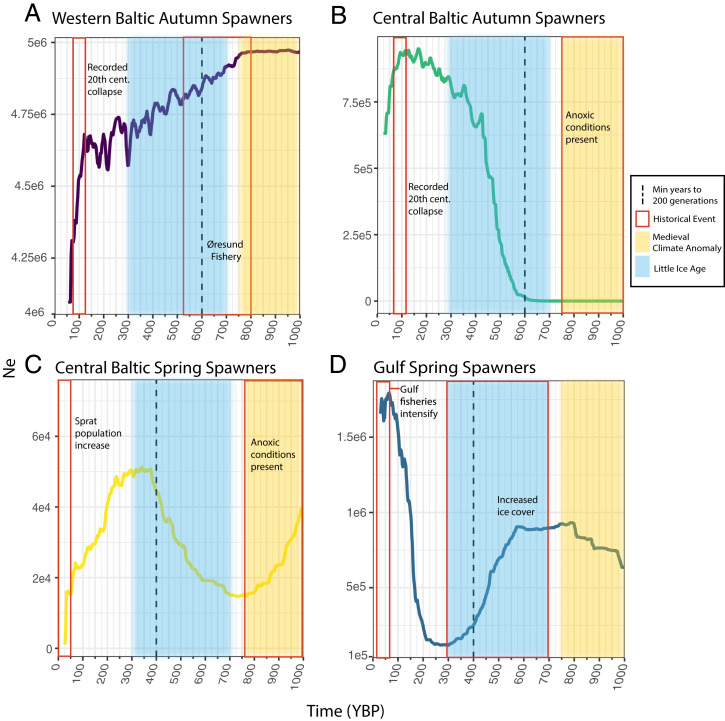
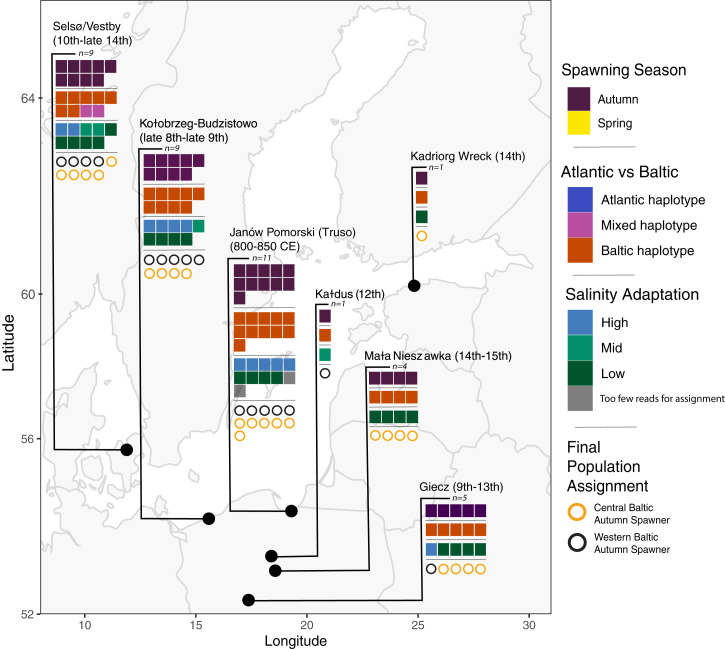
The world's oceans are currently facing major stressors in the form of overexploitation and anthropogenic climate change. The Baltic Sea was home to the first "industrial" fishery ∼800 y ago targeting the Baltic herring, a species that is still economically and culturally important today. Yet, the early origins of marine industries and the long-term ecological consequences of historical and contemporary fisheries remain debated. Here, we study long-term population dynamics of Baltic herring to evaluate the past impacts of humans on the marine environment. We combine modern whole-genome data with ancient DNA (aDNA) to identify the earliest-known long-distance herring trade in the region, illustrating that extensive fish trade began during the Viking Age. We further resolve population structure within the Baltic and observe demographic independence for four local herring stocks over at least 200 generations. It has been suggested that overfishing at Øresund in the 16th century resulted in a demographic shift from autumn-spawning to spring-spawning herring dominance in the Baltic. We show that while the Øresund fishery had a negative impact on the western Baltic herring stock, the demographic shift to spring-spawning dominance did not occur until the 20th century. Instead, demographic reconstructions reveal population trajectories consistent with expected impacts of environmental change and historical reports on shifting fishing targets over time. This study illustrates the joint impact of climate change and human exploitation on marine species as well as the role historical ecology can play in conservation and management policies.
目前,全球海洋正面临过度开发和人为气候变化等重大压力。大约 800 年前,波罗的海成为了首个“工业化”渔业的所在地,目标是捕捞波罗的海鲱鱼,这种鱼类至今在经济和文化上仍然具有重要意义。然而,海洋产业的早期起源以及历史和当代渔业对长期生态的影响仍存在争议。在这里,我们研究了波罗的海鲱鱼的长期种群动态,以评估人类对海洋环境的过去影响。我们将现代全基因组数据与古代 DNA(aDNA)相结合,以确定该地区最早已知的长途鲱鱼贸易,表明广泛的鱼类贸易始于维京时代。我们进一步解析了波罗的海内部的种群结构,并观察到至少 200 代以来四个本地鲱鱼种群的人口结构独立。有人认为,16 世纪在厄勒海峡的过度捕捞导致了波罗的海秋季产卵的鲱鱼向春季产卵的鲱鱼优势的种群转变。我们表明,虽然厄勒海峡的渔业对西部波罗的海鲱鱼种群产生了负面影响,但这种向春季产卵优势的种群转变直到 20 世纪才发生。相反,人口重建显示,人口轨迹与气候变化和历史上随着时间推移而改变捕捞目标的预期影响一致。这项研究说明了气候变化和人类开发对海洋物种的共同影响,以及历史生态学在保护和管理政策中的作用。