Maastricht University, Department of Psychiatry and Neuropsychology, Alzheimer Centre Limburg, School for Mental Health and Neurosciences, Maastricht, The Netherlands.
Karolinska Institutet, Department for Neurobiology, Care Sciences and Society, Center for Alzheimer Research, Division of Neurogeriatrics, Solna, Sweden.
Alzheimers Dement. 2023 May;19(5):1800-1820. doi: 10.1002/alz.12811. Epub 2022 Oct 25.
The credibility of model-based economic evaluations of Alzheimer's disease (AD) interventions is central to appropriate decision-making in a policy context. We report on the International PharmacoEconomic Collaboration on Alzheimer's Disease (IPECAD) Modeling Workshop Challenge.
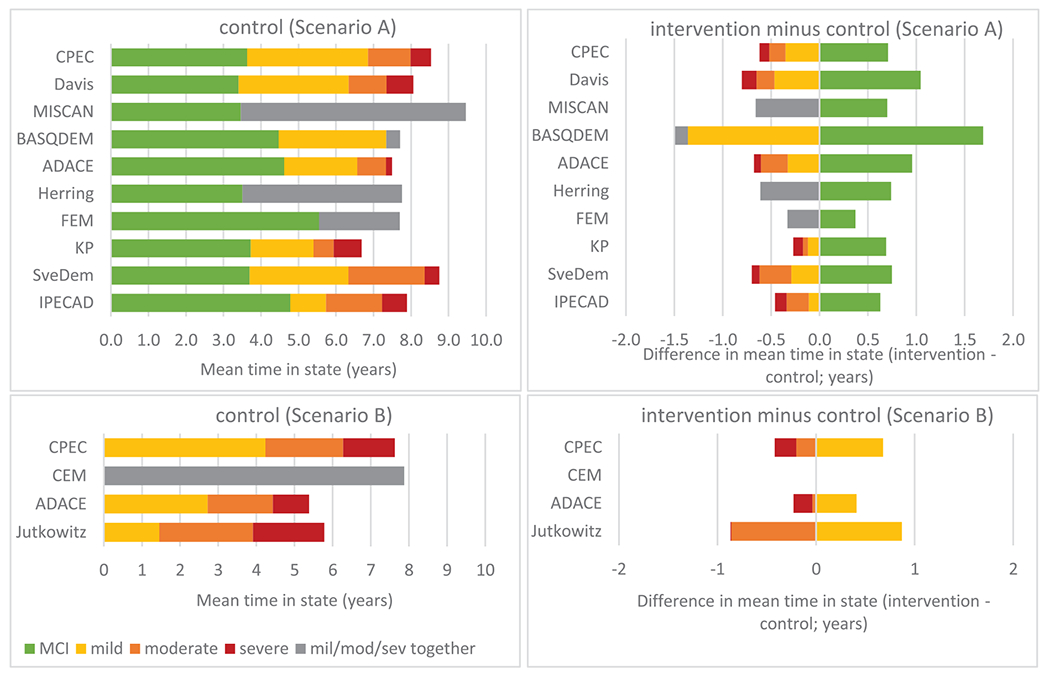
Two common benchmark scenarios, for the hypothetical treatment of AD mild cognitive impairment (MCI) and mild dementia, were developed jointly by 29 participants. Model outcomes were summarized, and cross-comparisons were discussed during a structured workshop.
A broad concordance was established among participants. Mean 10-year restricted survival and time in MCI in the control group ranged across 10 MCI models from 6.7 to 9.5 years and 3.4 to 5.6 years, respectively; and across 4 mild dementia models from 5.4 to 7.9 years (survival) and 1.5 to 4.2 years (mild dementia).
The model comparison increased our understanding of methods, data used, and disease progression. We established a collaboration framework to assess cost-effectiveness outcomes, an important step toward transparent and credible AD models.
在政策背景下,对阿尔茨海默病(AD)干预措施进行基于模型的经济评估的可信度是做出适当决策的核心。我们报告了国际阿尔茨海默病药物经济学合作组织(IPECAD)模型研讨会挑战赛的情况。
29 名参与者共同制定了两个常见的基准情景,用于假设性治疗 AD 轻度认知障碍(MCI)和轻度痴呆。在一个结构化的研讨会上总结了模型结果,并进行了交叉比较。
参与者之间建立了广泛的一致性。在 10 个 MCI 模型中,对照组的 10 年限制生存和 MCI 时间范围从 6.7 年到 9.5 年不等,分别为 3.4 年到 5.6 年;在 4 个轻度痴呆模型中,从 5.4 年到 7.9 年(生存)和 1.5 年到 4.2 年(轻度痴呆)不等。
模型比较增加了我们对方法、使用的数据和疾病进展的理解。我们建立了一个合作框架来评估成本效益结果,这是使 AD 模型透明和可信的重要一步。