Division of Infection and Immunity, UCL, London, UK.
Quantitative Biosciences Institute (QBI), University of California San Francisco, San Francisco, CA, USA.
Nat Microbiol. 2022 Nov;7(11):1762-1776. doi: 10.1038/s41564-022-01247-0. Epub 2022 Oct 26.
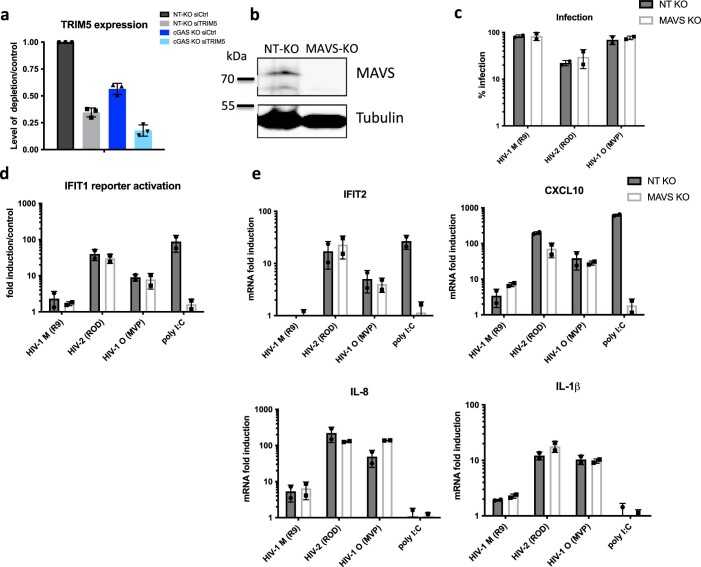
Of the 13 known independent zoonoses of simian immunodeficiency viruses to humans, only one, leading to human immunodeficiency virus (HIV) type 1(M) has become pandemic, causing over 80 million human infections. To understand the specific features associated with pandemic human-to-human HIV spread, we compared replication of HIV-1(M) with non-pandemic HIV-(O) and HIV-2 strains in myeloid cell models. We found that non-pandemic HIV lineages replicate less well than HIV-1(M) owing to activation of cGAS and TRIM5-mediated antiviral responses. We applied phylogenetic and X-ray crystallography structural analyses to identify differences between pandemic and non-pandemic HIV capsids. We found that genetic reversal of two specific amino acid adaptations in HIV-1(M) enables activation of TRIM5, cGAS and innate immune responses. We propose a model in which the parental lineage of pandemic HIV-1(M) evolved a capsid that prevents cGAS and TRIM5 triggering, thereby allowing silent replication in myeloid cells. We hypothesize that this capsid adaptation promotes human-to-human spread through avoidance of innate immune response activation.
在已知的 13 种可导致人类感染的灵长类动物免疫缺陷病毒独立传染病中,只有一种导致人类免疫缺陷病毒(HIV)1 型(M)成为大流行病毒,导致超过 8000 万人感染。为了了解与大流行的人际 HIV 传播相关的特定特征,我们比较了 HIV-1(M)与非大流行 HIV-(O)和 HIV-2 株在髓样细胞模型中的复制情况。我们发现,由于 cGAS 和 TRIM5 介导的抗病毒反应的激活,非大流行 HIV 谱系的复制效果不如 HIV-1(M)好。我们应用系统发育和 X 射线晶体学结构分析来识别大流行和非大流行 HIV 衣壳之间的差异。我们发现,HIV-1(M)中两种特定氨基酸适应性的遗传逆转使 TRIM5、cGAS 和先天免疫反应被激活。我们提出了一个模型,即大流行 HIV-1(M)的亲代谱系进化出一种衣壳,可防止 cGAS 和 TRIM5 的触发,从而允许在髓样细胞中进行静默复制。我们假设这种衣壳适应性通过避免先天免疫反应的激活促进了人际传播。