Lipids and Atherosclerosis Unit, Internal Medicine Unit, Reina Sofia University Hospital, 14004, Cordoba, Spain.
Department of Medical and Surgical Science, University of Cordoba, 14004, Córdoba, Spain.
BMC Med. 2022 Oct 27;20(1):373. doi: 10.1186/s12916-022-02566-z.
Type 2 diabetes mellitus (T2DM) is one of the most widely spread diseases, affecting around 90% of the patients with diabetes. Metabolomics has proven useful in diabetes research discovering new biomarkers to assist in therapeutical studies and elucidating pathways of interest. However, this technique has not yet been applied to a cohort of patients that have remitted from T2DM.
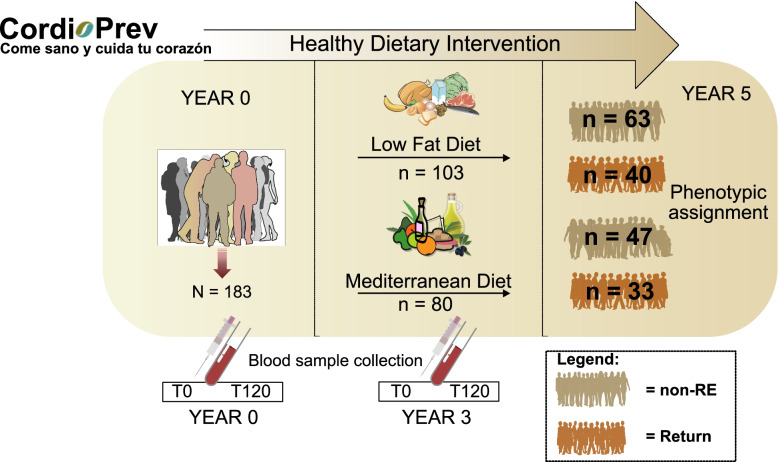
All patients with a newly diagnosed T2DM at baseline (n = 190) were included. An untargeted metabolomics approach was employed to identify metabolic differences between individuals who remitted (RE), and those who did not (non-RE) from T2DM, during a 5-year study of dietary intervention. The biostatistical pipeline consisted of an orthogonal projection on the latent structure discriminant analysis (O-PLS DA), a generalized linear model (GLM), a receiver operating characteristic (ROC), a DeLong test, a Cox regression, and pathway analyses.
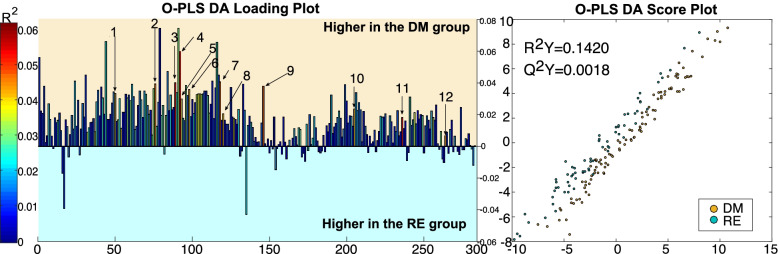
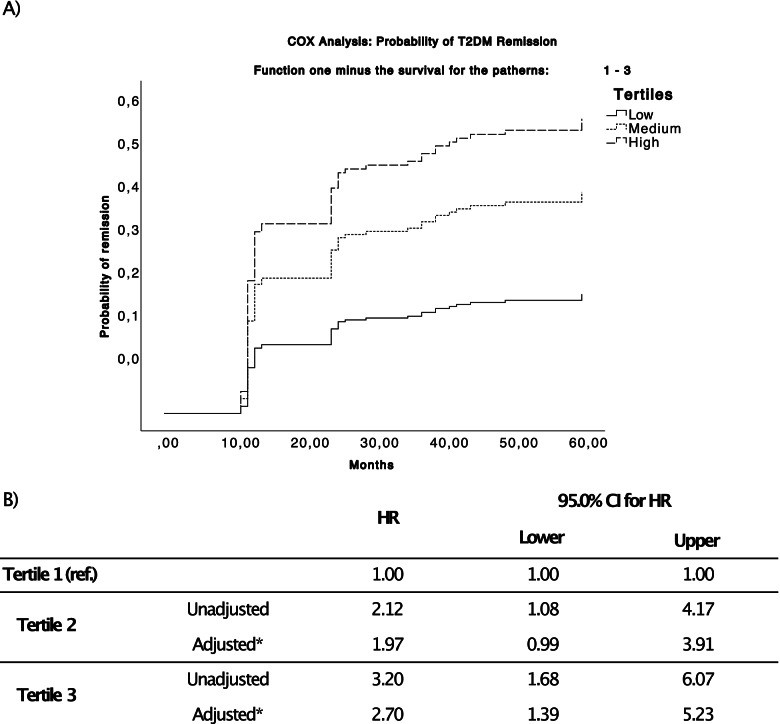
The model identified a significant increase in 12 metabolites in the non-RE group compared to the RE group. Cox proportional hazard models, calculated using these 12 metabolites, showed that patients in the high-score tercile had significantly (p-value < 0.001) higher remission probabilities (Hazard Ratio, HR, = 2.70) than those in the lowest tercile. The predictive power of these metabolites was further studied using GLMs and ROCs. The area under the curve (AUC) of the clinical variables alone is 0.61, but this increases up to 0.72 if the 12 metabolites are considered. A DeLong test shows that this difference is statistically significant (p-value = 0.01).
Our study identified 12 endogenous metabolites with the potential to predict T2DM remission following a dietary intervention. These metabolites, combined with clinical variables, can be used to provide, in clinical practice, a more precise therapy.
ClinicalTrials.gov, NCT00924937.
2 型糖尿病(T2DM)是最广泛传播的疾病之一,影响大约 90%的糖尿病患者。代谢组学已被证明在糖尿病研究中非常有用,可发现新的生物标志物以辅助治疗研究并阐明相关途径。然而,该技术尚未应用于 T2DM 缓解的患者队列。
本研究纳入了基线时新诊断为 T2DM 的所有患者(n=190)。采用非靶向代谢组学方法,在为期 5 年的饮食干预研究中,比较 T2DM 缓解(RE)和未缓解(non-RE)患者之间的个体代谢差异。该生物统计分析流程包括正交投影判别分析(O-PLS DA)、广义线性模型(GLM)、受试者工作特征(ROC)曲线、DeLong 检验、Cox 回归和途径分析。
该模型确定在非-RE 组中与 RE 组相比,有 12 种代谢物显著增加。使用这 12 种代谢物计算的 Cox 比例风险模型表明,高分位 tertile 的患者缓解概率显著(p 值 < 0.001)更高(危险比,HR,= 2.70),而最低 tertile 的患者则更低。使用 GLMs 和 ROCs 进一步研究这些代谢物的预测能力。仅临床变量的曲线下面积(AUC)为 0.61,但如果考虑 12 种代谢物,该 AUC 增加至 0.72。DeLong 检验表明这种差异具有统计学意义(p 值= 0.01)。
我们的研究确定了 12 种内源性代谢物,它们有可能预测饮食干预后 T2DM 的缓解。这些代谢物与临床变量相结合,可用于为临床实践提供更精确的治疗。
ClinicalTrials.gov,NCT00924937。