Urso Luca, Rocca Giovanni Christian, Borgia Francesca, Lancia Federica, Malorgio Antonio, Gagliano Mauro, Zanetto Mauro, Uccelli Licia, Cittanti Corrado, Ippolito Carmelo, Evangelista Laura, Bartolomei Mirco
Department of Translational Medicine, University of Ferrara, Via Aldo Moro 8, 44124 Ferrara, Italy.
Nuclear Medicine Unit, Oncological Medical and Specialist Department, University Hospital of Ferrara, 44124 Ferrara, Italy.
Biomedicines. 2022 Oct 1;10(10):2463. doi: 10.3390/biomedicines10102463.
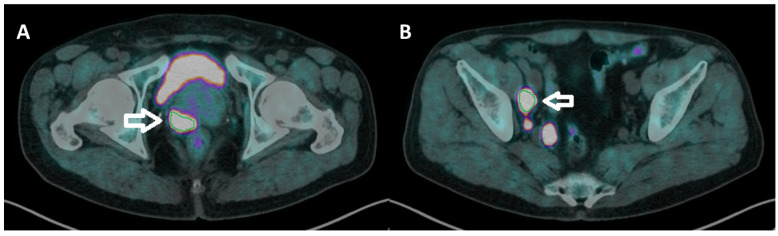
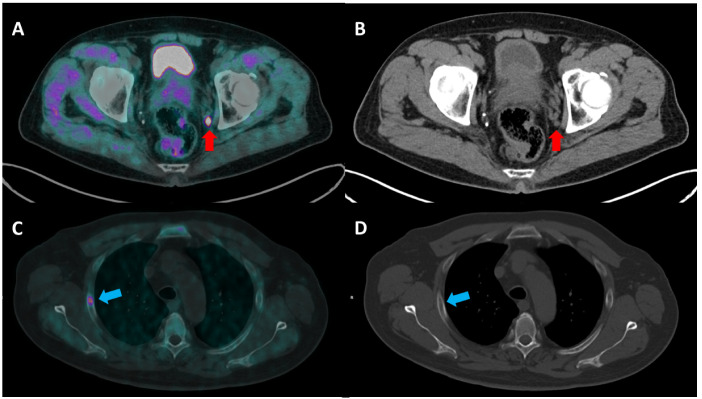
Initial staging of prostate cancer (PCa) is usually performed with conventional imaging (CI), involving computed tomography (CT) and bone scanning (BS). The aim of this study was to analyze the role of [F]F-choline positron emission tomography (PET)/CT in the initial management and outcome prediction of PCa patients by analyzing data from a multidisciplinary approach. We retrospectively analyzed 82 patients who were discussed by the uro-oncology board of the University Hospital of Ferrara for primary staging newly diagnosed PCa (median age 72 (56-86) years; median baseline prostate specific antigen (PSA) equal to 8.73 ng/mL). Patients were divided into three groups based on the imaging performed: group A = only CI; group B = CI + [F]F-choline PET/CT; group C = only [F]F-choline PET/CT. All data on imaging findings, therapy decisions and patient outcomes were retrieved from hospital information systems. Moreover, we performed a sub-analysis of semiquantitative parameters extracted from [F]F-choline PET/CT to search any correlation with patient outcomes. The number of patients included in each group was 35, 35 and 12, respectively. Patients with higher values of initial PSA were subjected to CI + PET/CT ( = 0.005). Moreover, the use of [F]F-choline PET/CT was more frequent in patients with higher Gleason score (GS) or ISUP grade ( = 0.013). The type of treatment performed (surgery = 33; radiation therapy = 22; surveillance = 6; multimodality therapy = 6; systemic therapy = 13; not available = 2) did not show any relationship with the modality adopted to stage the disease. [F]F-choline PET/CT induced a change of planned therapy in 5/35 patients in group B (14.3%). Moreover, patients investigated with [F]F-choline PET/CT alone demonstrated longer biochemical recurrence (BCR)-free survival (30.8 months) in comparison to patients of groups A and B (15.5 and 23.5 months, respectively, = 0.006), probably due to a more accurate selection of primary treatment. Finally, total lesion choline kinase activity (TLCKA) of the primary lesion, calculated by multiplying metabolic tumor volume and mean standardized uptake value (SUVmean), was able to more effectively discriminate patients who had recurrence after therapy compared to those without ( = 0.03). In our real-world experience [F]F-choline PET/CT as a tool for the initial management of PCa had a relevant impact in terms of therapy selection and was associated with longer BCR-free survival. Moreover, TLCKA of the primary lesion looks a promising parameter for predicting recurrence after curative therapy.
前列腺癌(PCa)的初始分期通常采用传统成像(CI)进行,包括计算机断层扫描(CT)和骨扫描(BS)。本研究的目的是通过分析多学科方法的数据,分析[F]F-胆碱正电子发射断层扫描(PET)/CT在PCa患者初始管理和预后预测中的作用。我们回顾性分析了费拉拉大学医院泌尿肿瘤委员会讨论的82例新诊断PCa初始分期的患者(中位年龄72(56 - 86)岁;中位基线前列腺特异性抗原(PSA)等于8.73 ng/mL)。根据所进行的成像将患者分为三组:A组 = 仅CI;B组 = CI + [F]F-胆碱PET/CT;C组 = 仅[F]F-胆碱PET/CT。从医院信息系统中检索所有关于成像结果、治疗决策和患者预后的数据。此外,我们对从[F]F-胆碱PET/CT中提取的半定量参数进行了亚分析,以寻找与患者预后的任何相关性。每组纳入的患者数量分别为35、35和12。初始PSA值较高的患者接受CI + PET/CT(P = 0.005)。此外,[F]F-胆碱PET/CT在Gleason评分(GS)或国际泌尿病理学会(ISUP)分级较高的患者中使用更为频繁(P = 0.013)。所进行的治疗类型(手术 = 33;放疗 = 22;监测 = 6;多模态治疗 = 6;全身治疗 = 13;不可用 = 2)与疾病分期所采用的方式没有显示出任何关系。[F]F-胆碱PET/CT在B组5/35例患者(14.3%)中导致了计划治疗的改变。此外,与A组和B组患者(分别为15.5和23.5个月)相比,仅接受[F]F-胆碱PET/CT检查的患者表现出更长的无生化复发(BCR)生存期(30.8个月)(P = 0.006),这可能是由于对初始治疗的选择更为准确。最后,通过将代谢肿瘤体积和平均标准化摄取值(SUVmean)相乘计算得出的原发灶总病变胆碱激酶活性(TLCKA),与未复发的患者相比,能够更有效地鉴别治疗后复发的患者(P = 0.03)。在我们的实际经验中,[F]F-胆碱PET/CT作为PCa初始管理的工具,在治疗选择方面具有重要影响,并且与更长的无BCR生存期相关。此外,原发灶的TLCKA看起来是预测根治性治疗后复发的一个有前景的参数。