Floreani Annarosa, Gabbia Daniela, De Martin Sara
Department of Surgery, Oncology and Gastroenterology, University of Padova, 35131 Padova, Italy.
Scientific Institute for Research, Hospitalization and Healthcare, 37024 Verona, Italy.
Biomedicines. 2022 Oct 2;10(10):2464. doi: 10.3390/biomedicines10102464.
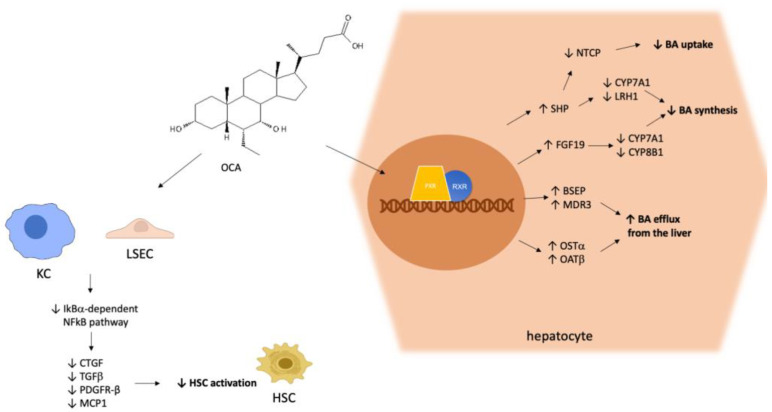
Primary biliary cholangitis (PBC) is a rare autoimmune cholestatic liver disease that may progress to fibrosis and/or cirrhosis. Treatment options are currently limited. The first-line therapy for this disease is the drug ursodeoxycholic acid (UDCA), which has been proven to normalize serum markers of liver dysfunction, halt histologic disease progression, and lead to a prolongation of transplant-free survival. However, 30-40% of patients unfortunately do not respond to this first-line therapy. Obeticholic acid (OCA) is the only registered agent for second-line treatment in UDCA-non responders. In this review, we focus on the pharmacological features of OCA, describing its mechanism of action of and its tolerability and efficacy in PBC patients. We also highlight current perspectives on future therapies for this condition.
原发性胆汁性胆管炎(PBC)是一种罕见的自身免疫性胆汁淤积性肝病,可能进展为肝纤维化和/或肝硬化。目前的治疗选择有限。该病的一线治疗药物是熊去氧胆酸(UDCA),已证实其可使肝功能异常的血清标志物恢复正常,阻止组织学疾病进展,并延长无移植生存期。然而,不幸的是,30%-40%的患者对这种一线治疗无反应。奥贝胆酸(OCA)是唯一获批用于UDCA治疗无效患者二线治疗的药物。在本综述中,我们重点关注OCA的药理学特性,描述其作用机制以及在PBC患者中的耐受性和疗效。我们还强调了针对这种疾病未来治疗的当前观点。