Castriota Luca, Falautano Manuela, Maggio Teresa, Perzia Patrizia
Italian Institute for Environmental Protection and Research, Department for the Monitoring and Protection of the Environment and for the Conservation of Biodiversity, Unit for Conservation Management and Sustainable Use of Fish and Marine Resources, Lungomare Cristoforo Colombo 4521 (Ex Complesso Roosevelt), Località Addaura, 90149 Palermo, Italy.
Biology (Basel). 2022 Oct 8;11(10):1473. doi: 10.3390/biology11101473.
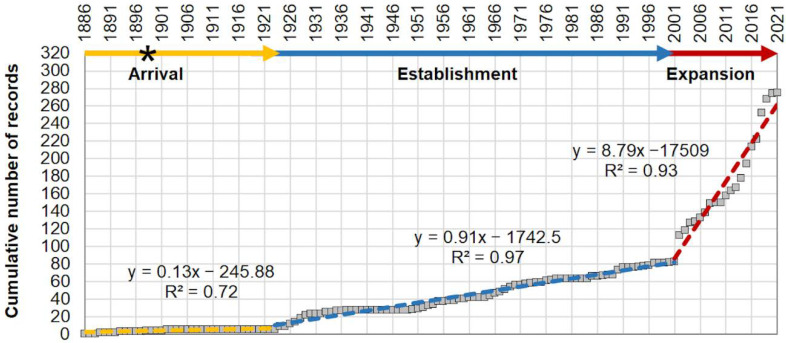
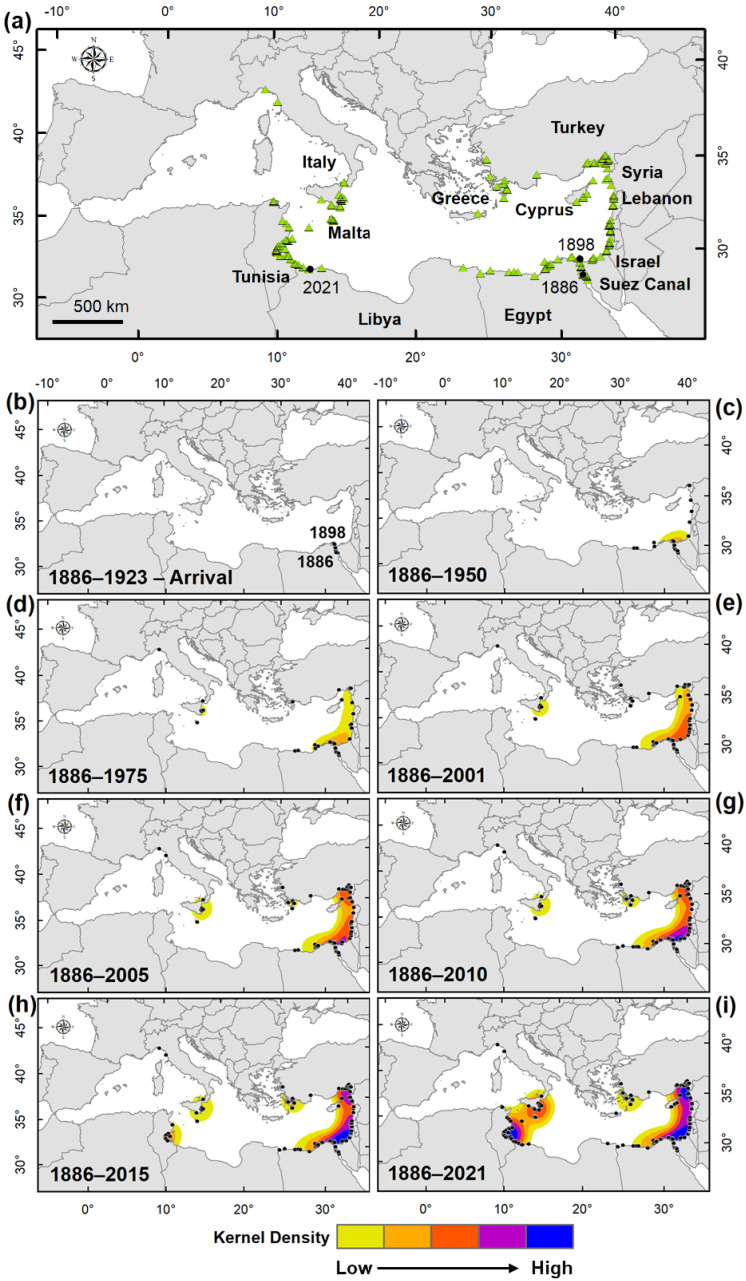
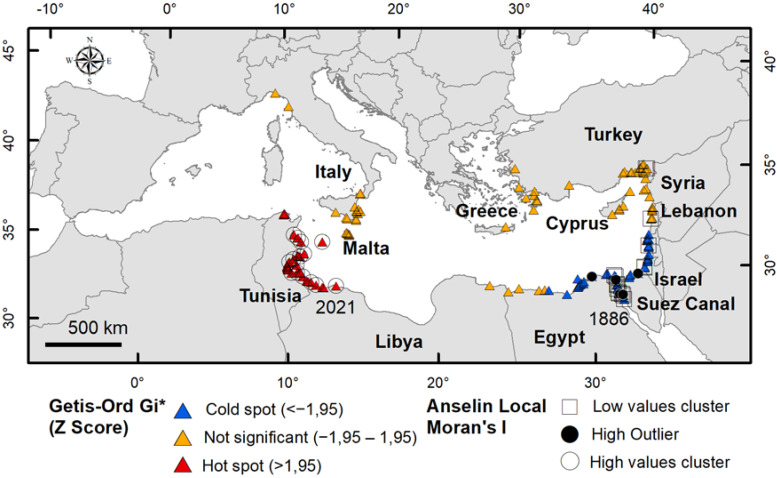
Invasive alien species represent one of the main environmental emergencies and are considered by the scientific community as being among the leading causes of biodiversity loss on a global scale. Therefore, detecting their pathways, hotspot areas and invasion trends becomes extremely important also for management purposes. A systematic review on presence of in the Suez Canal and Mediterranean Sea was carried out in order to study the invasion paths from its entry from the Red Sea into the Suez Canal (1886) until recently (2021) through ecological indicators elaborated with GIS spatial-temporal statistics. Arrival, establishment and expansion phases and areas of in the Mediterranean were identified. Settlement areas were detected along the Suez Canal as well as in the Levantine Sea, western Ionian Sea and Tunisian plateau ecoregions. Since 2015 a persistent area has formed in Tunisia from where the species is spreading northward and eastward. The study provides an insight on the impact of on biodiversity and ecosystem services and proposes a series of desirable management actions to mitigate the expansion of its population. Following the 8Rs model that introduces the rules to mitigate non-indigenous species pollution, six of them (Recognize, Reduce, Replace, Reuse, Remove, and Regulate) have been identified as applicable and are discussed.
外来入侵物种是主要的环境突发事件之一,被科学界视为全球生物多样性丧失的主要原因之一。因此,检测它们的传播途径、热点区域和入侵趋势对于管理目的也变得极为重要。为了通过利用GIS时空统计数据精心编制的生态指标,研究从其1886年从红海进入苏伊士运河直至最近(2021年)的入侵路径,我们对苏伊士运河和地中海中的[物种名称未给出]的存在情况进行了系统综述。确定了[物种名称未给出]在地中海的到达、定殖和扩散阶段及区域。沿着苏伊士运河以及黎凡特海、爱奥尼亚海西部和突尼斯高原生态区域检测到了定殖区域。自2015年以来,突尼斯形成了一个持续存在的区域,该物种正从那里向北和向东扩散。该研究深入了解了[物种名称未给出]对生物多样性和生态系统服务的影响,并提出了一系列理想的管理行动,以减轻其种群的扩张。遵循引入减轻非本土物种污染规则的8R模型,已确定其中六项(识别、减少、替代、再利用、清除和监管)适用并进行了讨论。