Sim On, Ryu Dongman, Lee Junghwan, Lee Chiseung
Department of Biomedical Engineering, Graduate School, Pusan National University, Busan 46241, Korea.
Medical Research Institute, Pusan National University, Busan 46241, Korea.
Bioengineering (Basel). 2022 Oct 2;9(10):519. doi: 10.3390/bioengineering9100519.
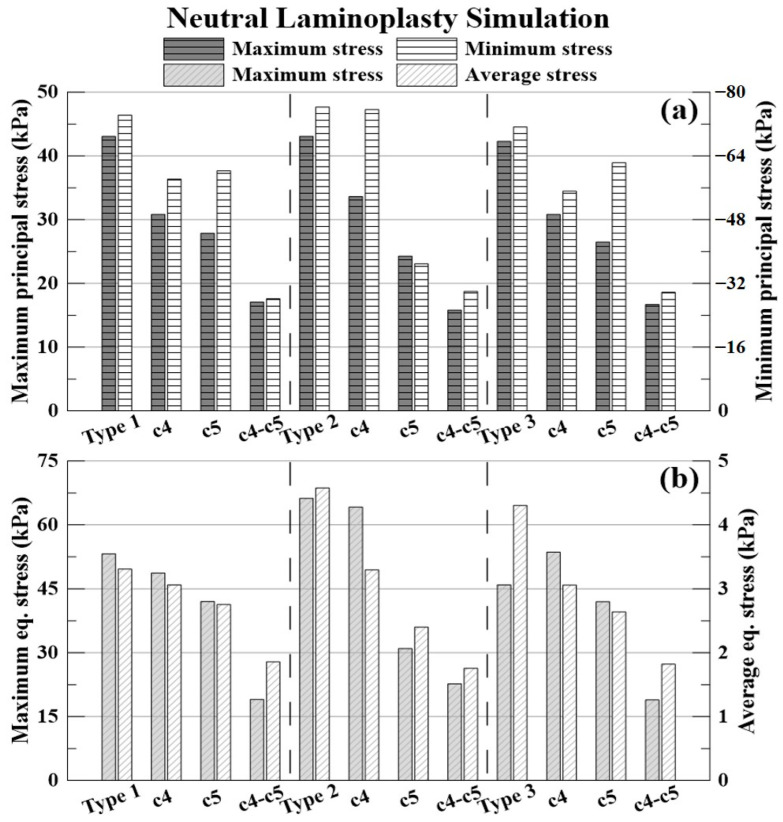
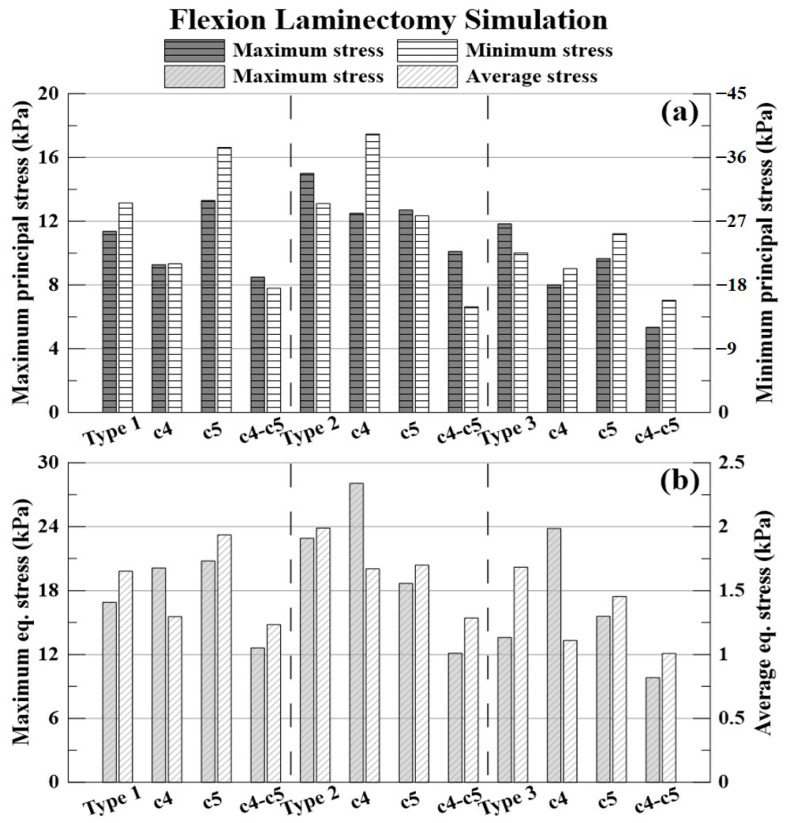
Most studies on the ossification of the posterior longitudinal ligament (OPLL) using the finite element method were conducted in the neutral state, and the resulting decompression was judged to be good. As these studies do not reflect the actual behavior of the cervical spine, this study conducted an analysis in the neutral state and a biomechanical analysis during flexion and extension behaviors. After validation via the construction of an intact cervical spine model, the focal OPLL model was inserted into the C4-C5 segment and a simulation was performed. The neutral state was shown by applying a fixed condition to the lower part of the T1 and -axis fixed condition of the spinal cord and simulating spinal cord compression with OPLL. For flexion and extension simulation, a ±30-degree displacement was additionally applied to the top of the C2 dens. Accordingly, it was confirmed that spinal cord decompression did not work well during the flexion and extension behaviors, but rather increased. Thus, if patients with focal OPLL inevitably need to undergo posterior decompression, additional surgery using an anterior approach should be considered.
大多数使用有限元方法对后纵韧带骨化(OPLL)进行的研究都是在中立状态下进行的,并且由此得出的减压效果被判定为良好。由于这些研究没有反映颈椎的实际行为,本研究在中立状态下进行了分析,并在屈伸行为期间进行了生物力学分析。通过构建完整的颈椎模型进行验证后,将局灶性OPLL模型插入C4-C5节段并进行模拟。通过对T1下部施加固定条件以及脊髓的 - 轴固定条件并模拟OPLL对脊髓的压迫来显示中立状态。对于屈伸模拟,在C2齿突顶部额外施加±30度的位移。因此,证实了在屈伸行为期间脊髓减压效果不佳,反而有所增加。因此,如果局灶性OPLL患者不可避免地需要进行后路减压,则应考虑采用前路进行额外手术。