Chang Hsiao-Yun, Chen Jiun-Rong, Chen Yi-Hsiu, Xiao Qian, Chen Ya-Ling, Yang Suh-Ching
School of Nutrition and Health Sciences, College of Nutrition, Taipei Medical University, Taipei 11031, Taiwan.
Research Center of Geriatric Nutrition, College of Nutrition, Taipei Medical University, Taipei 11031, Taiwan.
Bioengineering (Basel). 2022 Oct 6;9(10):526. doi: 10.3390/bioengineering9100526.
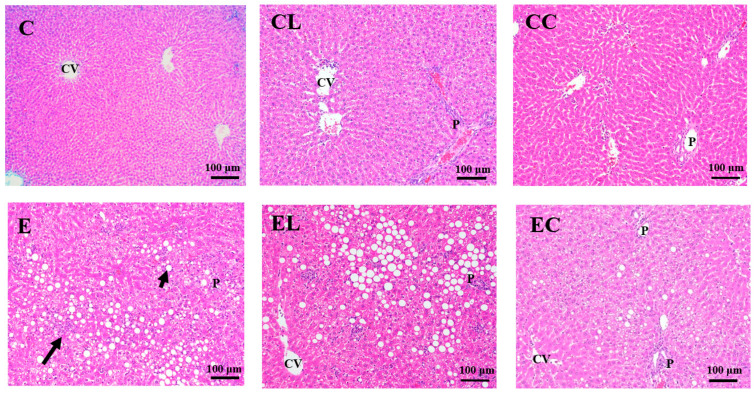
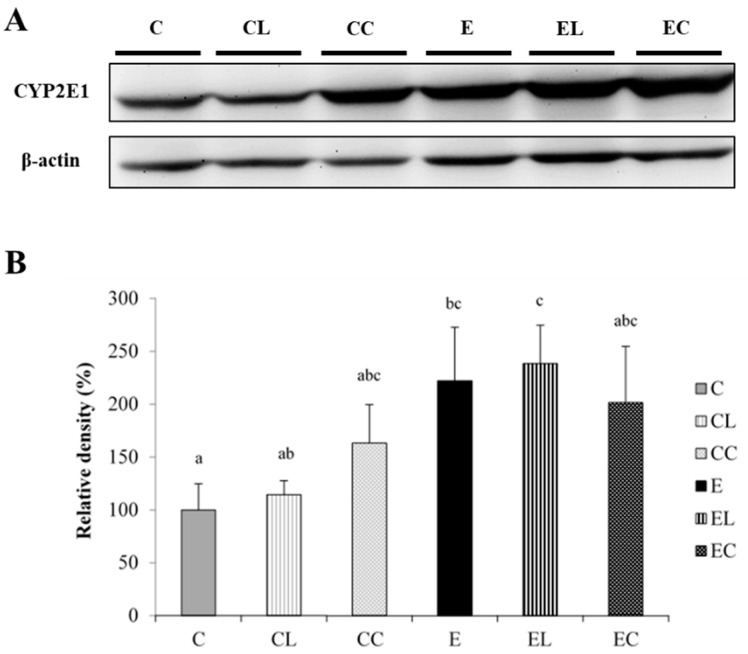
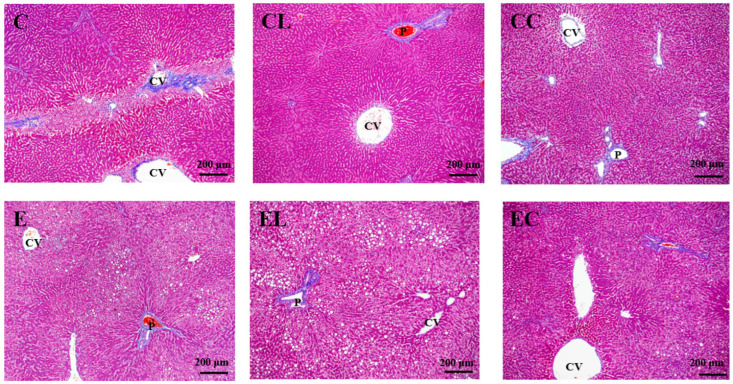
The purpose of this study was to clarify the role of saturated fats from cocoa butter (plant source) compared with lard (animal source) on alcoholic liver damage in rats. Male Wistar rats were fed either a control diet (C) or an ethanol diet (E), and the dietary fats (corn oil, olive oil, and safflower oil) of these two diets were further replaced by lard (CL, EL) or cocoa butter (CC, EC). After 8-week feeding, plasma aspartate aminotransferase (AST) and alanine aminotransferase (ALT) activities, hepatic triglyceride (TG) levels, plasma intercellular adhesion molecular (ICAM)-1 levels, hepatic cytochrome P450 2E1 (CYP2E1) protein expression, and hepatic interleukin (IL)-1β significantly increased in the E group compared to the C group. In addition, hepatic histopathological scores of fatty changes, inflammatory cell infiltration, and degeneration and necrosis in the E group were significantly higher compared to those in the C group. However, fatty changes were significantly inhibited only in the EC group as well as hepatic inflammatory cell infiltration, degeneration, and necrosis being significantly lower in the EL and EC groups. Plasma ICAM-1 and hepatic tumor necrosis factor (TNF)-α, IL-1β, IL-6, and IL-10 levels were significantly lower in the EL and EC groups than those in the E group. Moreover, a correlation analysis showed that hepatic histopathological scores of degeneration and necrosis were significantly positively correlated with erythrocytic oleic acid (C18:1) and were negatively correlated with linoleic acid (C18:2). In conclusion, cocoa butter protected the liver against lipid accumulation and inflammation in rats chronically fed ethanol.
本研究的目的是阐明可可脂(植物来源)中的饱和脂肪与猪油(动物来源)相比,对大鼠酒精性肝损伤的作用。雄性Wistar大鼠分别喂食对照饮食(C)或乙醇饮食(E),这两种饮食中的膳食脂肪(玉米油、橄榄油和红花油)进一步被猪油(CL、EL)或可可脂(CC、EC)替代。喂养8周后,与C组相比,E组的血浆天冬氨酸转氨酶(AST)和丙氨酸转氨酶(ALT)活性、肝甘油三酯(TG)水平、血浆细胞间黏附分子(ICAM)-1水平、肝细胞色素P450 2E1(CYP2E1)蛋白表达以及肝白细胞介素(IL)-1β显著升高。此外,与C组相比,E组肝脂肪变性、炎性细胞浸润以及变性和坏死的组织病理学评分显著更高。然而,仅在EC组中脂肪变性受到显著抑制,并且EL组和EC组中肝炎性细胞浸润、变性和坏死显著更低。EL组和EC组的血浆ICAM-1以及肝肿瘤坏死因子(TNF)-α、IL-1β、IL-6和IL-10水平显著低于E组。此外,相关性分析表明,肝变性和坏死的组织病理学评分与红细胞油酸(C18:1)显著正相关,与亚油酸(C18:2)负相关。总之,可可脂可保护长期喂食乙醇的大鼠肝脏免受脂质蓄积和炎症的影响。