Molecular Biology of Reproduction and Development Research Group, Institut d'Investigacions Biomèdiques August Pi i Sunyer (IDIBAPS), Fundació Clínic per a la Recerca Biomèdica, Departament de Biomedicina, Facultat de Medicina i Ciències de la Salut, Universitat de Barcelona (UB), 08036 Barcelona, Spain.
Biochemistry and Molecular Genetics Service, Clínic Barcelona, 08036 Barcelona, Spain.
Int J Mol Sci. 2022 Oct 17;23(20):12398. doi: 10.3390/ijms232012398.
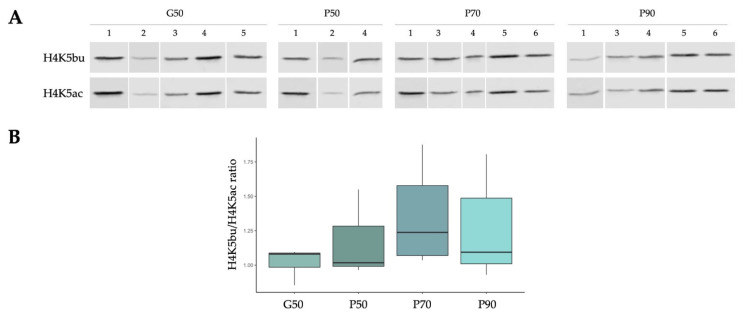
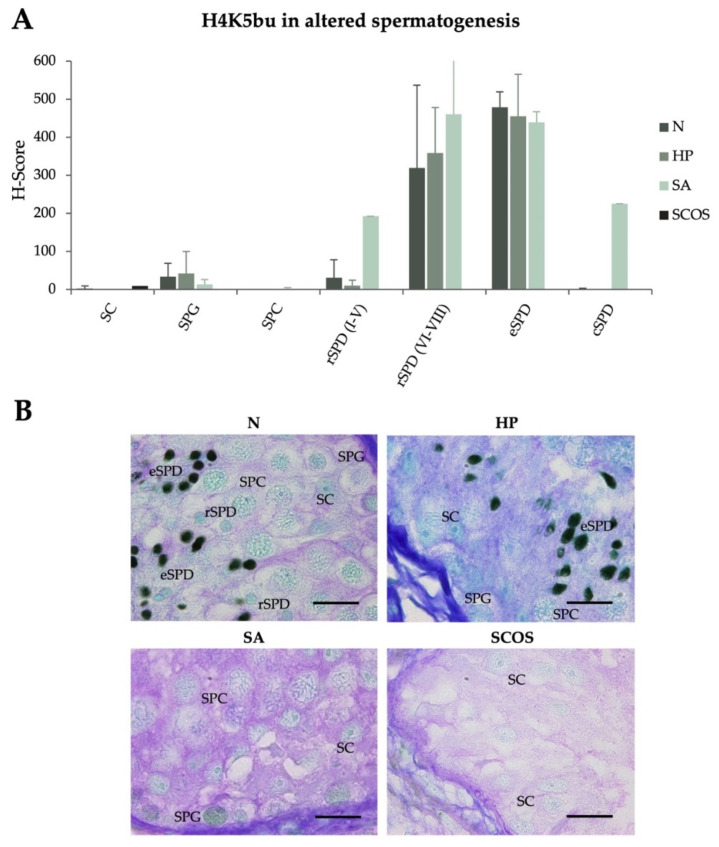
Male germ cells experience a drastic chromatin remodeling through the nucleo-histone to nucleo-protamine (NH-NP) transition necessary for proper sperm functionality. Post-translational modifications (PTMs) of H4 Lys5, such as acetylation (H4K5ac), play a crucial role in epigenetic control of nucleosome disassembly facilitating protamine incorporation into paternal DNA. It has been shown that butyrylation on the same residue (H4K5bu) participates in temporal regulation of NH-NP transition in mice, delaying the bromodomain testis specific protein (BRDT)-dependent nucleosome disassembly and potentially marking retained nucleosomes. However, no information was available so far on this modification in human sperm. Here, we report a dual behavior of H4K5bu and H4K5ac in human normal spermatogenesis, suggesting a specific role of H4K5bu during spermatid elongation, coexisting with H4K5ac although with different starting points. This pattern is stable under different testicular pathologies, suggesting a highly conserved function of these modifications. Despite a drastic decrease of both PTMs in condensed spermatids, they are retained in ejaculated sperm, with 30% of non-colocalizing nucleosome clusters, which could reflect differential paternal genome retention. Whereas no apparent effect of these PTMs was observed associated with sperm quality, their presence in mature sperm could entail a potential role in the zygote.
男性生殖细胞经历了剧烈的染色质重塑,通过核小体-组蛋白到核小体-鱼精蛋白(NH-NP)的转变,这对于精子的正常功能是必要的。H4 赖氨酸 5 的翻译后修饰(PTMs),如乙酰化(H4K5ac),在核小体解体的表观遗传调控中起着至关重要的作用,促进鱼精蛋白掺入父本 DNA。已经表明,同一残基上的丁酰化(H4K5bu)参与了 NH-NP 转变在小鼠中的时间调控,延迟了溴结构域睾丸特异性蛋白(BRDT)依赖性核小体解体,并可能标记保留的核小体。然而,目前还没有关于人类精子中这种修饰的信息。在这里,我们报告了 H4K5bu 和 H4K5ac 在人类正常精子发生中的双重行为,表明 H4K5bu 在精子细胞伸长过程中具有特定的作用,尽管与 H4K5ac 不同,但存在于同一时期。这种模式在不同的睾丸病变下是稳定的,表明这些修饰具有高度保守的功能。尽管这两种 PTM 在浓缩的精子细胞中急剧减少,但它们在射出的精子中保留下来,有 30%的非共定位核小体簇,这可能反映了父本基因组的不同保留。虽然这些 PTM 与精子质量没有明显的关联,但它们在成熟精子中的存在可能在受精卵中具有潜在的作用。