Asthma Unit, Respiratory and Allergy Department, Hospital de la Santa Creu i Sant Pau, Biomedical Research Institute Sant Pau (IIB Sant Pau), Department of Medicine, Universitat Autònoma de Barcelona, 08041 Barcelona, Spain.
Inflammatory Diseases Unit, Biomedical Research Institute Sant Pau (IIB Sant Pau), 08041 Barcelona, Spain.
Int J Environ Res Public Health. 2022 Oct 17;19(20):13400. doi: 10.3390/ijerph192013400.
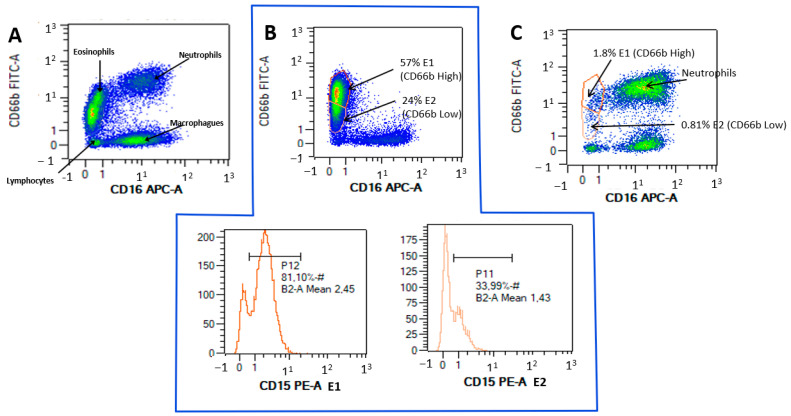
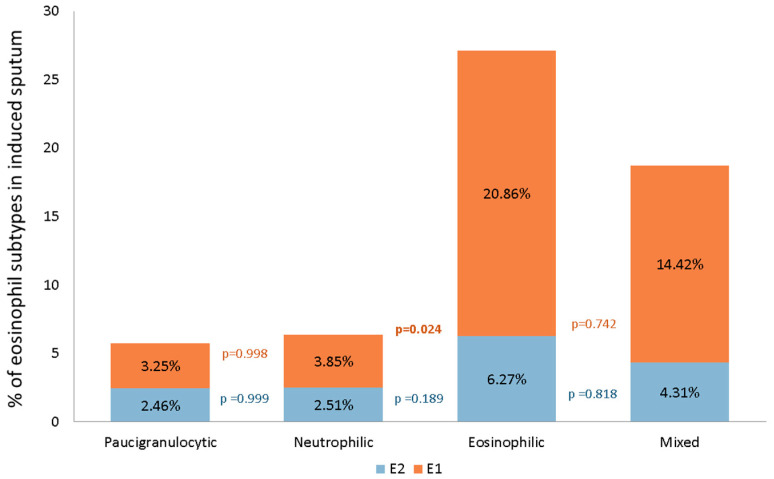
Two subsets of eosinophils have been described: resident eosinophils with homeostatic functions (rEOS) in healthy subjects and in patients with nonallergic eosinophilic asthma, and inflammatory eosinophils (iEOS) in blood and lung samples from patients with allergic asthma. We explored if it would be possible to identify different subsets of eosinophils using flow cytometry and the gating strategy applied to induced sputum. We conducted an observational cross-sectional single-center study of 62 patients with persistent allergic asthma. Inflammatory cells from induced sputum samples were counted by light microscopy and flow cytometry, and cytokine levels in the supernatant were determined. Two subsets of eosinophils were defined that we call E1 (CD66b-high and CD15-high) and E2 (CD66b-low and CD15-low). Of the 62 patients, 24 were eosinophilic, 18 mixed, 10 paucigranulocytic, and 10 neutrophilic. E1 predominated over E2 in the eosinophilic and mixed patients (20.86% vs. 6.27% and 14.42% vs. 4.31%, respectively), while E1 and E2 were similar for neutrophilic and paucigranulocytic patients. E1 correlated with IL-5, fractional exhaled nitric oxide, and blood eosinophils. While eosinophil subsets have been identified for asthma in blood, we have shown that they can also be identified in induced sputum.
健康受试者和非过敏性嗜酸性哮喘患者中具有稳态功能的固有嗜酸性粒细胞 (rEOS),以及过敏性哮喘患者血液和肺样本中的炎症性嗜酸性粒细胞 (iEOS)。我们探索了是否可以使用流式细胞术和应用于诱导痰的门控策略来识别不同的嗜酸性粒细胞亚群。我们进行了一项观察性横断面单中心研究,纳入了 62 例持续性过敏性哮喘患者。通过光学显微镜和流式细胞术对诱导痰样本中的炎性细胞进行计数,并测定上清液中的细胞因子水平。我们定义了两种嗜酸性粒细胞亚群,我们称之为 E1(CD66b-高和 CD15-高)和 E2(CD66b-低和 CD15-低)。在 62 例患者中,24 例为嗜酸性粒细胞增多,18 例为混合性,10 例为少粒细胞性,10 例为中性粒细胞性。在嗜酸性粒细胞增多和混合性患者中,E1 多于 E2(分别为 20.86%比 6.27%和 14.42%比 4.31%),而在中性粒细胞性和少粒细胞性患者中,E1 和 E2 相似。E1 与 IL-5、呼出气一氧化氮分数和血嗜酸性粒细胞相关。虽然已经在血液中确定了哮喘的嗜酸性粒细胞亚群,但我们已经表明它们也可以在诱导痰中识别。