Ucero-Lozano Roberto, Pérez-Llanes Raúl, López-Pina José Antonio, Cuesta-Barriuso Rubén
Department of Physiotherapy, European University of Madrid, 28670 Madrid, Spain.
Department of Physiotherapy, Catholic University San Antonio-UCAM, 30107 Murcia, Spain.
J Clin Med. 2022 Oct 21;11(20):6216. doi: 10.3390/jcm11206216.
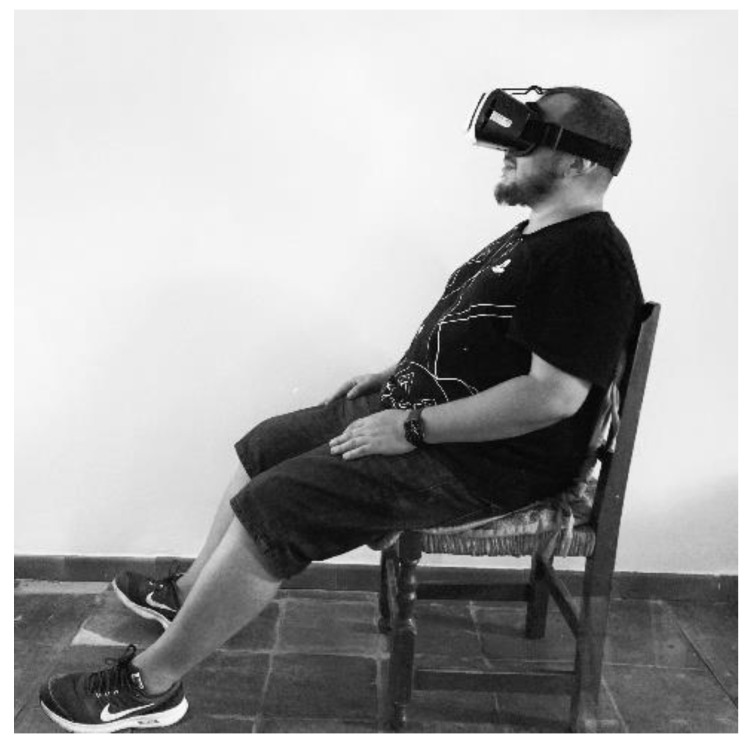
(1) Background: Hemarthrosis is a typical clinical manifestation in patients with hemophilia. Its recurrence causes hemophilic arthropathy, characterized by chronic joint pain. Watching movement recorded from a first-person perspective and immersively can be effective in the management of chronic pain. The objective of this study was to evaluate the effectiveness of an immersive virtual reality intervention in improving the pain intensity, joint condition, muscle strength and range of motion in patients with hemophilic knee arthropathy. (2) Methods: Thirteen patients with hemophilic knee arthropathy were recruited. The patients wore virtual reality glasses and watched a flexion-extension movement of the knee on an immersive 180° video, recorded from a first-person perspective over a 28-day period. The primary variable was the pain intensity (visual analog scale). The secondary variables were the joint status (Hemophilia Joint Health Score), quadriceps and hamstring strength (dynamometry), and range of motion (goniometry). (3) Results: After the intervention period, statistically significant differences were observed in the intensity of the joint pain (Standard error [SE] = 19.31; 95% interval confidence [95%CI] = -1.05; -0.26), joint condition (SE = 18.68; 95%CI = -1.16; -0.52) and quadriceps strength (SE = 35.00; 95%CI = 2.53; 17.47). We found that 38.46% and 23.07% of the patients exhibited an improvement in their quadriceps muscle strength and joint condition above the minimum detectable change for both variables (8.21% and 1.79%, respectively). (4) Conclusions: One hundred and eighty degree immersive VR motion visualization can improve the intensity of joint pain in patients with hemophilic knee arthropathy. An intervention using immersive virtual reality can be an effective complementary approach to improve the joint condition and quadriceps strength in these patients.
(1) 背景:关节积血是血友病患者的典型临床表现。其复发会导致血友病性关节病,特征为慢性关节疼痛。以第一人称视角沉浸式观看运动记录对慢性疼痛的管理可能有效。本研究的目的是评估沉浸式虚拟现实干预对改善血友病性膝关节炎患者的疼痛强度、关节状况、肌肉力量和关节活动范围的有效性。(2) 方法:招募了13名血友病性膝关节炎患者。患者佩戴虚拟现实眼镜,在28天内观看从第一人称视角录制的180°沉浸式膝关节屈伸运动视频。主要变量是疼痛强度(视觉模拟量表)。次要变量是关节状况(血友病关节健康评分)、股四头肌和腘绳肌力量(测力计测量)以及关节活动范围(角度测量)。(3) 结果:干预期后,在关节疼痛强度(标准误差[SE]=19.31;95%置信区间[95%CI]=-1.05;-0.26)、关节状况(SE=18.68;95%CI=-1.16;-0.52)和股四头肌力量(SE=35.00;95%CI=2.53;17.47)方面观察到具有统计学意义的差异。我们发现,38.46%和23.07%的患者股四头肌力量和关节状况的改善超过了这两个变量的最小可检测变化(分别为8.21%和1.79%)。(4) 结论:180度沉浸式虚拟现实运动可视化可改善血友病性膝关节炎患者的关节疼痛强度。使用沉浸式虚拟现实的干预可以是改善这些患者关节状况和股四头肌力量的有效辅助方法。