Estrada Natalia, Zamora Lurdes, Ferrer-Marín Francisca, Palomo Laura, García Olga, Vélez Patricia, De la Fuente Iris, Sagüés Miguel, Cabezón Marta, Cortés Montserrat, Vallansot Rolando Omar, Senín-Magán María Alicia, Boqué Concepción, Xicoy Blanca
Myeloid Neoplasms Group, Josep Carreras Leukaemia Research Institute, ICO-Hospital Germans Trias i Pujol, Universitat Autònoma de Barcelona, 08916 Badalona, Spain.
Hospital General Universitario Morales Meseguer, CIBERER (CB15/00055), IMIB-Pascual Parrilla, UCAM, 30008 Murcia, Spain.
J Clin Med. 2022 Oct 21;11(20):6217. doi: 10.3390/jcm11206217.
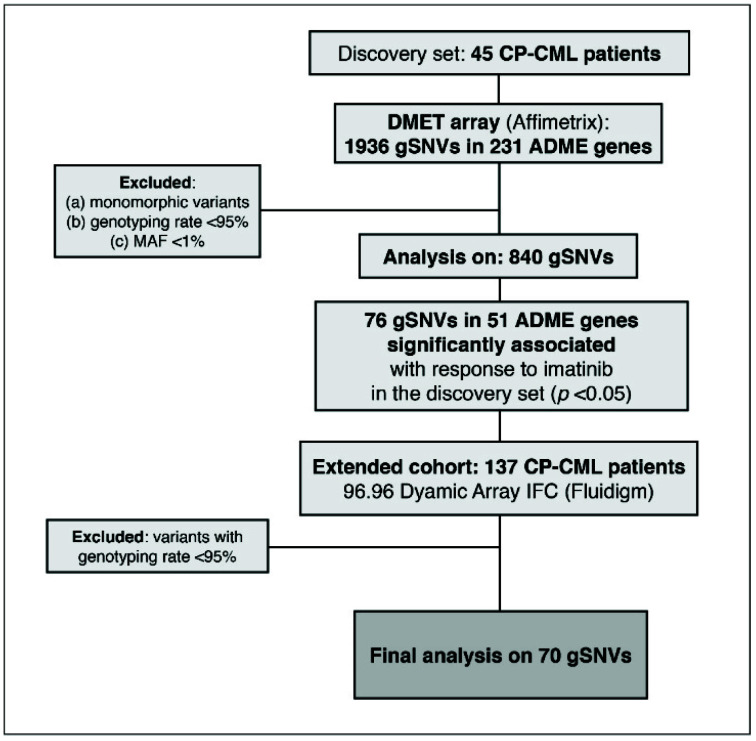
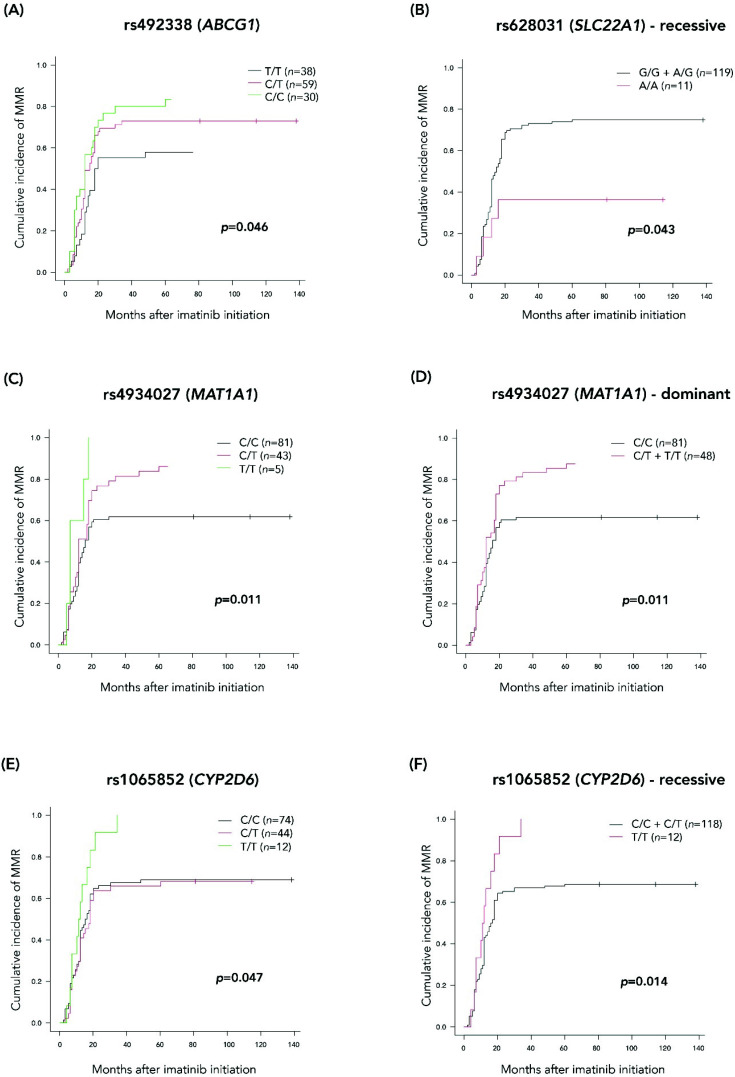
Imatinib is the most common first-line tyrosine kinase inhibitor (TKI) used to treat chronic-phase chronic myeloid leukemia (CP-CML). However, only a proportion of patients achieve major molecular response (MMR), so there is a need to find biological factors that aid the selection of the optimal therapeutic strategy (imatinib vs. more potent second-generation TKIs). The aim of this retrospective study was to understand the contribution of germline single-nucleotide variants (gSNVs) in the achievement of MMR with imatinib. In particular, a discovery cohort including 45 CP-CML patients was analyzed through the DMET array, which interrogates 1936 variants in 231 genes related to the absorption, distribution, metabolism and excretion (ADME) process. Variants statistically significant in the discovery cohort were then tested in an extended and independent cohort of 137 CP-CML patients. Finally, a total of 7 gSNVs (-rs492338, -rs496550, -rs497692, -rs1135840, -rs7003319, -rs4934027 and -rs628031) and one haplotype in the gene were significantly associated with the achievement of MMR with first-line imatinibtreatment. In conclusion, we identified a genetic signature of response to imatinib in CP-CML patients that could be useful in selecting those patients that may benefit from starting imatinib as first-line therapy, therefore avoiding the toxicity related to second-generation TKIs.
伊马替尼是用于治疗慢性期慢性髓性白血病(CP-CML)最常用的一线酪氨酸激酶抑制剂(TKI)。然而,只有一部分患者能达到主要分子反应(MMR),因此有必要寻找有助于选择最佳治疗策略(伊马替尼与更强效的第二代TKI)的生物学因素。这项回顾性研究的目的是了解种系单核苷酸变异(gSNV)在伊马替尼治疗达到MMR中的作用。具体而言,通过DMET芯片分析了一个包含45例CP-CML患者的发现队列,该芯片可检测与吸收、分布、代谢和排泄(ADME)过程相关的231个基因中的1936个变异。然后在一个由137例CP-CML患者组成的扩大且独立的队列中对在发现队列中具有统计学意义的变异进行检测。最后,共有7个gSNV(-rs492338、-rs496550、-rs497692、-rs1135840、-rs7003319、-rs4934027和-rs628031)以及该基因中的一个单倍型与一线伊马替尼治疗达到MMR显著相关。总之,我们在CP-CML患者中确定了对伊马替尼反应的遗传特征,这可能有助于选择那些可能从一线使用伊马替尼治疗中获益的患者,从而避免与第二代TKI相关的毒性。