Guerra Sierra Beatriz E, Arteaga-Figueroa Luis A, Sierra-Pelaéz Susana, Alvarez Javier C
Universidad de Santander-Facultad de Ciencias Exactas Naturales Y Agropecuarias, Research Group in Agro-Environmental Biotechnology and Health (MICROBIOTA), Bucaramanga 680002, Colombia.
Research Group in Biodiversity, Evolution and Conservation (BEC), School of Applied Sciences and Engineering, EAFIT University, Medellín 050022, Colombia.
J Fungi (Basel). 2022 Oct 1;8(10):1042. doi: 10.3390/jof8101042.
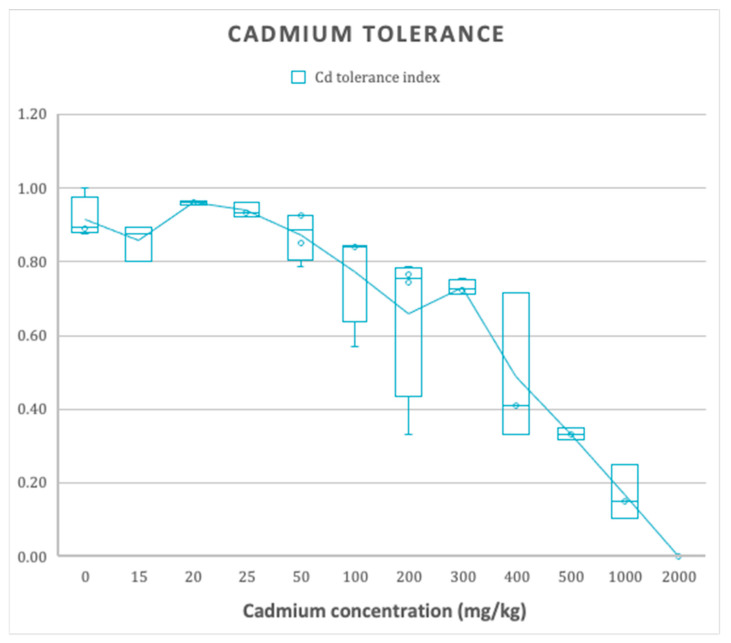
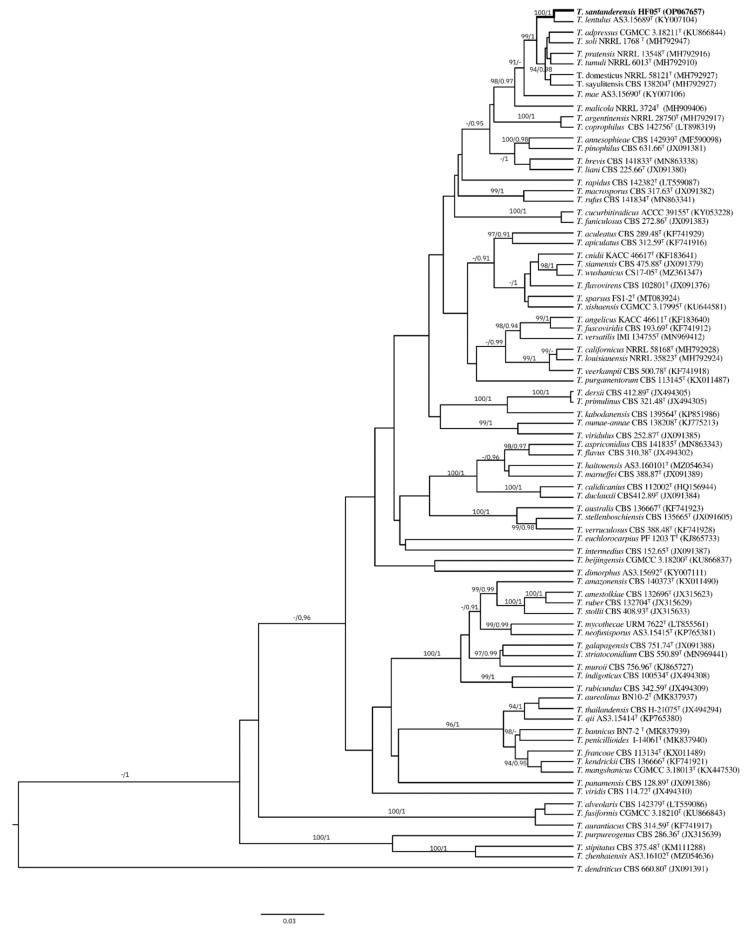
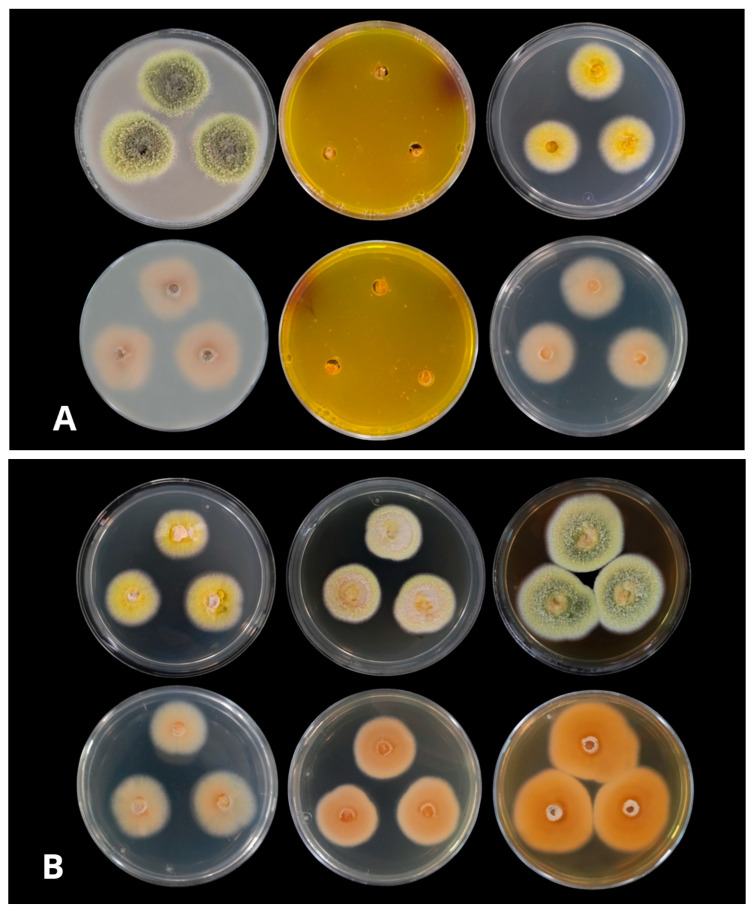
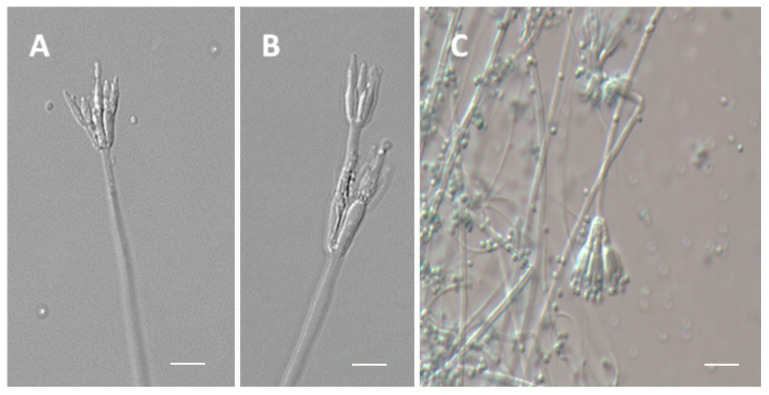
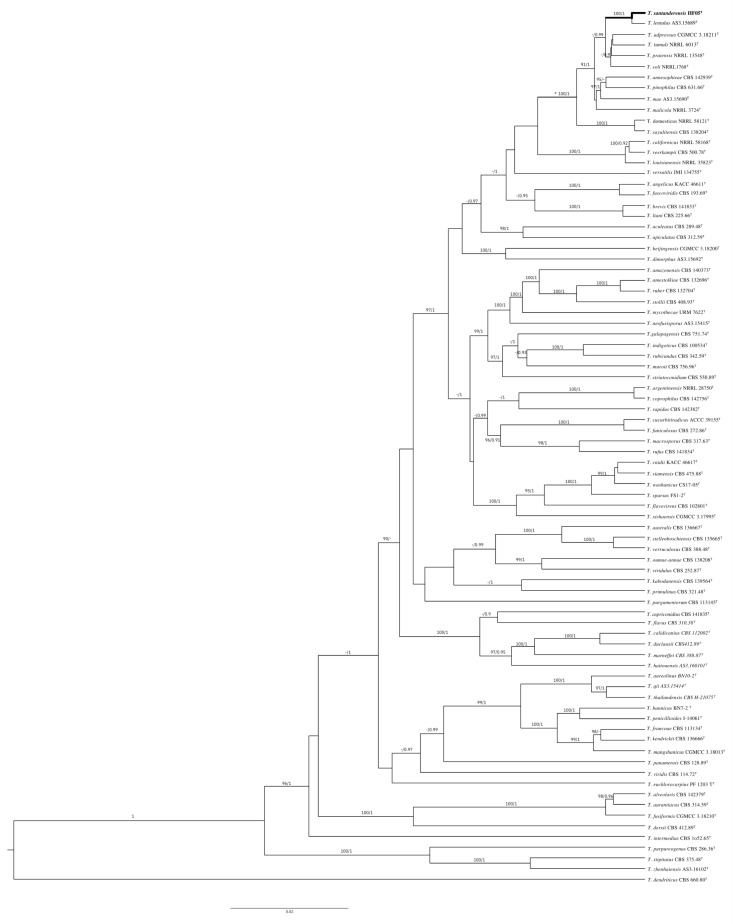
Inorganic pollutants in Colombian cocoa ( L.) agrosystems cause problems in the production, quality, and exportation of this raw material worldwide. There has been an increased interest in bioprospecting studies of different fungal species focused on the biosorption of heavy metals. Furthermore, fungi constitute a valuable, profitable, ecological, and efficient natural soil resource that could be considered in the integrated management of cadmium mitigation. This study reports a new species of isolated from a cocoa soil sample collected in San Vicente de Chucurí, Colombia. is featured by Lemon Yellow (R. Pl. IV) mycelium on CYA, mono-to-biverticillade conidiophores, and acerose phialides. is distinguished from related species by its growth rate on CYAS and powdery textures on MEA, YES and OA, high acid production on CREA and smaller conidia. It is differentiated from by its growth rate on CYA medium at 37 °C without exudate production, its cream (R. PI. XVI) margin on MEA, and dense sporulation on YES and CYA. Phylogenetic analysis was performed using a polyphasic approach, including different phylogenetic analyses of combined and individual ITS, , , and gene sequences that indicate that it is new to science and is named sp. nov. This new species belongs to the section and is closely related to , and (inside the species complex) in the inferred phylogeny. Mycelia growth of the fungal strains was subjected to a range of 0-400 mg/kg Cd and incorporated into malt extract agar (MEA) in triplicates. Fungal radial growth was recorded every three days over a 13-day incubation period and In vitro cadmium tolerance tests showed a high tolerance index (0.81) when the mycelium was exposed to 300 mg/kg of Cd. Results suggest showed tolerance to Cd concentrations that exceed the permissible limits for contaminated soils, and it is promising for its use in bioremediation strategies to eliminate Cd from highly contaminated agricultural soils.
哥伦比亚可可(L.)农业系统中的无机污染物给这种原材料在全球范围内的生产、质量和出口带来了问题。人们对不同真菌物种的生物勘探研究越来越感兴趣,这些研究聚焦于重金属的生物吸附。此外,真菌是一种有价值、可盈利、生态且高效的天然土壤资源,在镉减排的综合管理中值得考虑。本研究报告了一种从哥伦比亚圣维森特 - 德丘库里采集的可可土壤样本中分离出的新物种。该物种在CYA培养基上的特征为柠檬黄色(R. Pl. IV)菌丝体、单轮至双轮生分生孢子梗以及针状瓶梗。它与相关物种的区别在于其在CYAS上的生长速率、在MEA、YES和OA上的粉状质地、在CREA上的高酸产量以及较小的分生孢子。它与在37°C的CYA培养基上生长且无渗出物产生、在MEA上边缘呈奶油色(R. PI. XVI)以及在YES和CYA上密集产孢的物种不同。使用多相方法进行了系统发育分析,包括对ITS、、、和基因序列的组合及单独分析,结果表明它是科学上新发现的物种,被命名为 sp. nov。这个新物种属于 组,在推断的系统发育中与 、 和 (在 物种复合体内部)密切相关。将真菌菌株的菌丝体生长置于0 - 400 mg/kg的镉范围内,并一式三份地掺入麦芽提取物琼脂(MEA)中。在13天的培养期内,每三天记录一次真菌的径向生长,体外镉耐受性测试表明,当菌丝体暴露于300 mg/kg的镉时,耐受性指数较高(0.81)。结果表明 对超过污染土壤允许限度的镉浓度具有耐受性,并且在从高度污染的农业土壤中去除镉的生物修复策略中具有应用前景。