Mefleh Marina, Boukid Fatma, Fadda Costantino
Department of Agronomy, University of Sassari, Via De Nicola, 07100 Sassari, Italy.
ClonBio Group Ltd., 6 Fitzwilliam Pl, D02 XE61 Dublin, Ireland.
Life (Basel). 2022 Oct 15;12(10):1613. doi: 10.3390/life12101613.
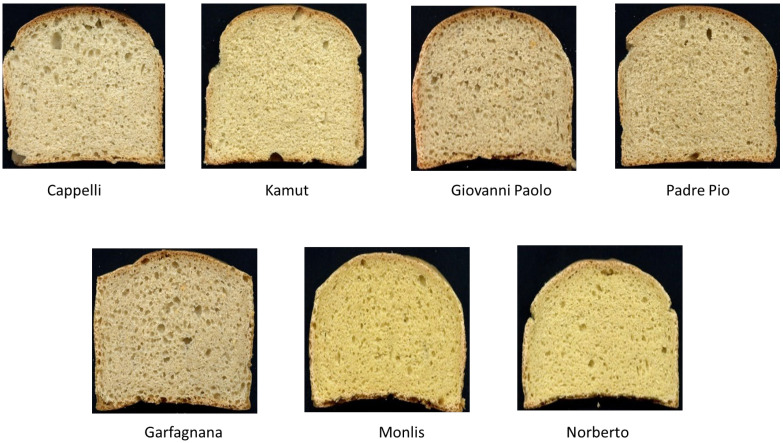
Ancient and old wheat grains are gaining interest as a genetic reservoir to develop improved Italian genotypes with peculiar features. In this light, the aim of this study was to assess the baking performance of two improved einkorn (Monlis and Norberto) and two improved emmer (Padre Pio and Giovanni Paolo) genotypes in comparison with two Italian landraces (Garfagnana and Cappelli) and Khorasan. This set was evaluated following a holistic approach considering the flour, dough, and bread properties. The results showed that the flour properties, dough rheology, pasting, and fermentation parameters, as well as the bread properties, significantly differed among the studied genotypes. Cappelli produced the bread with the best quality, i.e., the highest volume and lowest firmness. Despite having the same pedigrees, Giovanni Paolo and Padre Pio resulted in significantly different technological properties. Giovanni Paolo flour showed the highest protein content and provided a dough with a high gas production capacity, resulting in the bread having a similar firmness to Cappelli. Padre Pio flour provided bread having a similar volume to Cappelli but a high firmness similar to Khorasan and Garfagnana. The einkorn genotypes, Monlis and Norberto, showed poor fermentation properties and high gelatinization viscosity that resulted in bread with poor quality. Alternatively, they could be more suitable for making non-fermented flatbreads. Our results showed that the improved wheat showed a high versatility of features, which offers bakers a flexible material to make a genotype of bread types.
古老和陈旧的小麦籽粒作为一种遗传资源正受到关注,有望培育出具有独特特性的改良意大利基因型小麦。在此背景下,本研究旨在评估两种改良单粒小麦(Monlis和Norberto)以及两种改良二粒小麦(Padre Pio和Giovanni Paolo)基因型与两种意大利地方品种(Garfagnana和Cappelli)以及霍拉桑小麦相比的烘焙性能。采用综合方法对这组材料进行评估,考虑了面粉、面团和面包的特性。结果表明,所研究的基因型在面粉特性、面团流变学、糊化和发酵参数以及面包特性方面存在显著差异。Cappelli制作出的面包质量最佳,即体积最大且硬度最低。尽管Giovanni Paolo和Padre Pio具有相同的谱系,但它们的工艺特性却存在显著差异。Giovanni Paolo面粉的蛋白质含量最高,其面团产气能力强,制作出的面包硬度与Cappelli的相似。Padre Pio面粉制作出的面包体积与Cappelli的相似,但硬度较高,与霍拉桑小麦和Garfagnana的相似。单粒小麦基因型Monlis和Norberto的发酵性能较差,糊化粘度较高,导致面包质量不佳。或者,它们可能更适合制作非发酵扁平面包。我们的结果表明,改良小麦具有高度的特性多样性,为面包师提供了一种灵活的材料来制作多种类型的面包。