Golea Camelia Maria, Stroe Silviu-Gabriel, Gâtlan Anca-Mihaela, Codină Georgiana Gabriela
Faculty of Food Engineering, "Ştefan cel Mare" University, 720229 Suceava, Romania.
Vegetal Genetic Resources Bank "Mihai Cristea", 720224 Suceava, Romania.
Plants (Basel). 2023 May 29;12(11):2138. doi: 10.3390/plants12112138.
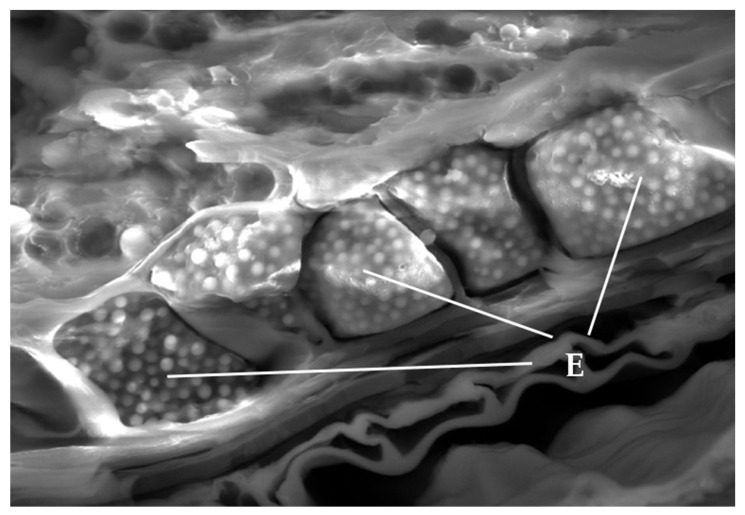
Different wheat species, common wheat ( subsp. aestivum), spelt ( subsp. ) and einkorn ( subsp. ), were analyzed for physicochemical (moisture, ash, protein, wet gluten, lipid, starch, carbohydrates, test weight and thousand-kernel mass) and mineral elements (Ca, Mg, K, Na, Zn, Fe, Mn and Cu) concentrations in grains. Additionally, wheat grain microstructure was determined using a scanning electron microscope. SEM micrographs of wheat grains show that einkorn has smaller type A starch granule diameters and more compact protein bonds compared to common wheat and spelt grains, making it easier to digest. The ancient wheat grains presented higher values for ash, protein, wet gluten and lipid content compared to the common wheat grains, whereas the carbohydrates and starch content were significantly ( < 0.05) lower. The mean values showed that spelt ( subsp. ) grains presented the highest values for Ca, Mg and K, while einkorn ( subsp. ) grains had the highest values for the microelements Zn, Mn and Cu. The highest values of Fe were recorded for common wheat varieties whereas no significant differences among the species were obtained for Na content. The principal component analysis ( > 0.05) between wheat flours characteristics showed a close association between wheat grain species and between the chemical characteristics of gluten and protein content (r = 0.994), lipid and ash content (r = 0.952) and starch and carbohydrate content (r = 0.927), for which high positive significant correlations ( < 0.05) were obtained. Taking into account that Romania is the fourth largest wheat producer at the European level, this study is of great global importance. According to the results obtained, the ancient species have higher nutritional value from the point of view of chemical compounds and macro elements of minerals. This may be of great importance for consumers who demand bakery products with high nutritional quality.
对不同的小麦品种,即普通小麦(亚种aestivum)、斯佩尔特小麦(亚种 )和单粒小麦(亚种 ),分析了其籽粒中的理化性质(水分、灰分、蛋白质、湿面筋、脂质、淀粉、碳水化合物、容重和千粒重)以及矿物质元素(钙、镁、钾、钠、锌、铁、锰和铜)的含量。此外,使用扫描电子显微镜测定了小麦籽粒的微观结构。小麦籽粒的扫描电子显微镜图像显示,与普通小麦和斯佩尔特小麦籽粒相比,单粒小麦的A型淀粉颗粒直径较小,蛋白质键更紧密,因此更易于消化。与普通小麦籽粒相比,古老小麦籽粒的灰分、蛋白质、湿面筋和脂质含量更高,而碳水化合物和淀粉含量则显著较低(<0.05)。平均值表明,斯佩尔特小麦(亚种 )籽粒的钙、镁和钾含量最高,而单粒小麦(亚种 )籽粒的锌、锰和铜等微量元素含量最高。普通小麦品种的铁含量最高,而不同品种间钠含量无显著差异。小麦粉特性之间的主成分分析(>0.05)表明,小麦籽粒品种之间以及面筋化学特性与蛋白质含量(r = 0.994)、脂质和灰分含量(r = 0.952)以及淀粉和碳水化合物含量(r = 0.927)之间存在密切关联,均获得了高度正相关(<0.05)。考虑到罗马尼亚是欧洲第四大小麦生产国,这项研究具有重大的全球意义。根据所得结果,从化合物和矿物质宏观元素的角度来看,古老品种具有更高的营养价值。这对于需要高营养品质烘焙产品的消费者可能具有重要意义。