Estofolete Cassia Fernanda, de Andrade Gandolfi Flora, de Aguiar Milhim Bruno Henrique, da Silva Gislaine Celestino Dutra, Dourado Fernanda Simões, Dos Santos Bárbara Ferreira, Vasilakis Nikos, Nogueira Maurício Lacerda
Laboratório de Pesquisas em Virologia, Faculdade de Medicina de São José do Rio Preto (FAMERP), São José do Rio Preto 15090-000, SP, Brazil.
Hospital de Base de São José do Rio Preto, São José do Rio Preto 15090-000, SP, Brazil.
Vaccines (Basel). 2022 Sep 20;10(10):1570. doi: 10.3390/vaccines10101570.
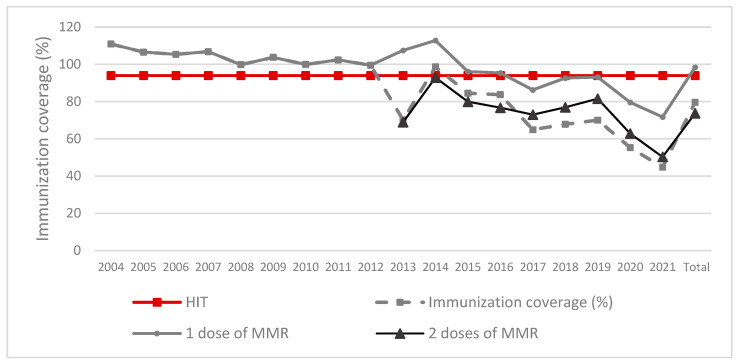
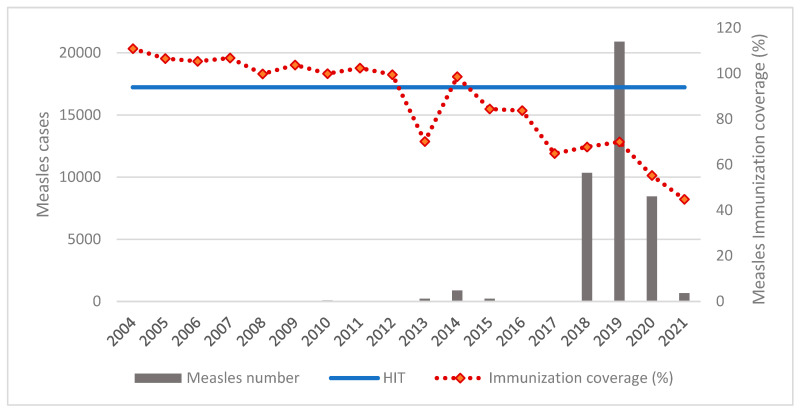
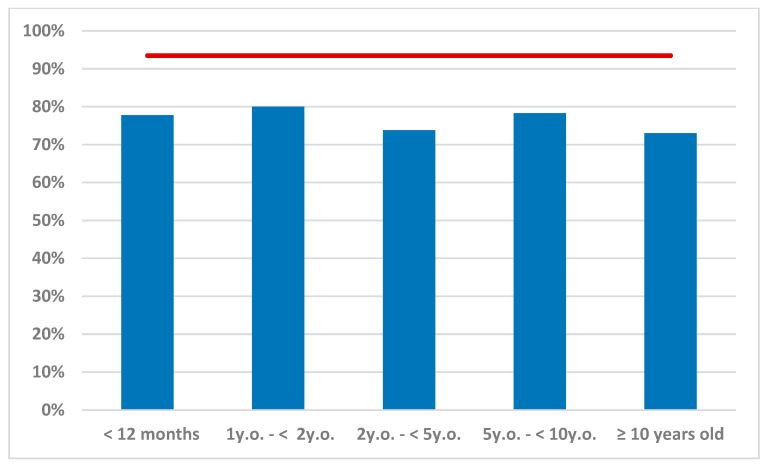
Measles is a highly contagious acute febrile disease responsible for sporadic but explosive outbreaks worldwide. Although it was considered eliminated from the Americas, the disease reemerged in 2017. This reemergence was linked to reduced immunization rates. Vaccination, early identification of cases, and blocking of the transmission chain are the most effective tools to combat measles, for which there is not a specific antiviral treatment. In this Brazilian prospective cross-sectional study, we investigated the prevalence of measles antibodies in children, a population vulnerable to significant morbidity and mortality from exposure to infection. Between December 2018 to November 2019, blood samples from 252 children were collected and assessed for the presence of measles-specific IgG antibodies and an overall prevalence of 75.8% was observed. We further stratified the cohort into age subgroups, none of which exhibited antibody presence levels above the herd immunity threshold of 94%. Moreover, the calculated number of secondary cases resulting from a case in any age group ranged from 3 to 4, demonstrating that even with partial vaccination coverage this disease is still concerning and highly transmissible. Despite global warnings about measles and previous efforts to combat the advance of the disease, data on antibody prevalence and vaccination coverage in several countries are still concerning and indicate that significant parts of the population could be affected. Seroprevalence studies like this one are important to highlight actual epidemiological conditions and emphasize the need for additional strategies to encourage immunization and avoid the potential impacts of measles, particularly in children who can be severely affected.
麻疹是一种高度传染性的急性发热疾病,在全球范围内引发散发性但具有爆发性的疫情。尽管美洲地区曾被认为已消除麻疹,但该疾病在2017年再度出现。此次再度出现与免疫接种率下降有关。接种疫苗、早期识别病例以及阻断传播链是对抗麻疹最有效的手段,目前尚无针对麻疹的特效抗病毒治疗方法。在这项巴西前瞻性横断面研究中,我们调查了儿童中麻疹抗体的流行情况,儿童群体因接触感染而极易出现严重发病和死亡。在2018年12月至2019年11月期间,采集了252名儿童的血样,并检测了麻疹特异性IgG抗体的存在情况,总体流行率为75.8%。我们进一步将队列分为年龄亚组,没有一个亚组的抗体存在水平高于群体免疫阈值94%。此外,计算得出任何年龄组中一例病例导致的二代病例数在3至4例之间,这表明即使疫苗接种覆盖率不高,该疾病仍然令人担忧且具有高度传染性。尽管全球对麻疹发出了警告,且此前为抗击该疾病的传播做出了努力,但一些国家的抗体流行率和疫苗接种覆盖率数据仍然令人担忧,这表明很大一部分人群可能会受到影响。这样的血清流行率研究对于突出实际的流行病学状况以及强调需要采取额外策略来鼓励免疫接种并避免麻疹的潜在影响非常重要,尤其是对于可能受到严重影响的儿童。