Papanikolaou Christina, Rapti Vasiliki, Stellas Dimitris, Stefanou Dimitra T, Syrigos Konstantinos, Pavlakis George N, Souliotis Vassilis L
Institute of Chemical Biology, National Hellenic Research Foundation, 11635 Athens, Greece.
Third Department of Medicine, Thoracic Diseases General Hospital Sotiria, School of Medicine, National and Kapodistrian University of Athens, 11527 Athens, Greece.
Vaccines (Basel). 2022 Oct 20;10(10):1764. doi: 10.3390/vaccines10101764.
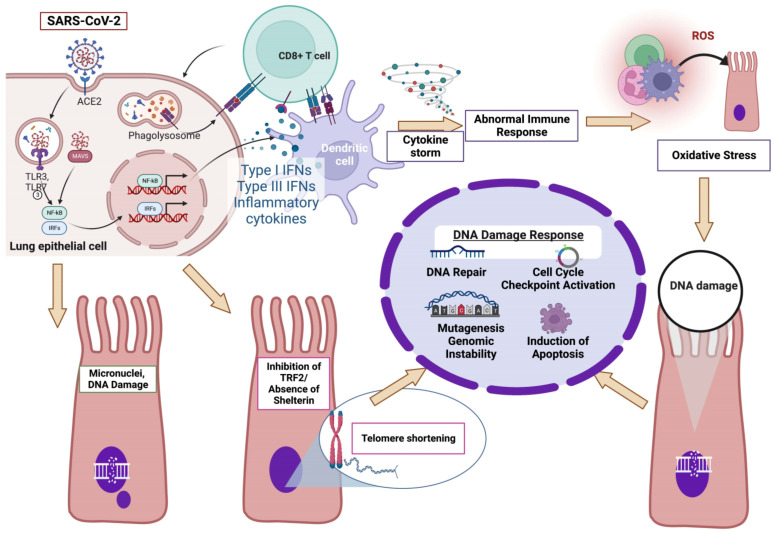
COVID-19 is an infectious disease caused by the SARS-CoV-2 coronavirus and characterized by an extremely variable disease course, ranging from asymptomatic cases to severe illness. Although all individuals may be infected by SARS-CoV-2, some people, including those of older age and/or with certain health conditions, including cardiovascular disease, diabetes, cancer, and chronic respiratory disease, are at higher risk of getting seriously ill. For cancer patients, there are both direct consequences of the COVID-19 pandemic, including that they are more likely to be infected by SARS-CoV-2 and more prone to develop severe complications, as well as indirect effects, such as delayed cancer diagnosis or treatment and deferred tests. Accumulating data suggest that aberrant SARS-CoV-2 immune response can be attributed to impaired interferon signaling, hyper-inflammation, and delayed adaptive immune responses. Interestingly, the SARS-CoV-2-induced immunological abnormalities, DNA damage induction, generation of micronuclei, and the virus-induced telomere shortening can abnormally activate the DNA damage response (DDR) network that plays a critical role in genome diversity and stability. We present a review of the current literature regarding the molecular mechanisms that are implicated in the abnormal interplay of the immune system and the DDR network, possibly contributing to some of the COVID-19 complications.
2019冠状病毒病(COVID-19)是一种由严重急性呼吸综合征冠状病毒2(SARS-CoV-2)引起的传染病,其病程极为多变,从无症状感染到重症皆有。尽管所有人都可能感染SARS-CoV-2,但包括老年人和/或患有某些健康状况(如心血管疾病、糖尿病、癌症和慢性呼吸道疾病)的人群,患重病的风险更高。对于癌症患者而言,COVID-19大流行既有直接后果,包括他们更易感染SARS-CoV-2且更易出现严重并发症,也有间接影响,如癌症诊断或治疗延迟以及检查推迟。越来越多的数据表明,SARS-CoV-2异常的免疫反应可能归因于干扰素信号传导受损、过度炎症反应以及适应性免疫反应延迟。有趣的是,SARS-CoV-2诱导的免疫异常、DNA损伤诱导、微核生成以及病毒诱导的端粒缩短可异常激活在基因组多样性和稳定性中起关键作用的DNA损伤反应(DDR)网络。我们对当前有关免疫系统与DDR网络异常相互作用的分子机制的文献进行综述,这些机制可能导致了部分COVID-19并发症。