Park Dong-Uk, Kim Jun-Yeop, Lee Jae-Rim, Kim Hee-Sun, Sim Hye-Young, Lee Ho, Han Yoon-Sic
Department of Oral and Maxillofacial Surgery, SMG-SNU Boramae Medical Center, Seoul, Republic of Korea.
Department of Prosthodontics, SMG-SNU Boramae Medical Center, Seoul, Republic of Korea.
J Dent Sci. 2022 Oct;17(4):1553-1558. doi: 10.1016/j.jds.2022.04.011. Epub 2022 Apr 27.
BACKGROUND/PURPOSE: The narrow alveolar ridge in the maxillary premolars area limits the angle of implant placement and the shape of the prosthesis. The aim of this study was to evaluate which implant prosthesis, screw-and-cement-retained prosthesis (SCRP) or cement-retained prosthesis (CRP), was more suitable for the maxillary premolar area.
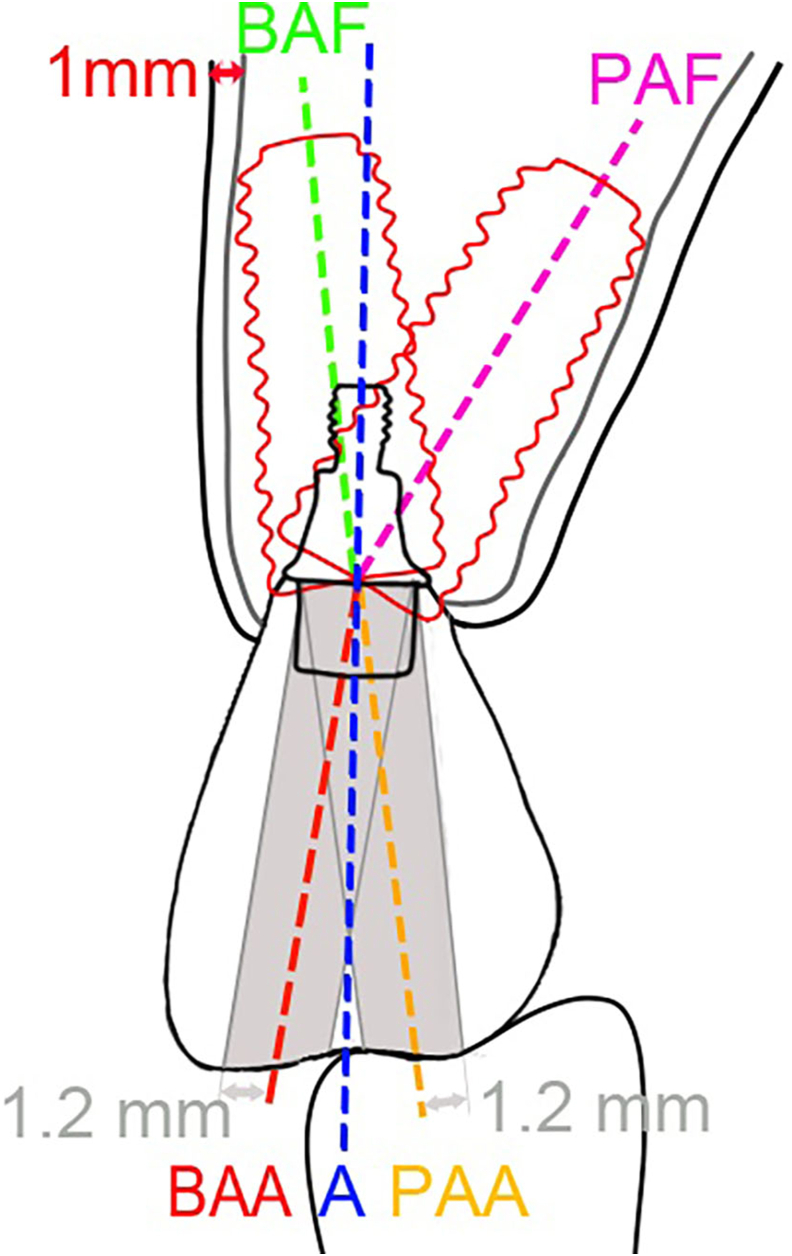
We conducted virtual implantation on 58 implant images from 47 patients obtained using cone beam computed tomography (CBCT). The width and buccal inclination of the alveolar bone, the angulation of the implant fixture, and the angulation of abutment were measured and calculated.
We determined that SCRP was feasible in 52% and 78.8% of first and second premolar areas, respectively. There was a positive relationship between the feasibility of SCRP and the premolar region in general ( = 0.031), although SCRP was more likely to be a possibility in the second premolar area. On multiple logistic regression analysis, the difference in the angle between the axis of the prosthesis and the axis of the alveolar bone (RA) was significantly associated with the type of prosthesis ( = 0.001). The RA was significantly higher for CRP implants (OR = 1.885; 95% CI: 1.31 to 2.70).
SCRP is not always feasible in the maxillary premolar area, especially in the first premolar area. If the difference between the angle of the axis of the prosthesis and the axis of the alveolar bone is large, it may be necessary for the clinician to consider CRP in the treatment planning stage.
背景/目的:上颌前磨牙区牙槽嵴狭窄限制了种植体植入角度和修复体形状。本研究旨在评估哪种种植修复体,即螺丝固位和粘结固位修复体(SCRP)或粘结固位修复体(CRP),更适合上颌前磨牙区。
我们对47例患者的58张种植体图像进行了虚拟植入,这些图像是使用锥形束计算机断层扫描(CBCT)获得的。测量并计算牙槽骨的宽度和颊侧倾斜度、种植体基台的角度以及基牙的角度。
我们确定SCRP在第一前磨牙区和第二前磨牙区分别有52%和78.8%的可行性。一般来说,SCRP的可行性与前磨牙区之间存在正相关(P = 0.031),尽管SCRP在第二前磨牙区更有可能可行。在多因素逻辑回归分析中,修复体轴线与牙槽骨轴线之间的角度差异(RA)与修复体类型显著相关(P = 0.001)。CRP种植体的RA显著更高(OR = 1.885;95%CI:1.31至2.70)。
SCRP在上颌前磨牙区并不总是可行的,尤其是在第一前磨牙区。如果修复体轴线与牙槽骨轴线的角度差异较大,临床医生在治疗计划阶段可能需要考虑CRP。