Hassan Syed Shams Ul, Samanta Saptadip, Dash Raju, Karpiński Tomasz M, Habibi Emran, Sadiq Abdul, Ahmadi Amirhossin, Bunagu Simona
Shanghai Key Laboratory for Molecular Engineering of Chiral Drugs, School of Pharmacy, Shanghai Jiao Tong University, Shanghai, China.
Department of Natural Product Chemistry, School of Pharmacy, Shanghai Jiao Tong University, Shanghai, China.
Front Pharmacol. 2022 Oct 10;13:1015835. doi: 10.3389/fphar.2022.1015835. eCollection 2022.
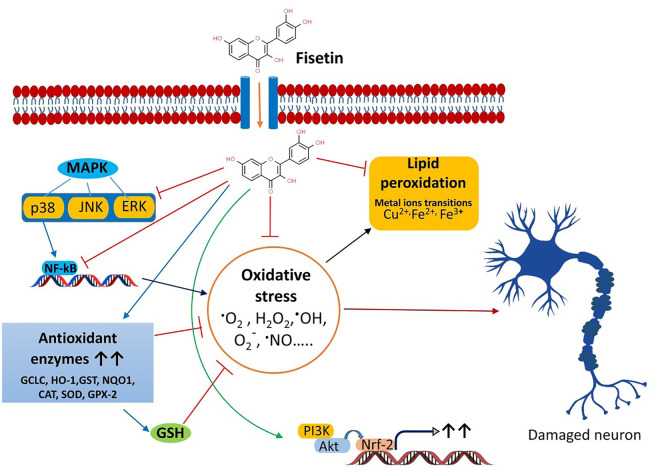
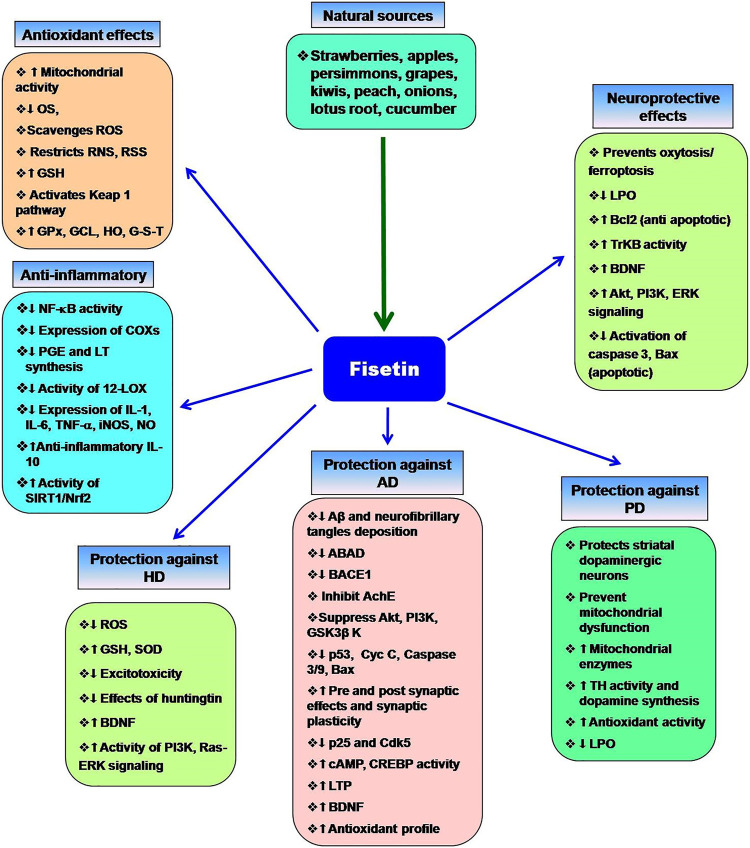
Oxidative stress (OS) disrupts the chemical integrity of macromolecules and increases the risk of neurodegenerative diseases. Fisetin is a flavonoid that exhibits potent antioxidant properties and protects the cells against OS. We have viewed the NCBI database, PubMed, Science Direct (Elsevier), Springer-Nature, ResearchGate, and Google Scholar databases to search and collect relevant articles during the preparation of this review. The search keywords are OS, neurodegenerative diseases, fisetin, etc. High level of ROS in the brain tissue decreases ATP levels, and mitochondrial membrane potential and induces lipid peroxidation, chronic inflammation, DNA damage, and apoptosis. The subsequent results are various neuronal diseases. Fisetin is a polyphenolic compound, commonly present in dietary ingredients. The antioxidant properties of this flavonoid diminish oxidative stress, ROS production, neurotoxicity, neuro-inflammation, and neurological disorders. Moreover, it maintains the redox profiles, and mitochondrial functions and inhibits NO production. At the molecular level, fisetin regulates the activity of PI3K/Akt, Nrf2, NF-κB, protein kinase C, and MAPK pathways to prevent OS, inflammatory response, and cytotoxicity. The antioxidant properties of fisetin protect the neural cells from inflammation and apoptotic degeneration. Thus, it can be used in the prevention of neurodegenerative disorders.
氧化应激(OS)会破坏大分子的化学完整性,并增加神经退行性疾病的风险。漆黄素是一种具有强大抗氧化特性的黄酮类化合物,可保护细胞免受氧化应激的影响。在撰写本综述时,我们查阅了美国国立医学图书馆数据库、PubMed、科学Direct(爱思唯尔)、施普林格自然、ResearchGate和谷歌学术数据库,以搜索和收集相关文章。搜索关键词为氧化应激、神经退行性疾病、漆黄素等。脑组织中高水平的活性氧(ROS)会降低三磷酸腺苷(ATP)水平、线粒体膜电位,并诱导脂质过氧化、慢性炎症、DNA损伤和细胞凋亡。随后的结果是各种神经元疾病。漆黄素是一种多酚化合物,常见于饮食成分中。这种黄酮类化合物的抗氧化特性可减轻氧化应激、ROS生成、神经毒性、神经炎症和神经紊乱。此外,它还能维持氧化还原状态和线粒体功能,并抑制一氧化氮(NO)的产生。在分子水平上,漆黄素调节磷脂酰肌醇-3-激酶/蛋白激酶B(PI3K/Akt)、核因子E2相关因子2(Nrf2)、核因子κB(NF-κB)、蛋白激酶C和丝裂原活化蛋白激酶(MAPK)信号通路的活性,以预防氧化应激、炎症反应和细胞毒性。漆黄素的抗氧化特性可保护神经细胞免受炎症和凋亡性退变的影响。因此,它可用于预防神经退行性疾病。