Kow Ren Yi, Mohamad Rafiai Norfazilah, Ahmad Alwi Akmal Azim, Low Chooi Leng, Ahmad Muhammad Wafiuddin, Zakaria Zamzuri, Zulkifly Ahmad Hafiz
Orthopedics, Traumatology, and Rehabilitation, IIUM (International Islamic University Malaysia), Kuantan, MYS.
Education and Research, Sultan Ahmad Shah Medical Centre @IIUM (International Islamic University Malaysia), Kuantan, MYS.
Cureus. 2022 Sep 23;14(9):e29515. doi: 10.7759/cureus.29515. eCollection 2022 Sep.
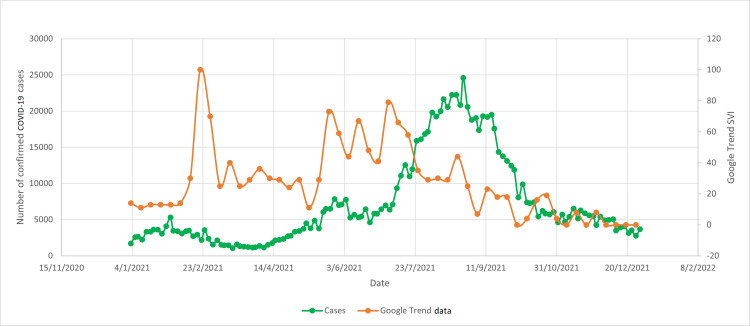
Background In light of the ongoing coronavirus disease 2019 (COVID-19) pandemic, vaccination is one of the most important defensive strategies in combating the severe acute respiratory syndrome coronavirus 2 (SARS-CoV-2). Vaccine hesitancy or anti-vaccination attitude has become a barrier to the nationwide vaccination program, potentially sabotaging the effectiveness of vaccination. Thus far, Google Trends (GT) has been used extensively for monitoring information-seeking behavior during the pandemic. We aimed to investigate the association between Google search, the vaccination rate, and the number of vaccinated and infected cases among the Malaysian population. Material and method GT's customizable geographic and temporal filters were applied to include results for predetermined keywords from January 1, 2021, to December 31, 2021. Both Malay and English languages were used to reflect the multi-racial and multi-lingual community in Malaysia. The search volume index (SVI) derived was compared with the numbers of vaccinated and infected cases which were extracted from the open-access database (COVIDNOW in Malaysia) within the same period. Both analyses were performed independently by two authors to ensure accuracy of the data extraction process. A descriptive analysis was used to compare GT analyses and the number of daily vaccinations and positive COVID-19 cases. Results The information-seeking behavior in the public fluctuated from time to time. The interest surged during the initiation of vaccination program and upon the outbreak of COVID-19 in Malaysia. The surge in interest prior to the peak of vaccination rate also indicated that the public tended to get information online prior to getting the vaccines. Conclusion This observational study illustrates the ability of GT to monitor the interest of vaccination among the Malaysian population during the pandemic. By monitoring the dynamic changes in Google Trends, healthcare authorities can get a glimpse of public perceptions such as attitude towards COVID-19 vaccine, hence potentially identify and stymie any dangerous online anti-vaccination rhetoric swiftly.
背景 鉴于2019年冠状病毒病(COVID-19)大流行仍在持续,疫苗接种是对抗严重急性呼吸综合征冠状病毒2(SARS-CoV-2)最重要的防御策略之一。疫苗犹豫或反疫苗态度已成为全国疫苗接种计划的障碍,可能会破坏疫苗接种的效果。到目前为止,谷歌趋势(GT)已被广泛用于监测大流行期间的信息寻求行为。我们旨在调查谷歌搜索、疫苗接种率以及马来西亚人群中接种和感染病例数之间的关联。
材料与方法 应用GT可定制的地理和时间过滤器,以纳入2021年1月1日至2021年12月31日预定关键词的结果。使用马来语和英语来反映马来西亚的多民族和多语言社区。将得出的搜索量指数(SVI)与同期从开放获取数据库(马来西亚的COVIDNOW)中提取的接种和感染病例数进行比较。两位作者独立进行这两项分析,以确保数据提取过程的准确性。采用描述性分析来比较GT分析与每日疫苗接种数和COVID-19阳性病例数。
结果 公众的信息寻求行为随时间波动。在疫苗接种计划启动时以及马来西亚COVID-19疫情爆发时,兴趣激增。在疫苗接种率达到峰值之前兴趣的激增还表明,公众在接种疫苗之前倾向于在网上获取信息。
结论 这项观察性研究说明了GT在大流行期间监测马来西亚人群疫苗接种兴趣的能力。通过监测谷歌趋势的动态变化,卫生当局可以了解公众的看法,例如对COVID-19疫苗的态度,从而有可能迅速识别并遏制任何危险的在线反疫苗言论。