An Hengqing, Xu Lei, Liu Yuanyuan, Ma Dongsheng, Zhang Dajun, Tao Ning
The First Affiliated Hospital, Xinjiang Medical University, Ürümqi, China.
Public Health and Preventive Medicine Post-Doctoral Mobile Station, Xinjiang Medical University, Ürümqi, China.
Front Psychol. 2022 Oct 10;13:1011137. doi: 10.3389/fpsyg.2022.1011137. eCollection 2022.
Use Bayes statistical methods to analyze the factors related to the working ability of petroleum workers in China and establish a predictive model for prediction so as to provide a reference for improving the working ability of petroleum workers.
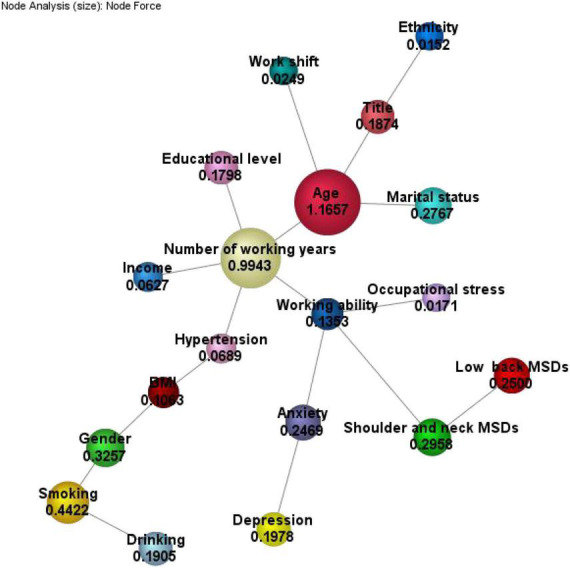
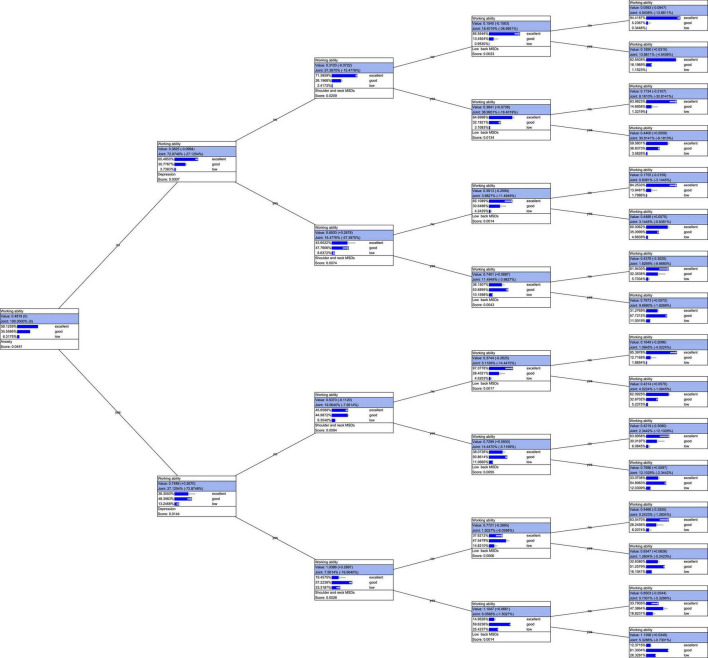
The data come from the health questionnaire database of petroleum workers in the Karamay region, Xinjiang, China. The database contains the results of a health questionnaire survey conducted with 4,259 petroleum workers. We established an unsupervised Bayesian network, using Node-Force to analyze the dependencies between influencing factors, and established a supervised Bayesian network, using mutual information analysis methods (MI) to influence factors of oil workers' work ability. We used the Bayesian target interpretation tree model to observe changes in the probability distribution of work ability classification under different conditions of important influencing factors. In addition, we established the Tree Augmented Naïve Bayes (TAN) prediction model to improve work ability, make predictions, and conduct an evaluation.
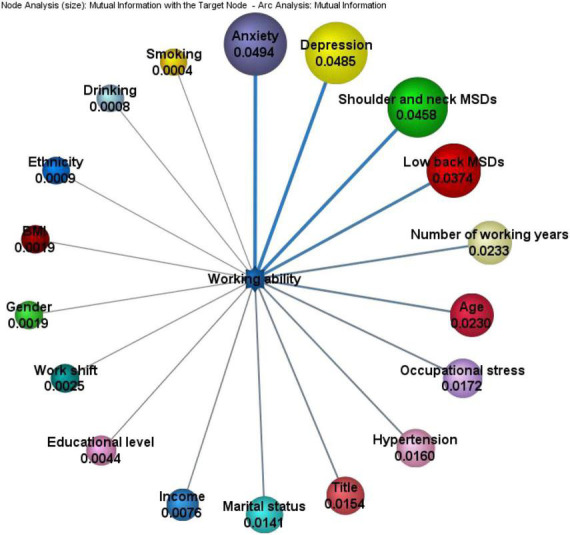
(1) The unsupervised Bayesian network shows that there is a direct relationship between shoulder and neck musculoskeletal diseases, anxiety, working age, and work ability, (2) The supervised Bayesian network shows that anxiety, depression, shoulder and neck musculoskeletal diseases (Musculoskeletal Disorders, MSDs), low back musculoskeletal disorders (Musculoskeletal Disorders, MSDs), working years, age, occupational stress, and hypertension are relatively important factors that affect work ability. Other factors have a relative impact on work ability but are less important.
Anxiety, depression, shoulder and neck MSDs, waist and back MSDs, and length of service are important influencing factors of work ability. The Tree Augmented Naïve Bayes prediction model has general performance in predicting workers' work ability, and the Bayesian model needs to be deepened in subsequent research and a more appropriate forecasting method should be chosen.
运用贝叶斯统计方法分析我国石油工人工作能力的相关因素,并建立预测模型进行预测,为提高石油工人工作能力提供参考。
数据来源于中国新疆克拉玛依地区石油工人健康问卷数据库。该数据库包含对4259名石油工人进行健康问卷调查的结果。我们建立了一个无监督贝叶斯网络,使用节点力分析影响因素之间的依赖性,并建立了一个有监督贝叶斯网络,使用互信息分析方法(MI)来分析石油工人工作能力的影响因素。我们使用贝叶斯目标解释树模型来观察在重要影响因素的不同条件下工作能力分类的概率分布变化。此外,我们建立了树增强朴素贝叶斯(TAN)预测模型来提高工作能力、进行预测并进行评估。
(1)无监督贝叶斯网络显示,肩颈肌肉骨骼疾病、焦虑、工作年限和工作能力之间存在直接关系;(2)有监督贝叶斯网络显示,焦虑、抑郁、肩颈肌肉骨骼疾病(肌肉骨骼疾病,MSDs)、腰背部肌肉骨骼疾病(肌肉骨骼疾病,MSDs)、工作年限、年龄、职业压力和高血压是影响工作能力的相对重要因素。其他因素对工作能力有相对影响,但不太重要。
焦虑、抑郁、肩颈肌肉骨骼疾病、腰背部肌肉骨骼疾病和工作年限是工作能力的重要影响因素。树增强朴素贝叶斯预测模型在预测工人工作能力方面具有一般性能,贝叶斯模型在后续研究中需要深化,并应选择更合适的预测方法。