
计算机模拟研究奎宁和奎尼丁作为 AKR1B1 和 AKR1B10 的潜在抑制剂:功能和结构特征。
In-silico Investigations of quinine and quinidine as potential Inhibitors of AKR1B1 and AKR1B10: Functional and structural characterization.
机构信息
Department of Pharmaceutical Chemistry, Faculty of Pharmacy, The Islamia University of Bahawalpur, Bahawalpur, Pakistan.
Tehsil head quarter hospital, Taunsa Sharif, Pakistan.
出版信息
PLoS One. 2022 Oct 27;17(10):e0271602. doi: 10.1371/journal.pone.0271602. eCollection 2022.
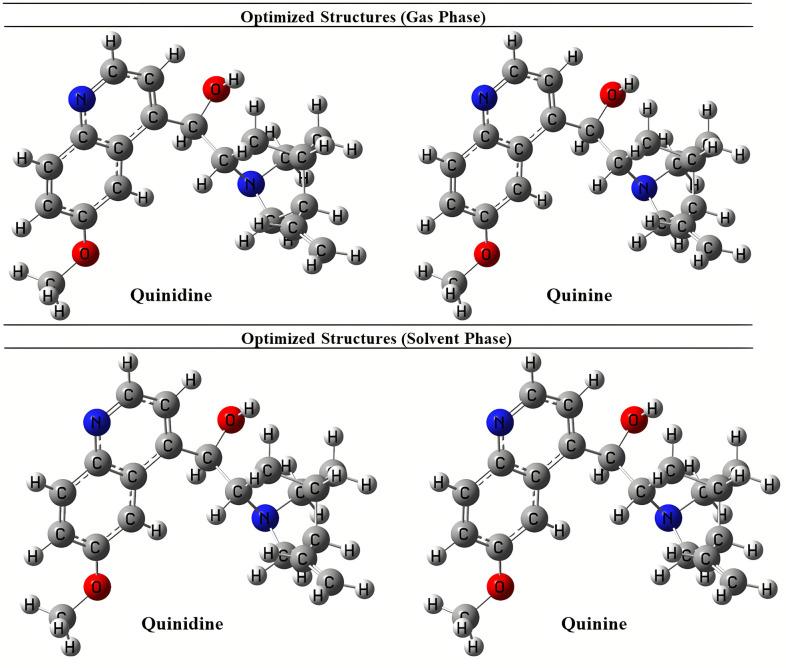
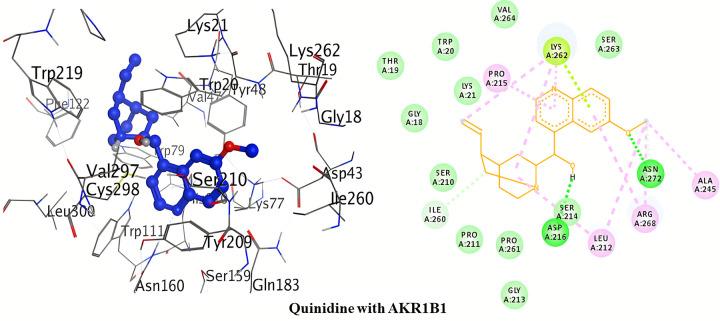
The aberrant expression of aldo keto reductases (AKR1B1 & AKR1B10) has been extensively studied in different types of cancer especially the colon cancer but a very few studies have yet been reported regarding the discovery of inhibitors for the treatment of colon cancer by targeting these isozymes. Therefore, there is a need of selective inhibitors of both targets for the eradication of colon cancer. Currently, the study is focused on the exploration of two quinolone compounds i.e., (S)-(6-Methoxyquinolin-4-yl)[(1S,2R,4S,5R)-5-vinylquinuclidin-2-yl]methanol (Quinidine) and (R)-(6-Methoxyquinolin-4-yl)[(1S,2S,4S,5R)-5-vinylquinuclidin-2-yl]methanol (Quinine) as the potential inhibitors of AKR1B1 and AKR1B10 via detailed in-silico approach. The structural properties including vibrational frequencies, dipole moment, polarizability and the optimization energies were estimated using density functional theory (DFT) calculations; where both compounds were found chemically reactive. After that, the optimized structures were used for the molecular docking studies and here quinidine was found more selective towards AKR1B1 and quinine exhibited maximum inhibition of AKR1B10. The results of molecular docking studies were validated by molecular dynamics simulations which provided the deep insight of stability of protein ligand complex. At the end, the ADMET properties were determined to demonstrate the druglikeness properties of both selected compounds. These findings suggested further exploration of both compounds at molecular level using different in-vivo and in-vitro approaches that will lead to the designing of potential inhibitor of AKR1B1/AKR1B10 for curing colon cancer and related malignancies.
醛酮还原酶 1B1 和 1B10 的异常表达已在多种类型的癌症中得到广泛研究,特别是结肠癌,但针对这些同工酶开发用于结肠癌治疗的抑制剂的研究却很少。因此,需要针对这两个靶点开发选择性抑制剂,以根除结肠癌。目前,研究重点是探索两种喹诺酮化合物,即(S)-(6-甲氧基-4-喹啉基)-[(1S,2R,4S,5R)-5-乙烯基-2-氮杂双环[2.2.1]庚烷-2-基]甲醇(奎宁)和(R)-(6-甲氧基-4-喹啉基)-[(1S,2S,4S,5R)-5-乙烯基-2-氮杂双环[2.2.1]庚烷-2-基]甲醇(奎尼丁),作为 AKR1B1 和 AKR1B10 的潜在抑制剂,采用详细的计算方法。使用密度泛函理论(DFT)计算对结构性质进行了估计,包括振动频率、偶极矩、极化率和优化能量;两种化合物均被证明具有化学反应性。之后,对优化后的结构进行了分子对接研究,结果表明奎宁更倾向于与 AKR1B1 结合,而奎尼丁对 AKR1B10 的抑制作用最大。分子对接研究的结果通过分子动力学模拟进行了验证,该模拟提供了蛋白质配体复合物稳定性的深入了解。最后,确定了 ADMET 性质,以证明所选两种化合物的类药性。这些发现表明,需要进一步在分子水平上对这两种化合物进行不同的体内和体外探索,从而设计出用于治疗结肠癌和相关恶性肿瘤的 AKR1B1/AKR1B10 的潜在抑制剂。






 Zotero 插件