Microbial Community Ecology Cluster, expertise group GREEN, Groningen Institute of Evolutionary Life Sciences (GELIFES), University of Groningen, Nijenborgh 7, 9747 AG, Groningen, The Netherlands.
Research Center for Environment and Clean Technology, National Research and Innovation Agency Republic of Indonesia (BRIN), Komplek LIPI, Jalan Sangkuriang No 21, Bandung 40135, Indonesia.
FEMS Microbiol Ecol. 2022 Nov 22;98(12). doi: 10.1093/femsec/fiac127.
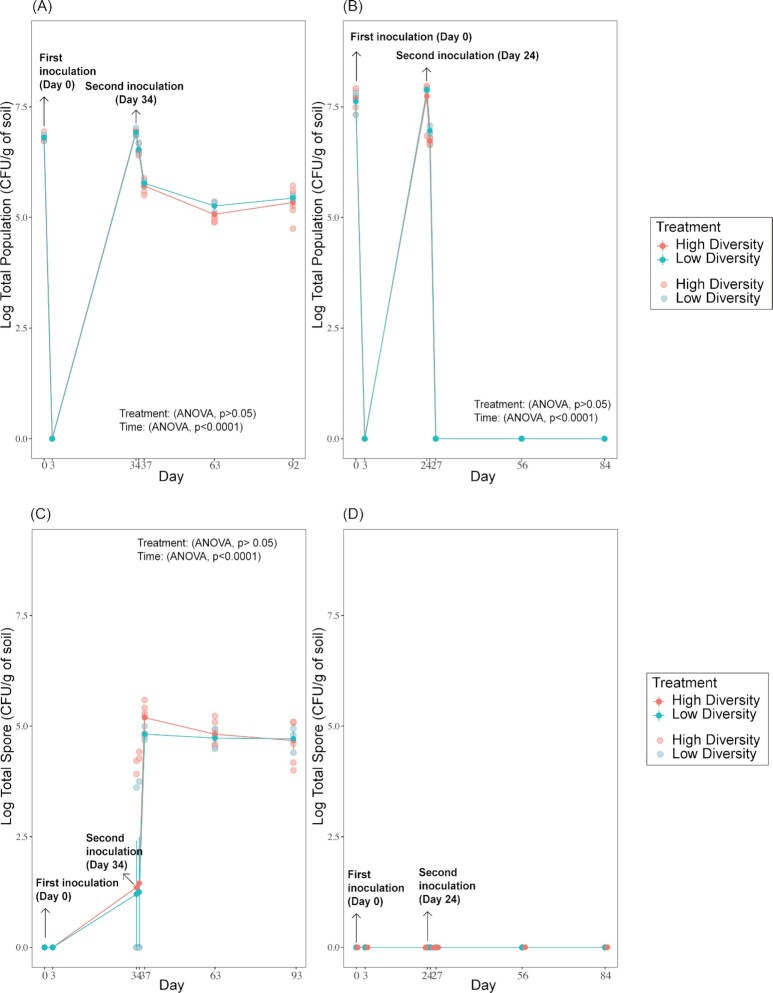
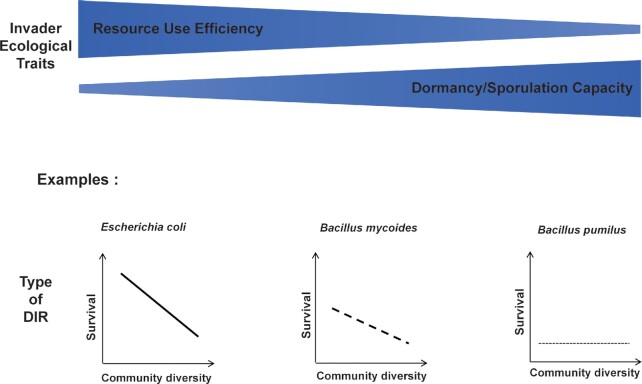
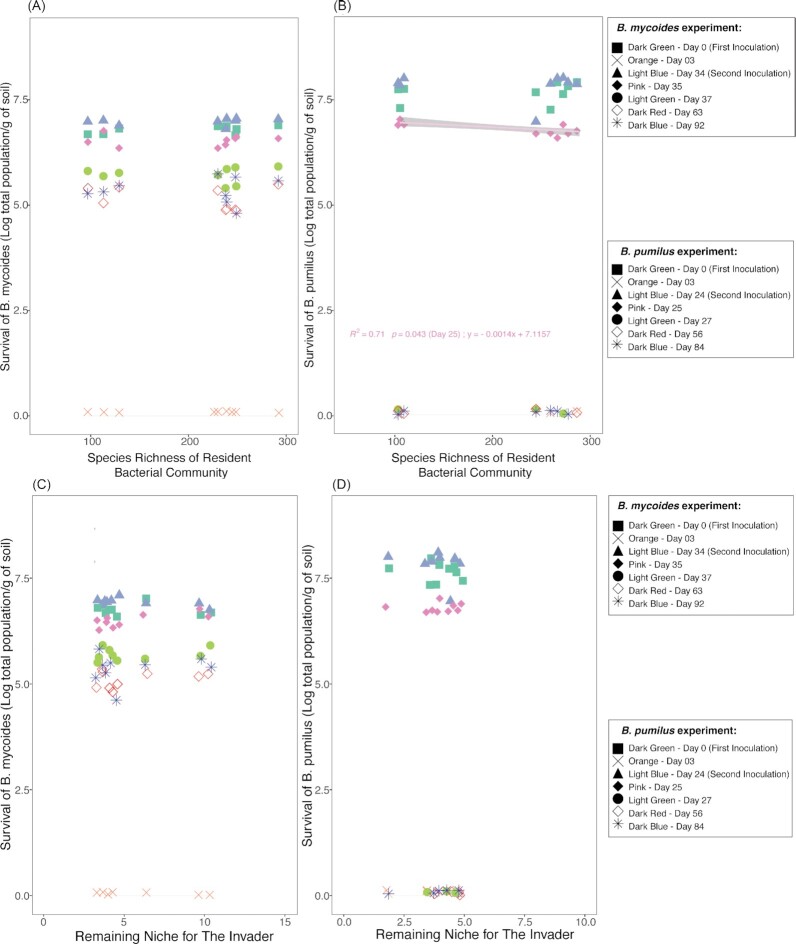
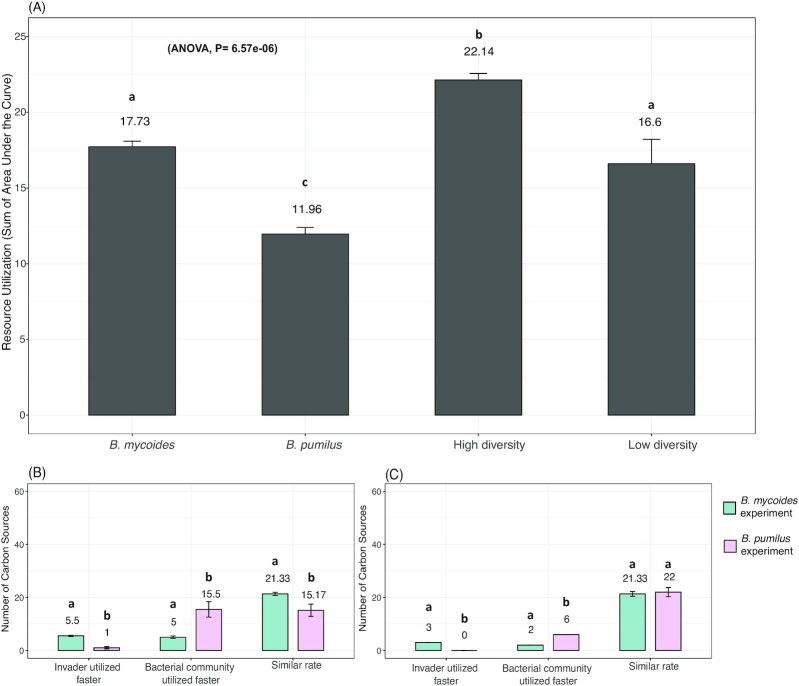
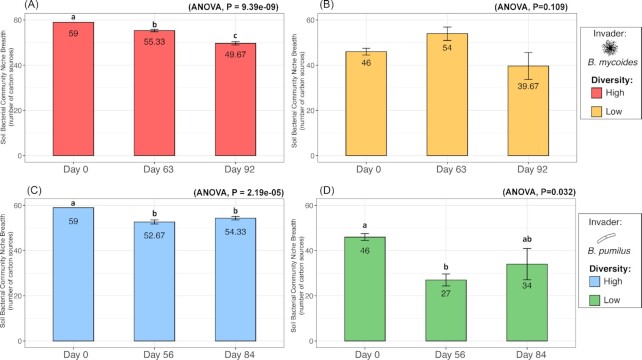
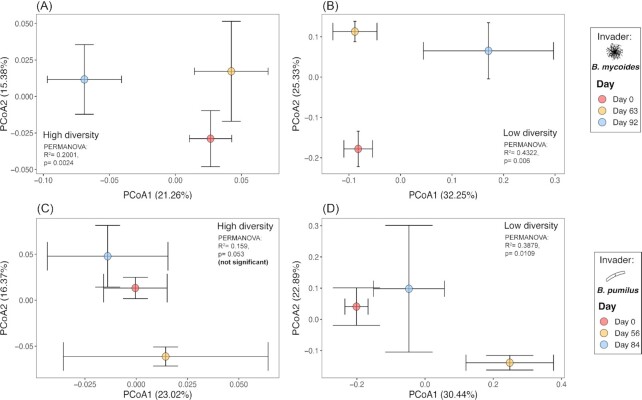
Microbial diversity can restrict the invasion and impact of alien microbes into soils via resource competition. However, this theory has not been tested on various microbial invaders with different ecological traits, particularly spore-forming bacteria. Here we investigated the survival capacity of two introduced spore-forming bacteria, Bacillus mycoides (BM) and B. pumillus (BP) and their impact on the soil microbiome niches with low and high diversity. We hypothesized that higher soil bacterial diversity would better restrict Bacillus survival via resource competition, and the invasion would alter the resident bacterial communities' niches only if inoculants do not escape competition with the soil community (e.g. through sporulation). Our findings showed that BP could not survive as viable propagules and transiently impacted the bacterial communities' niche structure. This may be linked to its poor resource usage and low growth rate. Having better resource use capacities, BM better survived in soil, though its survival was weakly related to the remaining resources left for them by the soil community. BM strongly affected the community niche structure, ultimately in less diverse communities. These findings show that the inverse diversity-invasibility relationship can be valid for some spore-forming bacteria, but only when they have sufficient resource use capacity.
微生物多样性可以通过资源竞争来限制外来微生物对土壤的入侵和影响。然而,这一理论尚未在具有不同生态特征的各种微生物入侵者(特别是形成孢子的细菌)上得到验证。在这里,我们研究了两种引入的形成孢子的细菌,Bacillus mycoides(BM)和B. pumilus(BP)的生存能力及其对低多样性和高多样性土壤微生物组生态位的影响。我们假设,较高的土壤细菌多样性将通过资源竞争更好地限制芽孢杆菌的生存,并且只有当接种物不会与土壤群落竞争(例如通过形成孢子)时,入侵才会改变驻留细菌群落的生态位。我们的研究结果表明,BP 不能作为有活力的繁殖体存活下来,并且会暂时影响细菌群落的生态位结构。这可能与其较差的资源利用和较低的生长速度有关。BM 具有更好的资源利用能力,因此在土壤中更好地存活下来,尽管其生存能力与土壤群落为其留下的剩余资源关系较弱。BM 强烈影响群落的生态位结构,最终在多样性较低的群落中也是如此。这些发现表明,对于某些形成孢子的细菌,反向多样性-可入侵性关系可能成立,但前提是它们具有足够的资源利用能力。