Vasantha-Srinivasan Prabhakaran, Park Ki Beom, Kim Kil Yong, Jung Woo-Jin, Han Yeon Soo
Department of Applied Biology, Institute of Environmentally Friendly Agriculture (IEFA), College of Agriculture and Life Sciences, Chonnam National University, Gwangju, Republic of Korea.
Research and Development Center, Invirustech Co., Inc., Gwangju, Republic of Korea.
Front Microbiol. 2025 Jan 17;15:1510036. doi: 10.3389/fmicb.2024.1510036. eCollection 2024.
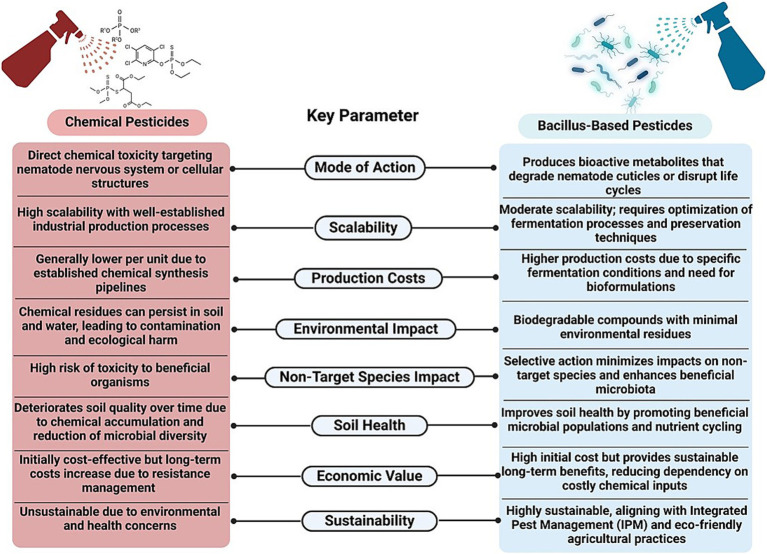
Plant-parasitic nematodes (PPNs), including root-knot nematodes ( spp.), cyst nematodes ( and spp.), and other economically significant nematode species, pose severe threats to global agriculture. These nematodes employ diverse survival strategies, such as dormancy in cysts or robust infective juvenile stages. Consequently, their management is challenging. Traditional control methods, such as the use of chemical nematicides, are increasingly scrutinized because of environmental and health concerns. This review focuses on the specific mechanisms employed by spp., including nematicidal compound production, systemic resistance induction, and cuticle degradation, to target root-knot and cyst nematodes. These mechanisms offer sustainable solutions for managing nematodes and promoting soil health by enhancing microbial diversity and nutrient cycling. An integrated approach leveraging based biocontrol is proposed to maximize efficacy and agricultural sustainability.
植物寄生线虫(PPNs),包括根结线虫(属)、孢囊线虫(和属)以及其他具有重要经济意义的线虫种类,对全球农业构成严重威胁。这些线虫采用多种生存策略,如在孢囊中休眠或处于强健的感染性幼虫阶段。因此,对它们的管理具有挑战性。传统的防治方法,如使用化学杀线虫剂,由于环境和健康问题,受到越来越多的审视。本综述聚焦于属所采用的特定机制,包括杀线虫化合物的产生、系统抗性的诱导以及表皮降解,以靶向根结线虫和孢囊线虫。这些机制通过增强微生物多样性和养分循环,为管理线虫和促进土壤健康提供了可持续的解决方案。提出了一种利用基于生物防治的综合方法,以最大限度地提高防治效果和农业可持续性。