Wang Qingqing, Tian Sha, Xiao Dahai, Zhao Ruotong, Zhang Xiaoxuan, Dou Zhijie, Li Chengbo, Ma Zheng
Department of Neurology, Chengde Medical University Affiliated Hospital, Hebei, China.
Transl Neurosci. 2022 Oct 10;13(1):354-360. doi: 10.1515/tnsci-2022-0252. eCollection 2022 Jan 1.
This study aimed to investigate the changes in serum levels of retinol-binding protein 4 (RBP4) with cerebral infarction, relationship of RBP4 with oxidative stress and carotid atherosclerosis, and its possible role in cerebral infarction.
According to the results of cervical vascular ultrasound, the experimental group was divided into three groups: intima thickening group ( = 31), stable plaque group ( = 51), and unstable plaque group ( = 54). Forty healthy subjects were selected as the control group. Their serum levels of RBP4, 8-iso-prostaglandin-F2alpha (8-iso-PGF2α), and catalase (CAT) were measured. Carotid vascular ultrasound was used to measure the plaque area and intima-media thickness (IMT).
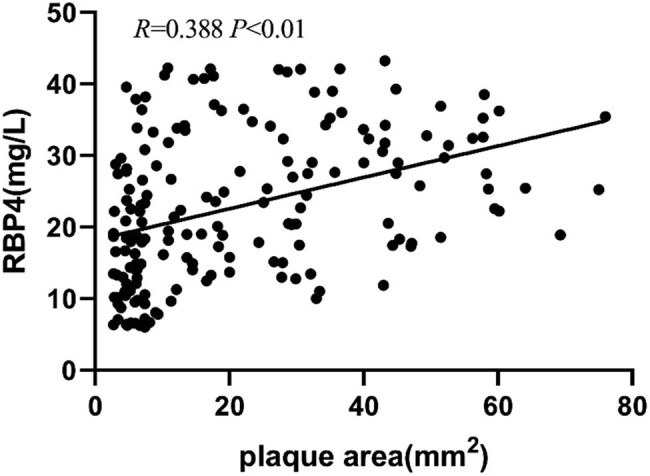
The serum RBP4 and 8-iso-PGF2α levels, IMT and plaque area in the control, intimal thickening, stable plaque, and unstable plaque groups increased, while the serum level of CAT decreased ( < 0.001). The serum levels of RBP4 positively correlated with 8-iso-PGF2α, IMT, and plaque area and negatively correlated with CAT level. The area under the receiver operating characteristic curve was 0.778 in predicting unstable plaques.
The serum levels of RBP4 were significantly elevated in elderly patients with cerebral infarction and correlated with oxidative stress injury and the degree of atherosclerosis. Serum RBP4 has diagnostic value for unstable plaques in carotid arteries.
本研究旨在探讨脑梗死患者血清视黄醇结合蛋白4(RBP4)水平的变化、RBP4与氧化应激及颈动脉粥样硬化的关系及其在脑梗死中的可能作用。
根据颈部血管超声检查结果,将实验组分为三组:内膜增厚组(n = 31)、稳定斑块组(n = 51)和不稳定斑块组(n = 54)。选取40例健康受试者作为对照组。检测他们血清中RBP4、8-异前列腺素F2α(8-iso-PGF2α)和过氧化氢酶(CAT)的水平。采用颈动脉血管超声测量斑块面积和内膜中层厚度(IMT)。
对照组、内膜增厚组、稳定斑块组和不稳定斑块组的血清RBP4和8-iso-PGF2α水平、IMT及斑块面积均升高,而血清CAT水平降低(P < 0.001)。血清RBP4水平与8-iso-PGF2α、IMT和斑块面积呈正相关,与CAT水平呈负相关。预测不稳定斑块的受试者工作特征曲线下面积为0.778。
老年脑梗死患者血清RBP4水平显著升高,且与氧化应激损伤和动脉粥样硬化程度相关。血清RBP4对颈动脉不稳定斑块具有诊断价值。