School of Public Health, The University of Queensland, Brisbane, Queensland, Australia.
Allergy and Lung Health Unit, School of Population and Global Health, The University of Melbourne, Carlton, Victoria, Australia.
BMJ Open. 2022 Oct 28;12(10):e064333. doi: 10.1136/bmjopen-2022-064333.
Previous studies have identified associations between individual reproductive factors and chronic disease risk among postmenopausal women. However, few have investigated the association of different markers of reproductive function, their interactions and risk factors of chronic disease among women approaching menopause. The Menarche-to-PreMenopause (M-PreM) Study aims to examine the relationship between reproductive factors across the reproductive lifespan and risk indicators for chronic disease among women in their early-to-mid-40s. The purpose of this cohort profile paper is to describe the rationale, study design and participant characteristics of the M-PreM Study.
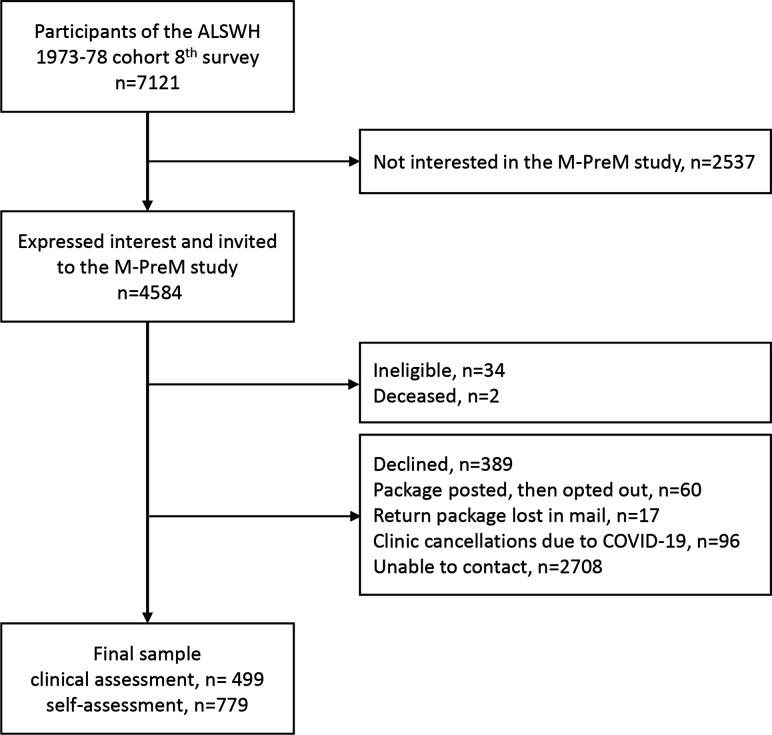
Women born in 1973-1978 who participated in the Australian Longitudinal Study on Women's Health (ALSWH) were invited to undertake a clinical or self-administered assessment. A total of 1278 women were recruited from June 2019 to June 2021.
The study measures included functional, cognitive and cardiometabolic tests, anthropometry, spirometry, respiratory health questionnaires, physical activity, sleep patterns, sex hormones, and cardiovascular and metabolic markers; whereas blood and saliva samples were used for the analysis of genetic variants of genes associated with reproductive characteristics and chronic disease. The mean age of the clinic and self-assessed participants was 44.6 and 45.3 years, respectively. The menopausal status of participants was similar between the two arms of the study: 38%-41% premenopausal, 20% perimenopausal, and 36% took oral contraception or hormone replacement therapy. Approximately 80% of women had at least one child and participants reported experiencing pregnancy complications: preterm birth (8%-13% of pregnancies), gestational diabetes (10%) and gestational hypertension (10%-15%).
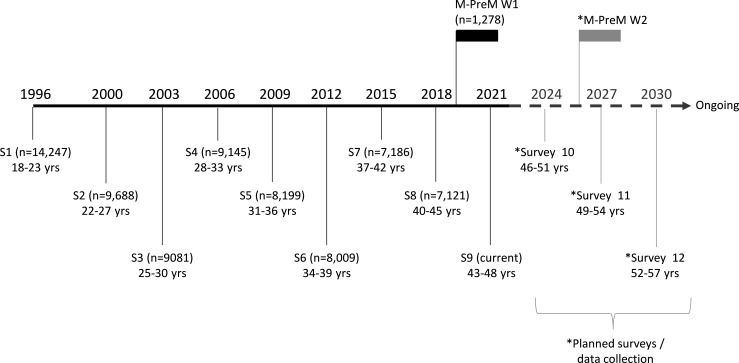
The biomedical data collected in the M-PreM Study will be linked to existing ALSWH survey data on sociodemographic factors, health behaviour, reproductive function, and early life factors collected over the past 20 years and health administrative data. The association between reproductive factors and risk indicators of chronic disease will be analysed.
先前的研究已经确定了个体生殖因素与绝经后妇女慢性疾病风险之间的关联。然而,很少有研究调查接近绝经的女性生殖功能的不同标志物、它们之间的相互作用以及慢性疾病的危险因素。Menarche-to-PreMenopause(M-PreM)研究旨在研究女性生殖寿命内生殖因素与 40 多岁早期至中期女性慢性疾病风险指标之间的关系。本队列特征论文的目的是描述 M-PreM 研究的基本原理、研究设计和参与者特征。
参加澳大利亚妇女健康纵向研究(ALSWH)的 1973-1978 年出生的女性被邀请进行临床或自我评估。共有 1278 名女性于 2019 年 6 月至 2021 年 6 月招募。
该研究的测量指标包括功能、认知和心血管代谢测试、人体测量、肺活量测定、呼吸健康问卷、体力活动、睡眠模式、性激素以及心血管和代谢标志物;同时,血液和唾液样本用于分析与生殖特征和慢性疾病相关的基因的遗传变异。临床和自我评估参与者的平均年龄分别为 44.6 岁和 45.3 岁。研究的两个部分参与者的绝经状态相似:38%-41% 的人处于绝经前期,20% 的人处于围绝经期,36% 的人服用口服避孕药或激素替代疗法。大约 80%的女性至少有一个孩子,参与者报告经历了妊娠并发症:早产(8%-13%的妊娠)、妊娠糖尿病(10%)和妊娠高血压(10%-15%)。
M-PreM 研究中收集的生物医学数据将与过去 20 年收集的关于社会人口因素、健康行为、生殖功能和早期生活因素的现有 ALSWH 调查数据以及健康管理数据相关联。将分析生殖因素与慢性疾病风险指标之间的关系。