Mackenzie Wearables Research Hub, Charles Perkins Centre, The University of Sydney, Sydney, NSW, Australia.
School of Health Sciences, Faculty of Medicine and Health, The University of Sydney, Sydney, NSW, Australia.
Diabetologia. 2024 Jun;67(6):1051-1065. doi: 10.1007/s00125-024-06090-y. Epub 2024 Mar 13.
AIMS/HYPOTHESIS: The aim of this study was to examine the dose-response associations of device-measured physical activity types and postures (sitting and standing time) with cardiometabolic health.
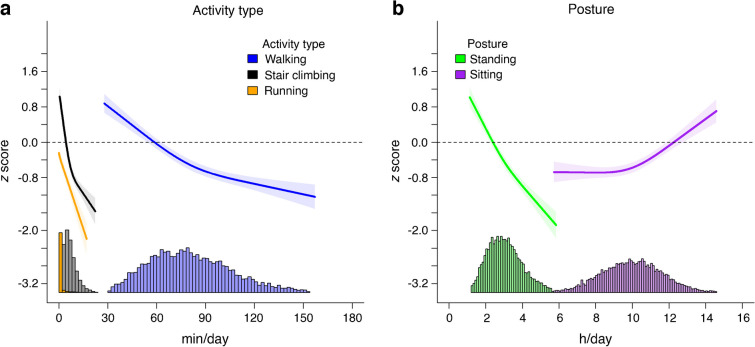
We conducted an individual participant harmonised meta-analysis of 12,095 adults (mean ± SD age 54.5±9.6 years; female participants 54.8%) from six cohorts with thigh-worn accelerometry data from the Prospective Physical Activity, Sitting and Sleep (ProPASS) Consortium. Associations of daily walking, stair climbing, running, standing and sitting time with a composite cardiometabolic health score (based on standardised z scores) and individual cardiometabolic markers (BMI, waist circumference, triglycerides, HDL-cholesterol, HbA and total cholesterol) were examined cross-sectionally using generalised linear modelling and cubic splines.
We observed more favourable composite cardiometabolic health (i.e. z score <0) with approximately 64 min/day walking (z score [95% CI] -0.14 [-0.25, -0.02]) and 5 min/day stair climbing (-0.14 [-0.24, -0.03]). We observed an equivalent magnitude of association at 2.6 h/day standing. Any amount of running was associated with better composite cardiometabolic health. We did not observe an upper limit to the magnitude of the dose-response associations for any activity type or standing. There was an inverse dose-response association between sitting time and composite cardiometabolic health that became markedly less favourable when daily durations exceeded 12.1 h/day. Associations for sitting time were no longer significant after excluding participants with prevalent CVD or medication use. The dose-response pattern was generally consistent between activity and posture types and individual cardiometabolic health markers.
CONCLUSIONS/INTERPRETATION: In this first activity type-specific analysis of device-based physical activity, ~64 min/day of walking and ~5.0 min/day of stair climbing were associated with a favourable cardiometabolic risk profile. The deleterious associations of sitting time were fully attenuated after exclusion of participants with prevalent CVD and medication use. Our findings on cardiometabolic health and durations of different activities of daily living and posture may guide future interventions involving lifestyle modification.
目的/假设:本研究的目的是研究设备测量的体力活动类型和姿势(坐立时间)与心脏代谢健康之间的剂量-反应关系。
我们对来自六个队列的 12095 名成年人(平均年龄 54.5±9.6 岁;女性参与者占 54.8%)进行了个体参与者协调荟萃分析,这些参与者佩戴大腿式加速度计,来自前瞻性体力活动、坐立和睡眠(ProPASS)联盟。使用广义线性模型和三次样条,分别使用一般线性模型和三次样条,从整体上检查每天行走、爬楼梯、跑步、站立和坐姿时间与心脏代谢健康综合评分(基于标准化 z 评分)和个体心脏代谢标志物(BMI、腰围、甘油三酯、高密度脂蛋白胆固醇、HbA 和总胆固醇)之间的横断面关联。
我们观察到,每天行走约 64 分钟(z 评分[95%CI]为-0.14[-0.25,-0.02])和每天爬楼梯 5 分钟(z 评分为-0.14[-0.24,-0.03])与更好的综合心脏代谢健康有关。每天站立 2.6 小时也有相同程度的关联。任何跑步量都与更好的综合心脏代谢健康有关。我们没有观察到任何活动类型或站立的剂量-反应关联的上限。坐姿时间与综合心脏代谢健康之间呈负相关,当每天持续时间超过 12.1 小时时,这种关联变得明显不利。排除患有 CVD 或使用药物的参与者后,坐姿时间与综合心脏代谢健康的关联不再显著。活动和姿势类型以及个体心脏代谢健康标志物之间的剂量-反应模式基本一致。
结论/解释:在这项基于设备的体力活动的首个特定活动类型分析中,每天行走约 64 分钟和每天爬楼梯约 5.0 分钟与有利的心脏代谢风险状况相关。排除患有 CVD 和使用药物的参与者后,坐姿时间的有害关联完全减弱。我们关于心脏代谢健康以及日常生活和姿势中不同活动的持续时间的发现,可能为涉及生活方式改变的未来干预提供指导。