Lady Davis Institute for Medical Research, Jewish General Hospital, 3755 Cote Ste Catherine Road, Montreal, QC, H3T 1E2, Canada.
Department of Psychiatry, McGill University, Montreal, QC, Canada.
Orphanet J Rare Dis. 2022 Oct 28;17(1):396. doi: 10.1186/s13023-022-02552-x.
More people with rare diseases likely receive disease education and emotional and practical support from peer-led support groups than any other way. Most rare-disease support groups are delivered outside of the health care system by untrained leaders. Potential benefits may not be achieved and harms, such as dissemination of inaccurate information, may occur. Our primary objective was to evaluate the effects of a rare-disease support group leader education program, which was developed collaboratively by researchers, peer support group leaders, and patient organization leaders, compared to waitlist control, on peer leader self-efficacy among scleroderma support group leaders.
The trial was a pragmatic, two-arm partially nested randomised controlled trial with 1:1 allocation into intervention or waitlist control. Eligible participants were existing or candidate peer support group leaders affiliated with a scleroderma patient organization. Leader training was delivered in groups of 5-6 participants weekly for 13 weeks in 60-90 min sessions via the GoToMeeting® videoconferencing platform. The program included 12 general leader training modules and one module specific to scleroderma. Primary outcome was leader self-efficacy, measured by the Support Group Leader Self-efficacy Scale (SGLSS) immediately post-intervention. Secondary outcomes were leader self-efficacy 3 months post-intervention; emotional distress, leader burnout, and volunteer satisfaction post-intervention and 3 months post-intervention; and program satisfaction among intervention participants post-intervention.
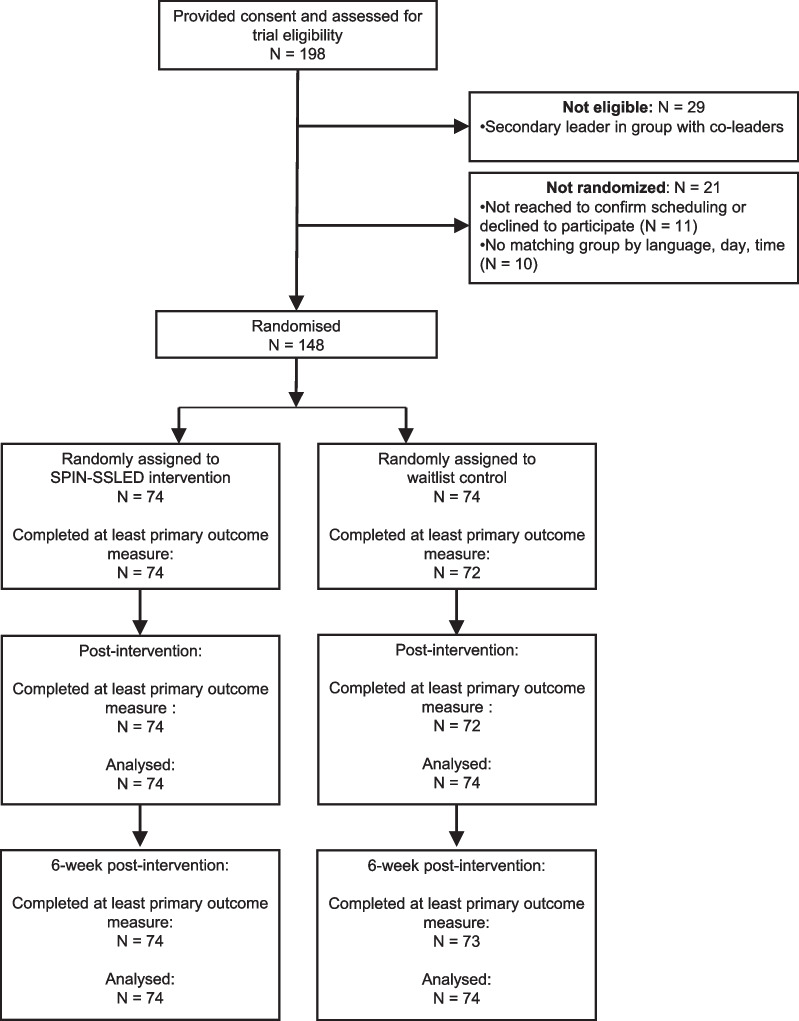
One hundred forty-eight participants were randomised to intervention (N = 74) or waitlist (N = 74). Primary outcome data were provided by 146 (99%) participants. Mean number of sessions attended was 11.4 (standard deviation = 2.6). Mean program satisfaction score (CSQ-8) was 30.3 (standard deviation = 3.0; possible range 8-32). Compared to waitlist control, leader self-efficacy was higher post-intervention [SGLSS; 16.7 points, 95% CI 11.0-22.3; standardized mean difference (SMD) 0.84] and 3 months later (15.6 points, 95% CI 10.2-21.0; SMD 0.73); leader volunteer satisfaction was significantly higher at both assessments, emotional distress was lower post-intervention but not 3 months later, and leader burnout was not significantly different at either assessment.
Peer support group leader education improved leader self-efficacy substantially. The program could be easily adapted for support group leaders in other rare diseases.
NCT03965780 ; registered on May 29, 2019.
与任何其他方式相比,更多患有罕见病的人可能会从由同伴领导的支持小组中获得疾病教育、情感和实际支持。大多数罕见病支持小组都是由未经培训的领导人在医疗保健系统之外提供的。可能无法实现潜在的益处,并且可能会出现传播不准确信息等危害。我们的主要目标是评估一项由研究人员、同伴支持小组领导人和患者组织领导人共同制定的罕见病支持小组领导教育计划的效果,与候补名单对照组相比,该计划对硬皮病支持小组领导的同伴领导自我效能感的影响。
该试验是一项实用的、双臂部分嵌套的随机对照试验,1:1 分配到干预组或候补名单对照组。合格的参与者是隶属于硬皮病患者组织的现有或潜在的同伴支持小组领导。领导培训以小组形式通过 GoToMeeting®视频会议平台每周进行一次,每次 60-90 分钟,每次 5-6 名参与者。该计划包括 12 个一般领导培训模块和一个针对硬皮病的模块。主要结局是领导自我效能感,在干预后立即通过支持小组领导自我效能感量表(SGLSS)进行测量。次要结局包括干预后 3 个月的领导自我效能感;干预后和 3 个月时的情绪困扰、领导倦怠和志愿者满意度;以及干预后干预参与者的计划满意度。
148 名参与者被随机分配到干预组(N=74)或候补名单组(N=74)。146 名(99%)参与者提供了主要结局数据。平均参加的课程数为 11.4(标准差=2.6)。平均计划满意度评分(CSQ-8)为 30.3(标准差=3.0;可能范围 8-32)。与候补名单对照组相比,干预后领导自我效能感更高[SGLSS;16.7 分,95%置信区间 11.0-22.3;标准化均数差(SMD)0.84]和 3 个月后更高(15.6 分,95%置信区间 10.2-21.0;SMD 0.73);领导志愿者满意度在两个评估中均显著更高,干预后情绪困扰较低,但 3 个月后情绪困扰没有差异,领导倦怠在两个评估中均无显著差异。
同伴支持小组领导教育显著提高了领导自我效能感。该计划可以很容易地适用于其他罕见病的支持小组领导。
NCT03965780;注册于 2019 年 5 月 29 日。