Department of Physiotherapy, Western Health, Melbourne, Victoria, Australia; Department of Critical Care, School of Medicine, The University of Melbourne, Victoria, Australia.
Melbourne School of Health Sciences, The University of Melbourne, Victoria, Australia; Institute for Breathing and Sleep, Victoria, Australia.
Physiotherapy. 2023 Mar;118:12-19. doi: 10.1016/j.physio.2022.09.003. Epub 2022 Sep 7.
To investigate the perceived barriers and enablers experienced by physiotherapists whilst delivering community and outpatient services during the COVID-19 pandemic.
Qualitative study undertaken at a University-affiliated hospital in Melbourne, Australia. Physiotherapists working in the outpatient setting participated in a semi-structured interview. Interviews were analysed using Framework Analysis, with themes mapped to the Theoretical Domains Framework (TDF).
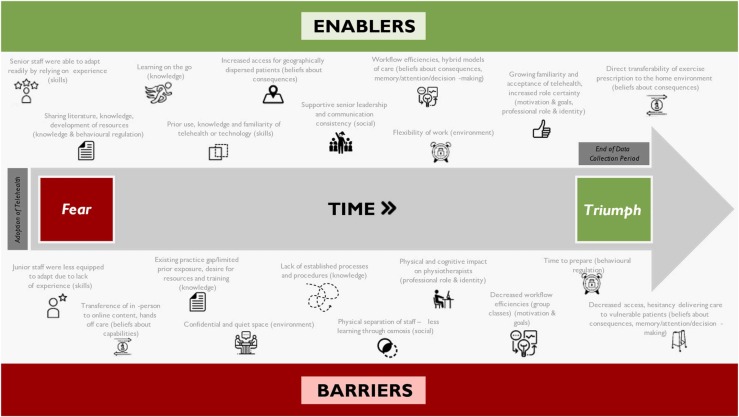
From 19 interviews, we identified major themes and mapped these to the TDF domains: 1. The pandemic rapidly closed the knowledge-practice gap; 2. Adaptation of existing skills and integration of new skills were required; 3. Supportive senior leadership helped the transition; 4. Capabilities and confidence improved with time; 5. Environmental factors were crucial to success or failure of telehealth; 6. Access to and delivery of care improved for some; 7. Identification of appropriate patients and future hybrid models of care; 8. Changes in work practices, role certainty and identity; 9. Development of educational resources consolidated knowledge; 10. Socialisation of telehealth and optimism for the future. Within each domain, key barriers and enablers were also identified.
The findings of this study suggest that the delivery of community and outpatient physiotherapy via telehealth during the COVID-19 pandemic was an initial challenge. Growing knowledge, confidence and ability to problem solve barriers enabled physiotherapists to move along the continuum of 'fear' to 'triumph' as the pandemic progressed. These results can be used by clinicians, managers, and academics to guide future workforce planning, hospital environmental design, and service delivery. CLINICAL MESSAGE.
调查物理治疗师在 COVID-19 大流行期间提供社区和门诊服务时所经历的感知障碍和促进因素。
在澳大利亚墨尔本的一所大学附属医院进行的定性研究。在门诊工作的物理治疗师参加了半结构化访谈。使用框架分析对访谈进行分析,并将主题映射到理论领域框架(TDF)。
从 19 次访谈中,我们确定了主要主题,并将这些主题映射到 TDF 领域:1. 大流行迅速缩小了知识-实践差距;2. 需要适应现有技能并整合新技能;3. 上级领导的支持有助于过渡;4. 能力和信心随着时间的推移而提高;5. 环境因素对远程医疗的成败至关重要;6. 一些人获得和提供护理的机会有所改善;7. 确定合适的患者和未来混合护理模式;8. 工作实践、角色确定性和身份的变化;9. 开发教育资源巩固知识;10. 远程医疗的社会化和对未来的乐观态度。在每个领域,还确定了关键障碍和促进因素。
这项研究的结果表明,在 COVID-19 大流行期间通过远程医疗提供社区和门诊物理治疗是一个初始挑战。随着知识、信心和解决障碍的能力的增长,物理治疗师能够沿着从“恐惧”到“胜利”的连续体前进,随着大流行的发展。这些结果可以为临床医生、管理人员和学者提供指导,以指导未来的劳动力规划、医院环境设计和服务提供。