Department of Environmental Safety, Institute of Aquaculture and Environmental Safety, Hungarian University of Agriculture and Life Sciences, Gödöllő, Hungary.
Department of Environmental Toxicology, Institute of Aquaculture and Environmental Safety, Hungarian University of Agriculture and Life Sciences, Gödöllő, Hungary.
Sci Rep. 2022 Oct 29;12(1):18258. doi: 10.1038/s41598-022-23117-9.
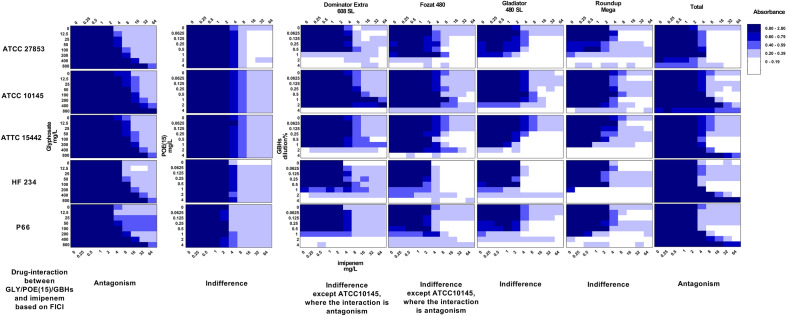
GBHs are the most widely used herbicides for weed control worldwide that potentially affect microorganisms, but the role of their sublethal exposure in the development of antibiotic resistance of Pseudomonas aeruginosa is still not fully investigated. Here, the effects of glyphosate acid (GLY), five glyphosate-based herbicides (GBHs), and POE(15), a formerly used co-formulant, on susceptibility to imipenem, a potent carbapenem-type antibiotic, in one clinical and four non-clinical environmental P. aeruginosa isolates were studied. Both pre-exposure in broth culture and co-exposure in solid media of the examined P. aeruginosa strains with 0.5% GBHs resulted in a decreased susceptibility to imipenem, while other carbapenems (doripenem and meropenem) retained their effectiveness. Additionally, the microdilution chequerboard method was used to examine additive/antagonistic/synergistic effects between GLY/POE(15)/GBHs and imipenem by determining the fractional inhibitory concentration (FIC) indexes. Based on the FIC index values, glyphosate acid and Total demonstrated a potent antagonistic effect in all P. aeruginosa strains. Dominator Extra 608 SL and Fozat 480 reduced the activity of imipenem in only one strain (ATCC10145), while POE(15) and three other GBHs did not have any effect on susceptibility to imipenem. Considering the simultaneous presence of GBHs and imipenem in various environmental niches, the detected interactions between these chemicals may affect microbial communities. The mechanisms of the glyphosate and GBH-induced imipenem resistance in P. aeruginosa are yet to be investigated.
GBHs 是全球应用最广泛的除草剂,用于杂草控制,可能会影响微生物,但它们的亚致死暴露在铜绿假单胞菌抗生素耐药性发展中的作用仍未完全研究。在这里,研究了草甘膦酸 (GLY)、五种草甘膦基除草剂 (GBHs) 和 POE(15)(以前使用的共溶剂)对一种临床和四种非临床环境铜绿假单胞菌分离株对亚胺培南(一种强效碳青霉烯类抗生素)敏感性的影响。在液体培养基中的预暴露和在固体培养基中的共暴露实验中,用 0.5%的 GBHs 处理检查的铜绿假单胞菌菌株,导致对亚胺培南的敏感性降低,而其他碳青霉烯类抗生素(多尼培南和美罗培南)保留了其有效性。此外,还使用微量稀释棋盘法通过测定部分抑菌浓度 (FIC) 指数来检查 GLY/POE(15)/GBHs 和亚胺培南之间的相加/拮抗/协同作用。根据 FIC 指数值,草甘膦酸和总草甘膦在所有铜绿假单胞菌菌株中表现出强烈的拮抗作用。Dominator Extra 608 SL 和 Fozat 480 仅在一种菌株(ATCC10145)中降低了亚胺培南的活性,而 POE(15) 和其他三种 GBHs 对亚胺培南的敏感性没有任何影响。考虑到 GBHs 和亚胺培南同时存在于各种环境小生境中,这些化学物质之间检测到的相互作用可能会影响微生物群落。草甘膦和 GBH 诱导铜绿假单胞菌对亚胺培南耐药的机制仍有待研究。