Institute of Anatomy and Cell Biology, Paracelsus Medical University, Nuremberg and Salzburg, Prof. Ernst Nathan Str. 1, 90419, Nuremberg, Germany.
Department of Biosciences and Medical Biology, Paris Lodron University Salzburg, Hellbrunnerstraße 34, 5020, Salzburg, Austria.
Histochem Cell Biol. 2023 Mar;159(3):275-292. doi: 10.1007/s00418-022-02156-3. Epub 2022 Oct 29.
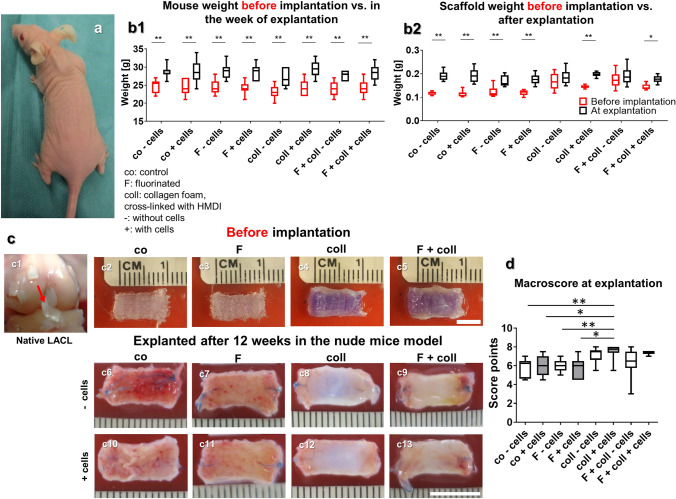
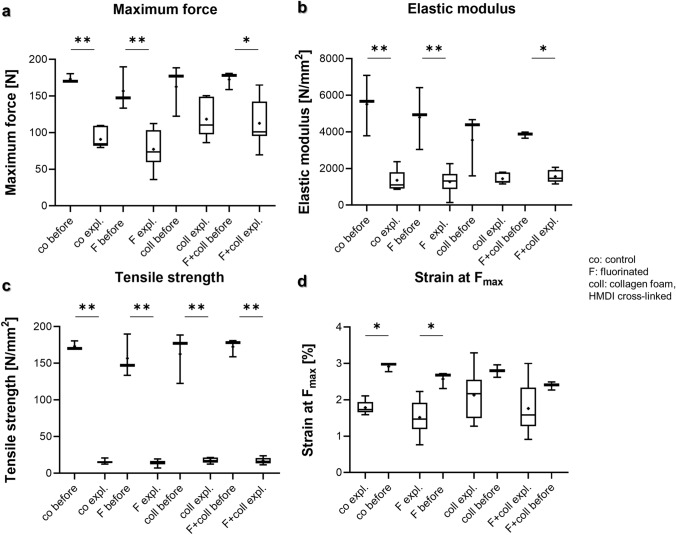
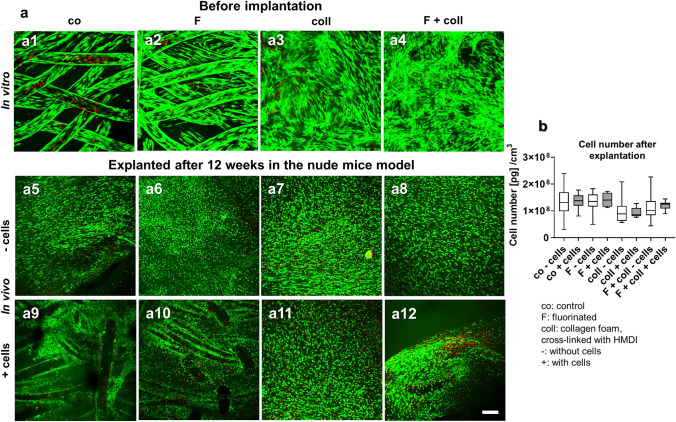
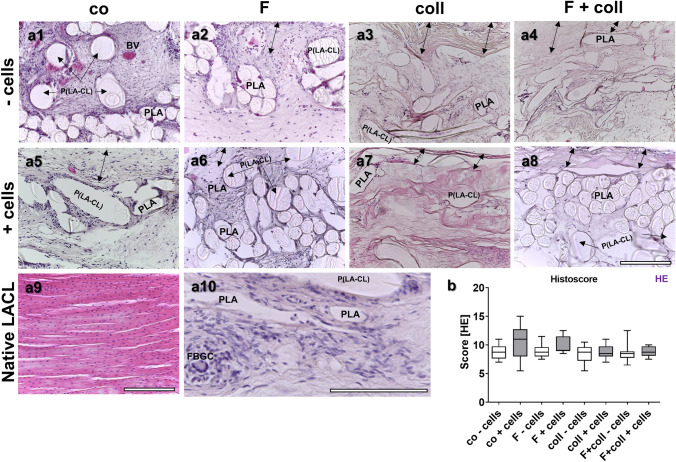
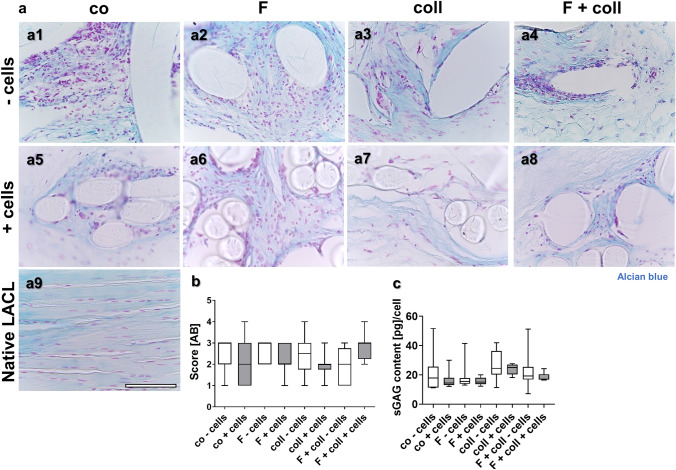
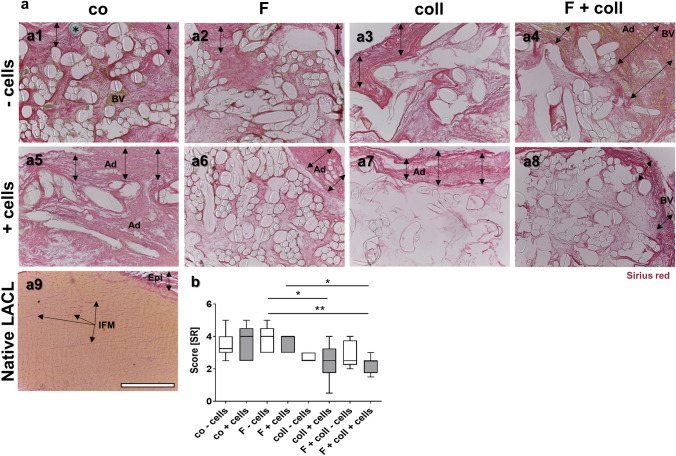
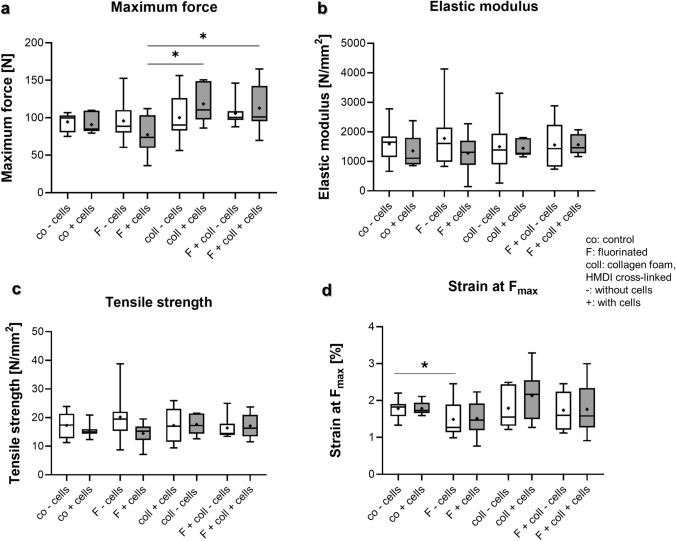
Although autografts represent the gold standard for anterior cruciate ligament (ACL) reconstruction, tissue-engineered ACLs provide a prospect to minimize donor site morbidity and limited graft availability. This study characterizes the ligamentogenesis in embroidered poly(L-lactide-co-ε-caprolactone) (P(LA-CL)) / polylactic acid (PLA) constructs using a dynamic nude mice xenograft model. (P(LA-CL))/PLA scaffolds remained either untreated (co) or were functionalized by gas fluorination (F), collagen foam cross-linked with hexamethylene diisocyanate (HMDI) (coll), or F combined with the foam (F + coll). Cell-free constructs or those seeded for 1 week with lapine ACL ligamentocytes were implanted into nude mice for 12 weeks. Following explantation, cell vitality and content, histo(patho)logy of scaffolds (including organs: liver, kidney, spleen), sulphated glycosaminoglycan (sGAG) contents and biomechanical properties were assessed.Scaffolds did not affect mice weight development and organs, indicating no organ toxicity. Moreover, scaffolds maintained their size and shape and reflected a high cell viability prior to and following implantation. Coll or F + coll scaffolds seeded with cells yielded superior macroscopic properties compared to the controls. Mild signs of inflammation (foreign-body giant cells and hyperemia) were limited to scaffolds without collagen. Microscopical score values and sGAG content did not differ significantly. Although remaining stable after explantation, elastic modulus, maximum force, tensile strength and strain at F were significantly lower in explanted scaffolds compared to those before implantation, with no significant differences between scaffold subtypes, except for a higher maximum force in F + coll compared with F samples (in vivo). Scaffold functionalization with fluorinated collagen foam provides a promising approach for ACL tissue engineering. a Lapine anterior cruciate ligament (LACL): red arrow, posterior cruciate ligament: yellow arrow. Medial anterior meniscotibial ligament: black arrow. b Explant culture to isolate LACL fibroblasts. c Scaffold variants: co: controls; F: functionalization by gas-phase fluorination; coll: collagen foam cross-linked with hexamethylene diisocyanate (HMDI). c1-2 Embroidery pattern of the scaffolds. d Scaffolds were seeded with LACL fibroblasts using a dynamical culturing approach as depicted. e Scaffolds were implanted subnuchally into nude mice, fixed at the nuchal ligament and sacrospinal muscle tendons. f Two weeks after implantation. g Summary of analyses performed. Scale bars 1 cm (b, d), 0.5 cm (c). (sketches drawn by G.S.-T. using Krita 4.1.7 [Krita foundation, The Netherlands]).
尽管自体移植物是前交叉韧带(ACL)重建的金标准,但组织工程 ACL 提供了一种减少供体部位发病率和移植物可用性有限的前景。本研究使用动态裸鼠异种移植模型来描述刺绣聚(L-丙交酯-共-ε-己内酯)(P(LA-CL))/聚乳酸(PLA)构建体中的韧带形成。(P(LA-CL))/PLA 支架保持未经处理(co)或通过气相氟化(F)、用六亚甲基二异氰酸酯(HMDI)交联的胶原泡沫(coll)、或 F 与泡沫结合(F+coll)功能化。无细胞支架或用兔 ACL 韧带细胞接种 1 周的支架被植入裸鼠中 12 周。在取出后,评估细胞活力和含量、支架的组织病理学(包括器官:肝、肾、脾)、硫酸化糖胺聚糖(sGAG)含量和生物力学特性。支架不影响小鼠体重发育和器官,表明没有器官毒性。此外,支架在植入前后保持其大小和形状,并保持高细胞活力。与对照组相比,用细胞接种的 coll 或 F+coll 支架产生了更好的宏观性能。没有胶原的支架仅出现轻微的炎症(异物巨细胞和充血)迹象。显微镜评分值和 sGAG 含量无显著差异。尽管在取出后保持稳定,但与植入前相比,植入后的支架弹性模量、最大力、拉伸强度和应变在 F 处明显降低,除了 F+coll 中的最大力高于 F 样品(体内)外,支架亚型之间没有显著差异。用氟化胶原泡沫对支架进行功能化是 ACL 组织工程的一种有前途的方法。a 兔前交叉韧带(LACL):红色箭头,后交叉韧带:黄色箭头。内侧前半月板胫骨韧带:黑色箭头。b 分离 LACL 成纤维细胞的支架培养物。c 支架变体:co:对照;F:通过气相氟化进行功能化;coll:用六亚甲基二异氰酸酯(HMDI)交联的胶原泡沫。c1-2 支架的刺绣图案。d 使用动态培养方法在 LACL 成纤维细胞上接种支架。e 将支架植入裸鼠皮下,固定在项韧带和骶棘肌腱上。f 植入后 2 周。g 进行的分析总结。比例尺 1cm(b,d),0.5cm(c)。(由 G.S.-T. 使用 Krita 4.1.7[荷兰 Krita 基金会]绘制的草图)。