Lazcano Rossana, Barreto Carmelia M, Salazar Ruth, Carapeto Fernando, Traweek Raymond S, Leung Cheuk H, Gite Swati, Mehta Jay, Ingram Davis R, Wani Khalida M, Vu Kim-Anh T, Parra Edwin R, Lu Wei, Zhou Jianling, Witt Russell G, Cope Brandon, Thirasastr Prapassorn, Lin Heather Y, Scally Christopher P, Conley Anthony P, Ratan Ravin, Livingston J Andrew, Zarzour Alexandra M, Ludwig Joseph, Araujo Dejka, Ravi Vinod, Patel Shreyaskumar, Benjamin Robert, Wargo Jennifer, Wistuba Ignacio I, Somaiah Neeta, Roland Christina L, Keung Emily Z, Solis Luisa, Wang Wei-Lien, Lazar Alexander J, Nassif Elise F
Translational Molecular Pathology, The University of Texas MD Anderson Cancer Center, Houston, TX, United States.
Surgical Oncology, The University of Texas MD Anderson Cancer Center, Houston, TX, United States.
Front Oncol. 2022 Oct 12;12:1008484. doi: 10.3389/fonc.2022.1008484. eCollection 2022.
Undifferentiated pleomorphic sarcoma (UPS) can be associated with a relatively dense immune infiltration. Immune checkpoint inhibitors (anti-PD1, anti-PDL1, and anti-CTLA4) are effective in 20% of UPS patients. We characterize the immune microenvironment of UPS and its association with oncologic outcomes.
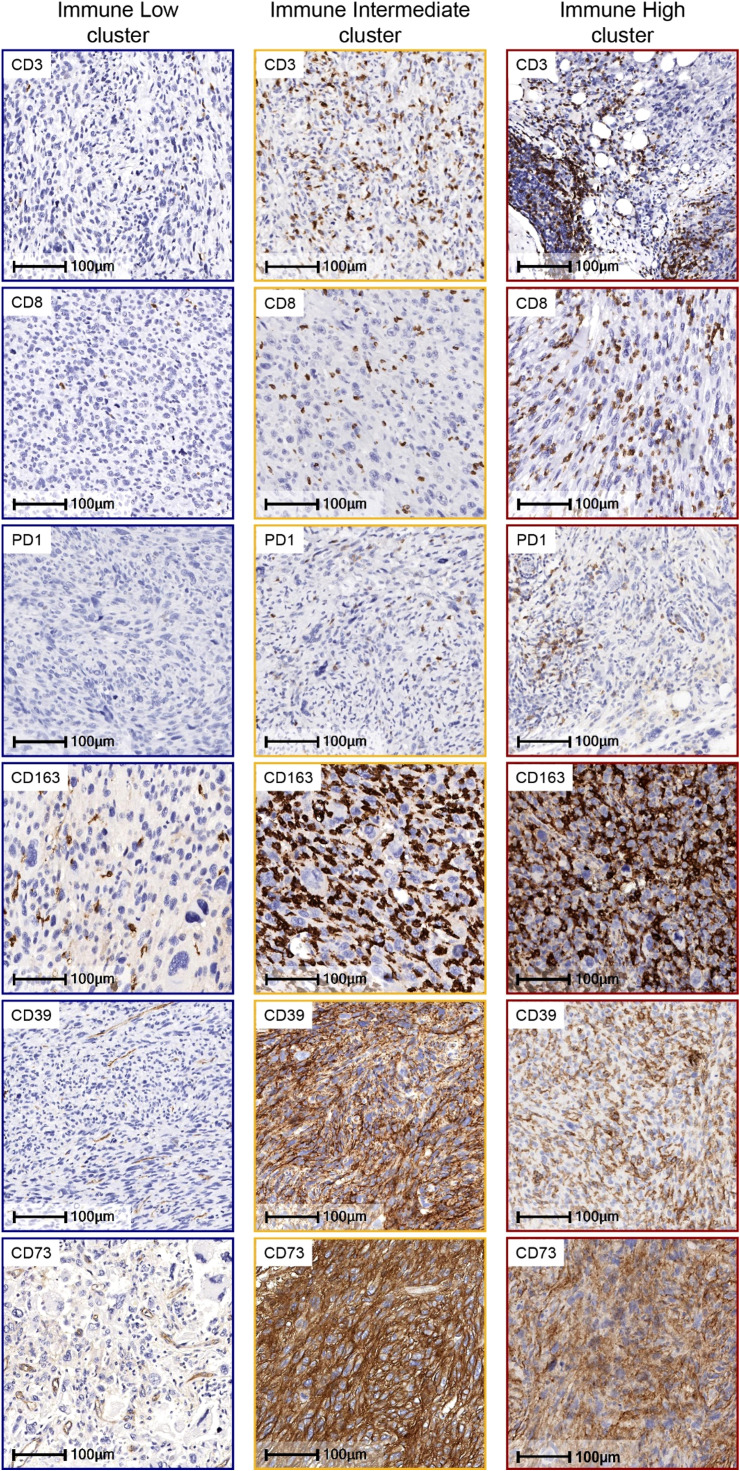
Surgically resected UPS samples were stained by immunohistochemistry (IHC) for the following: tumor-associated immune cells (CD3, CD8, CD163, CD20), immune checkpoints (stimulatory: OX40, ICOS; inhibitory: PD-L1, LAG3, IDO1, PD1), and the adenosine pathway (CD73, CD39). Sections were reviewed for the presence of lymphoid aggregates (LA). Clinical data were retrospectively obtained for all samples. The Wilcoxon rank-sum and Kruskal-Wallis tests were used to compare distributions. Correlations between biomarkers were measured by Spearman correlation. Univariate and multivariate Cox models were used to identify biomarkers associated with overall survival (OS) and disease-free survival (DFS). Unsupervised clustering was performed, and Kaplan-Meier curves and log-rank tests used for comparison of OS and DFS between immune clusters.
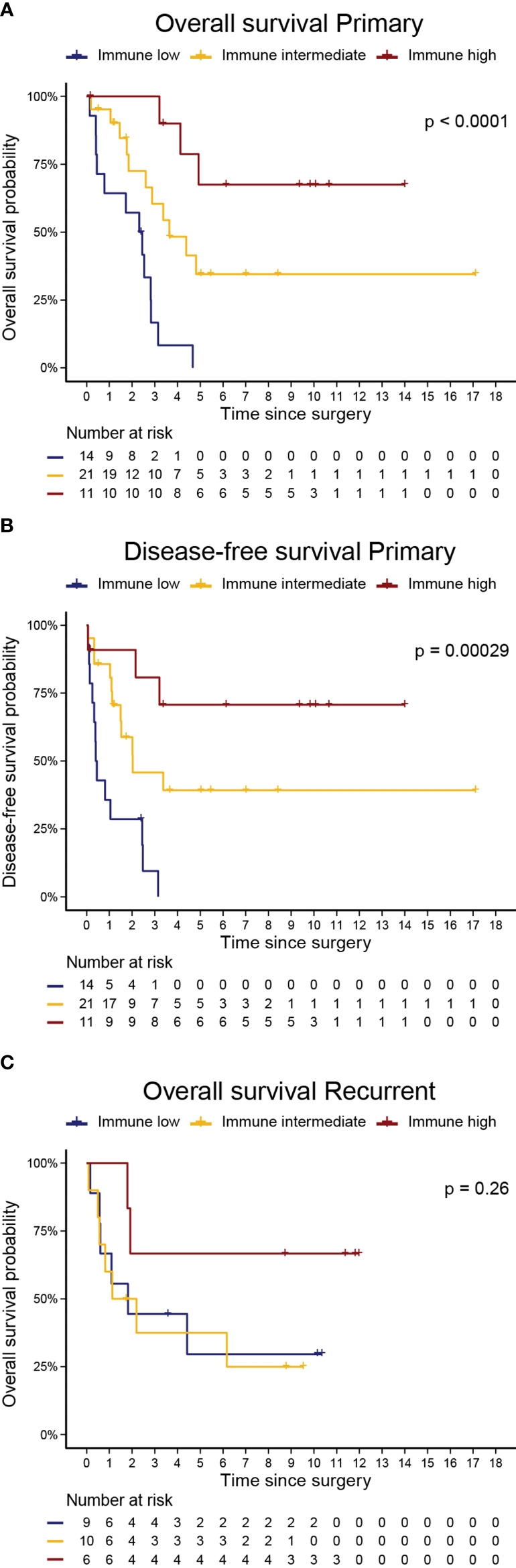
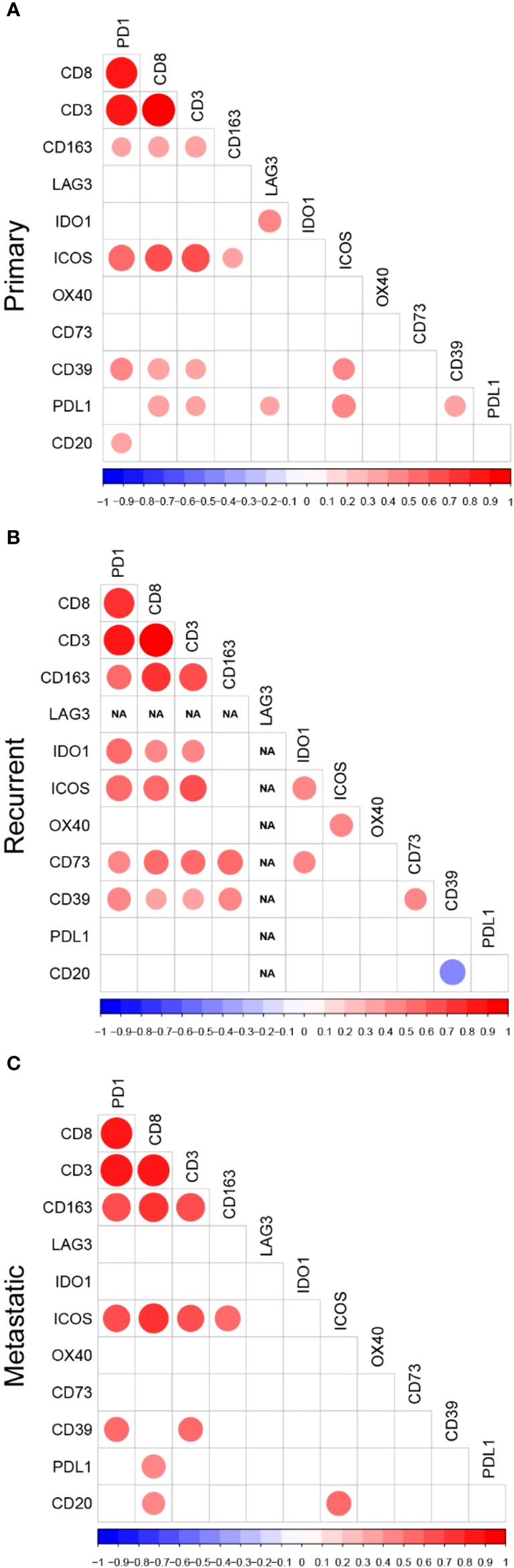
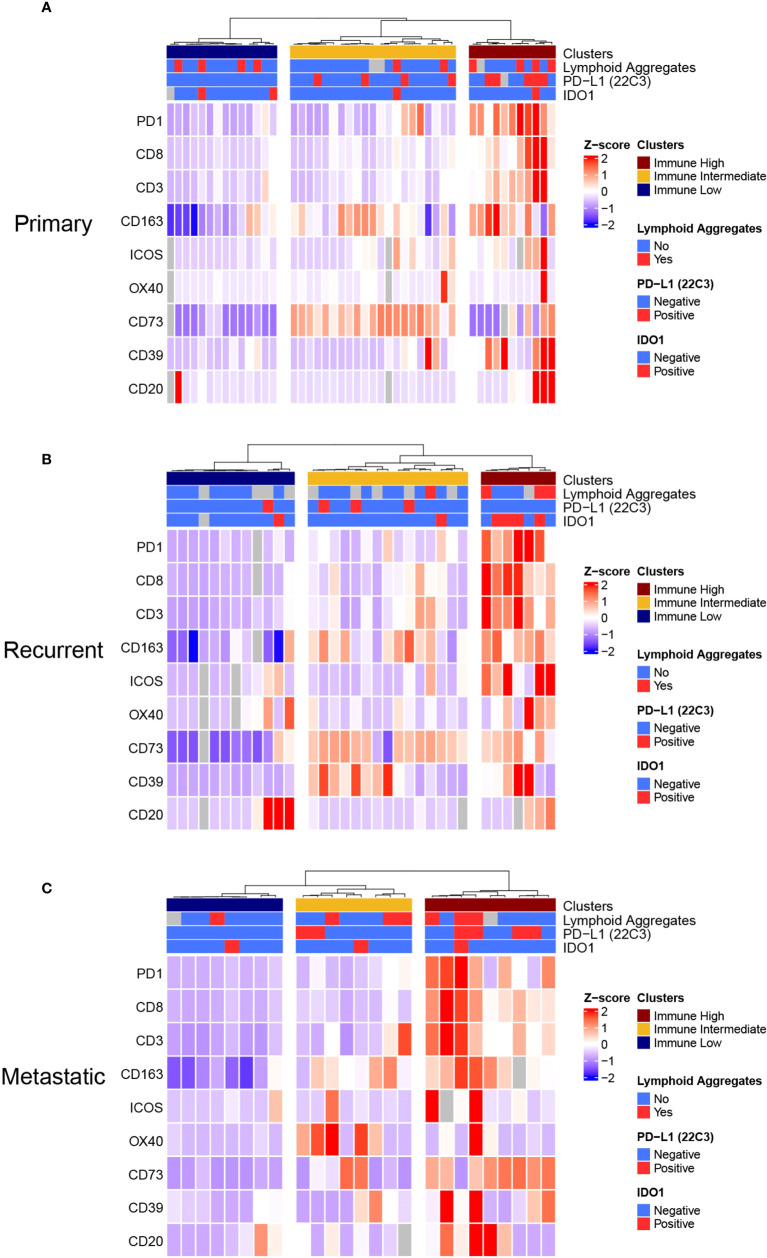
Samples analyzed (n=105) included 46 primary tumors, 34 local recurrences, and 25 metastases. LA were found in 23% (n=10/43), 17% (n=4/24), and 30% (n=7/23) of primary, recurrent, and metastatic samples, respectively. In primary UPS, CD73 expression was significantly higher after preoperative radiation therapy (=0.009). CD39 expression was significantly correlated with PD1 expression (primary: =0.002, recurrent: =0.004, metastatic: =0.001), PD-L1 expression (primary: =0.009), and CD3+ cell densities (primary: =0.016, recurrent: =0.043, metastatic: =0.028). In recurrent tumors, there was a strong correlation between CD39 and CD73 (0.015), and both were also correlated with CD163+ cell densities (CD39 0.013; CD73 0.001). In multivariate analyses, higher densities of CD3+ and CD8+ cells (Cox Hazard Ratio [HR]=0.33; =0.010) were independently associated with OS (CD3+, HR=0.19, <0.001; CD8+, HR= 0.33, =0.010) and DFS (CD3+, HR=0.34, =0.018; CD8+, HR=0.34, = 0.014). Unsupervised clustering of IHC values revealed three immunologically distinct clusters: immune high, intermediate, and low. In primary tumors, these clusters were significantly associated with OS (log-rank <0.0001) and DFS (<0.001).
We identified three immunologically distinct clusters of UPS Associated with OS and DFS. Our data support further investigations of combination anti-PD-1/PD-L1 and adenosine pathway inhibitors in UPS.
未分化多形性肉瘤(UPS)可能与相对密集的免疫浸润有关。免疫检查点抑制剂(抗PD1、抗PDL1和抗CTLA4)在20%的UPS患者中有效。我们对UPS的免疫微环境及其与肿瘤学结局的关联进行了表征。
对手术切除的UPS样本进行免疫组织化学(IHC)染色,检测以下指标:肿瘤相关免疫细胞(CD3、CD8、CD163、CD20)、免疫检查点(刺激性:OX40、ICOS;抑制性:PD-L1、LAG3、IDO1、PD1)以及腺苷途径(CD73、CD39)。检查切片中是否存在淋巴样聚集物(LA)。回顾性获取所有样本的临床数据。采用Wilcoxon秩和检验和Kruskal-Wallis检验比较分布情况。通过Spearman相关性分析测量生物标志物之间的相关性。使用单变量和多变量Cox模型识别与总生存期(OS)和无病生存期(DFS)相关的生物标志物。进行无监督聚类,并使用Kaplan-Meier曲线和对数秩检验比较免疫簇之间的OS和DFS。
分析的样本(n = 105)包括46例原发性肿瘤、34例局部复发肿瘤和25例转移瘤。LA分别在23%(n = 10/43)的原发性样本、17%(n = 4/24)的复发样本和30%(n = 7/23)的转移样本中被发现。在原发性UPS中,术前放疗后CD73表达显著升高(P = 0.009)。CD39表达与PD1表达显著相关(原发性:P = 0.002,复发性:P = 0.004,转移性:P = 0.001)、与PD-L1表达(原发性:P = 0.009)以及CD3 + 细胞密度(原发性:P = 0.016,复发性:P = 0.043,转移性:P = 0.028)显著相关。在复发性肿瘤中,CD39与CD73之间存在强相关性(P = 0.015),且二者均与CD163 + 细胞密度相关(CD39,P = 0.013;CD73,P = 0.001)。在多变量分析中,较高密度的CD3 + 和CD(8 +)细胞(Cox风险比[HR] = 0.33;P = 0.010)与OS独立相关(CD3 +,HR = 0.19,P < 0.001;CD8 +,HR = 0.33,P = 0.010)和DFS(CD3 +,HR = 0.34,P = 0.018;CD8 +,HR = 0.34,P = 0.014)。对IHC值进行无监督聚类揭示了三个免疫上不同的簇:免疫高、中、低。在原发性肿瘤中,这些簇与OS(对数秩,P < 0.0001)和DFS(P < 0.001)显著相关。
我们识别出了与OS和DFS相关的三个免疫上不同的UPS簇。我们的数据支持进一步研究在UPS中联合使用抗PD-1/PD-L1和腺苷途径抑制剂。