Cancer Genetics Laboratory, Peter MacCallum Cancer Centre, Melbourne, Victoria, Australia.
Drug Discovery Biology, Monash Institute of Pharmaceutical Sciences, Monash University, Melbourne, Victoria, Australia.
J Natl Cancer Inst. 2023 Feb 8;115(2):181-189. doi: 10.1093/jnci/djac196.
Breast cancers (BCs) that arise in individuals heterozygous for a germline pathogenic variant in a susceptibility gene, such as BRCA1 and BRCA2, PALB2, and RAD51C, have been shown to exhibit biallelic loss in the respective genes and be associated with triple-negative breast cancer (TNBC) and distinctive somatic mutational signatures. Tumor sequencing thus presents an orthogonal approach to assess the role of candidate genes in BC development.
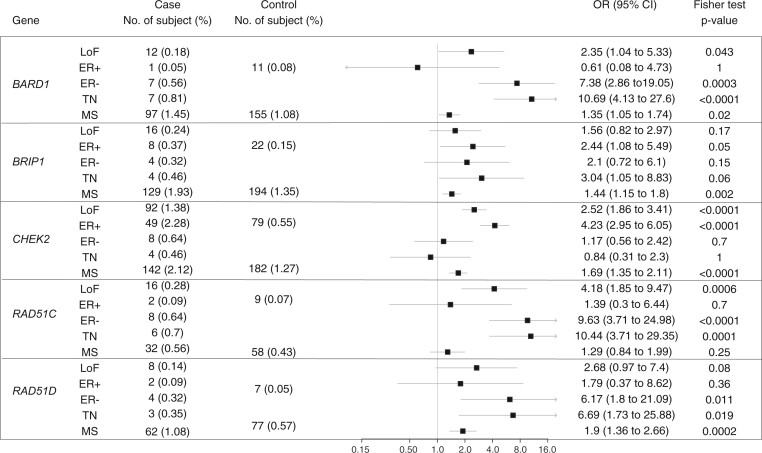
Exome sequencing was performed on paired normal-breast tumor DNA from 124 carriers of germline loss-of-function (LoF) or missense variant carriers in 15 known and candidate BC predisposition genes identified in the BEACCON case-control study. Biallelic inactivation and association with tumor genome features including mutational signatures and homologous recombination deficiency (HRD) score were investigated.
BARD1-carrying TNBC (4 of 5) displayed biallelic loss and associated high HRD scores and mutational signature 3, as did a RAD51D-carrying TNBC and ovarian cancer. Biallelic loss was less frequent in BRIP1 BCs (4 of 13) and had low HRD scores. In contrast to other established BC genes, BCs from carriers of CHEK2 LoF (6 of 17) or missense (2 of 20) variant had low rates of biallelic loss. Exploratory analysis of BC from carriers of LoF variants in candidate genes such as BLM, FANCM, PARP2, and RAD50 found little evidence of biallelic inactivation.
BARD1 and RAD51D behave as classic BRCA-like predisposition genes with biallelic inactivation, but this was not observed for any of the candidate genes. However, as demonstrated for CHEK2, the absence of biallelic inactivation does not provide definitive evidence against the gene's involvement in BC predisposition.
在携带有种系致病性变异体的个体中发生的乳腺癌(BC),例如 BRCA1 和 BRCA2、PALB2 和 RAD51C 等易感基因,已经显示出相应基因的双等位基因缺失,并与三阴性乳腺癌(TNBC)和独特的体细胞突变特征相关。因此,肿瘤测序提供了一种评估候选基因在 BC 发展中作用的正交方法。
在 BEACCON 病例对照研究中确定的 15 个已知和候选 BC 易感性基因中,对 124 名种系功能丧失(LoF)或错义变异携带者的配对正常乳腺肿瘤 DNA 进行外显子组测序。研究了双等位基因失活与肿瘤基因组特征(包括突变特征和同源重组缺陷(HRD)评分)的关联。
携带 BARD1 的 TNBC(5 例中的 4 例)显示出双等位基因缺失,并与高 HRD 评分和突变特征 3 相关,携带 RAD51D 的 TNBC 和卵巢癌也是如此。BRIP1 BC 中双等位基因缺失较少(13 例中的 4 例),且 HRD 评分较低。与其他已确立的 BC 基因相比,携带 CHEK2 LoF(17 例中的 6 例)或错义(20 例中的 2 例)变体的 BC 中双等位基因缺失的发生率较低。对候选基因(如 BLM、FANCM、PARP2 和 RAD50)中 LoF 变体携带者的 BC 进行探索性分析,发现双等位基因失活的证据很少。
BARD1 和 RAD51D 表现为经典的 BRCA 样易感性基因,具有双等位基因失活,但候选基因中没有观察到这种情况。然而,如 CHEK2 所示,双等位基因失活的缺失并不能提供该基因参与 BC 易感性的明确证据。