Population Health Program, QIMR Berghofer Medical Research Institute, Brisbane, QLD 4006, Australia.
Biostatistics Unit, The Cyprus Institute of Neurology and Genetics, Nicosia 2371, Cyprus; Centre for Cancer Genetic Epidemiology, Department of Public Health and Primary Care, University of Cambridge, Cambridge CB1 8RN, UK.
Am J Hum Genet. 2024 Sep 5;111(9):2059-2069. doi: 10.1016/j.ajhg.2024.07.004. Epub 2024 Aug 2.
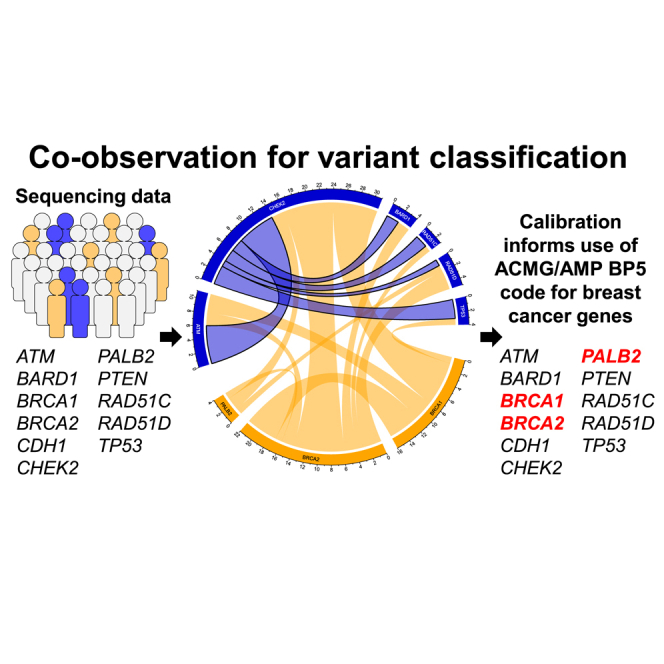
Co-observation of a gene variant with a pathogenic variant in another gene that explains the disease presentation has been designated as evidence against pathogenicity for commonly used variant classification guidelines. Multiple variant curation expert panels have specified, from consensus opinion, that this evidence type is not applicable for the classification of breast cancer predisposition gene variants. Statistical analysis of sequence data for 55,815 individuals diagnosed with breast cancer from the BRIDGES sequencing project was undertaken to formally assess the utility of co-observation data for germline variant classification. Our analysis included expected loss-of-function variants in 11 breast cancer predisposition genes and pathogenic missense variants in BRCA1, BRCA2, and TP53. We assessed whether co-observation of pathogenic variants in two different genes occurred more or less often than expected under the assumption of independence. Co-observation of pathogenic variants in each of BRCA1, BRCA2, and PALB2 with the remaining genes was less frequent than expected. This evidence for depletion remained after adjustment for age at diagnosis, study design (familial versus population-based), and country. Co-observation of a variant of uncertain significance in BRCA1, BRCA2, or PALB2 with a pathogenic variant in another breast cancer gene equated to supporting evidence against pathogenicity following criterion strength assignment based on the likelihood ratio and showed utility in reclassification of missense BRCA1 and BRCA2 variants identified in BRIDGES. Our approach has applicability for assessing the value of co-observation as a predictor of variant pathogenicity in other clinical contexts, including for gene-specific guidelines developed by ClinGen Variant Curation Expert Panels.
共同观察另一个基因中的致病性变异与一个基因变异,已被指定为反对常用变异分类指南致病性的证据。多个变异校正专家小组从共识意见中指定,这种证据类型不适用于乳腺癌易感性基因变异的分类。对来自 BRIDGES 测序项目的 55815 名被诊断患有乳腺癌的个体的序列数据进行了统计分析,以正式评估共同观察数据在种系变异分类中的效用。我们的分析包括 11 个乳腺癌易感性基因中的预期失功能变异和 BRCA1、BRCA2 和 TP53 中的致病性错义变异。我们评估了在假设独立性的情况下,两个不同基因中的致病性变异是否比预期更频繁或更不频繁地共同观察到。BRCA1、BRCA2 和 PALB2 中每种基因的致病性变异的共同观察比预期的要少。在调整诊断时的年龄、研究设计(家族性与基于人群)和国家后,这种耗竭的证据仍然存在。在 BRCA1、BRCA2 或 PALB2 中的意义不明的变异与另一个乳腺癌基因中的致病性变异共同观察,与基于似然比的致病性分配标准的支持证据相当,并显示出在 BRIDGES 中确定的 BRCA1 和 BRCA2 错义变异的重新分类中的效用。我们的方法适用于评估共同观察作为其他临床情况下变异致病性预测因子的价值,包括 ClinGen 变异校正专家小组制定的基因特异性指南。