
2022年毛里塔尼亚克里米亚-刚果出血热病例调查
Investigation Around Cases of Crimean-Congo Hemorrhagic Fever-Mauritania, 2022.
作者信息
Boushab Boushab Mohamed, Yanogo Pauline K, Barry Djibril, Benane Hacen Ahmed, El Bara Ahmed, Abdellah Moussa, Basco Leonardo K, Meda Nicolas
机构信息
Department of Internal Medicine and Infectious Diseases, Kiffa Hospital Center, Kiffa, Assaba, Mauritania.
Burkina Field Epidemiology and Laboratory Training Program, Université Joseph Ki-Zerbo, Ouagadougou, Burkina Faso.
出版信息
Open Forum Infect Dis. 2022 Oct 12;9(10):ofac534. doi: 10.1093/ofid/ofac534. eCollection 2022 Oct.
BACKGROUND
Crimean-Congo hemorrhagic fever (CCHF) is a zoonotic arbovirosis. Humans are infected by tick bites or contact with blood of infected animals. CCHF can be responsible for severe outbreaks due to human-to-human transmission. Our aims were to increase awareness and promote the search for risk factors and disease monitoring to prevent CCHF epidemic, capacity building, appropriate measures to treat patients, and information for the local population.
METHODS
During the outbreak of hemorrhagic fever from February to May 2022, blood samples were collected from 88 patients suspected to be infected with the virus. Diagnosis was established by reverse-transcription polymerase chain reaction (RT-PCR) and/or enzyme-linked immunosorbent assay.
RESULTS
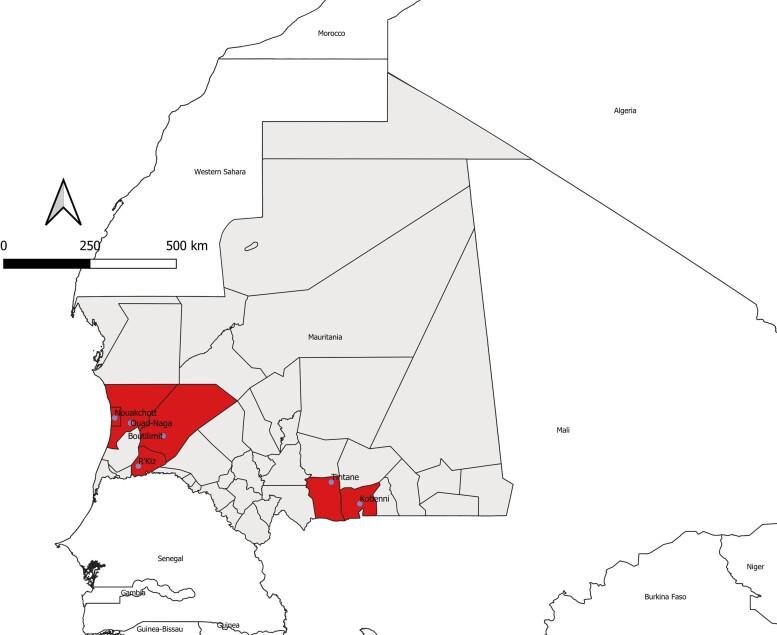
CCHF was confirmed by RT-PCR in 7 of 88 (8%) patients. Ticks were found in cattle, sheep, or goats in the areas where the subjects resided, with the exception of 1 CCHF-positive patient in close contact with fresh animal meat. Exposure to potential risk factors was found in all patients. The interval between the onset of symptoms and hospital admission was 2-3 days. All 7 patients were admitted to our hospital and treated promptly by blood transfusion. Two patients died.
CONCLUSIONS
Mortality is high in patients with the hemorrhagic form of CCHF. Disease prevention is necessary by strengthening vector control, avoiding contact and consumption of organic products from diseased animals, and vaccinating animals in areas where the disease is endemic. Furthermore, it is essential to establish management procedures for patients infected with CCHF virus.
背景
克里米亚-刚果出血热(CCHF)是一种人畜共患的虫媒病毒病。人类通过蜱叮咬或接触受感染动物的血液而感染。由于人际传播,CCHF可导致严重疫情。我们的目标是提高认识,促进对危险因素的寻找和疾病监测以预防CCHF流行,加强能力建设,采取适当的患者治疗措施,并为当地居民提供信息。
方法
在2022年2月至5月的出血热疫情期间,从88名疑似感染该病毒的患者中采集了血样。通过逆转录聚合酶链反应(RT-PCR)和/或酶联免疫吸附测定进行诊断。
结果
88名患者中有7名(8%)通过RT-PCR确诊为CCHF。在受试者居住地区的牛、羊或山羊身上发现了蜱虫,有1名CCHF阳性患者与新鲜动物肉密切接触除外。所有患者均发现有潜在危险因素暴露。症状出现至入院的间隔时间为2至3天。所有7名患者均入院并立即接受输血治疗。2名患者死亡。
结论
CCHF出血热形式患者的死亡率很高。通过加强病媒控制、避免接触和食用患病动物的有机产品以及在疾病流行地区给动物接种疫苗来预防疾病是必要的。此外,建立感染CCHF病毒患者的管理程序至关重要。
 Zotero 插件