Lu Xiaoyan, Jin Yanyan, Wang Yuzhen, Chen Yunlong, Fan Xiaohui
Pharmaceutical Informatics Institute, College of Pharmaceutical Sciences, Zhejiang University, Hangzhou, 310058, China.
Innovation Center in Zhejiang University, State Key Laboratory of Component-Based Chinese Medicine, Hangzhou, 310058, China.
J Pharm Anal. 2022 Oct;12(5):701-710. doi: 10.1016/j.jpha.2022.05.001. Epub 2022 May 16.
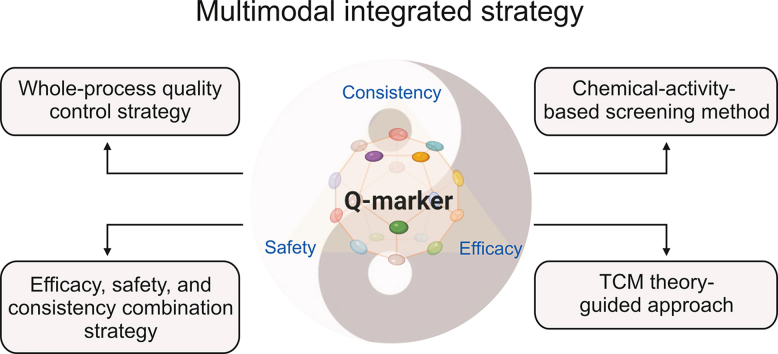
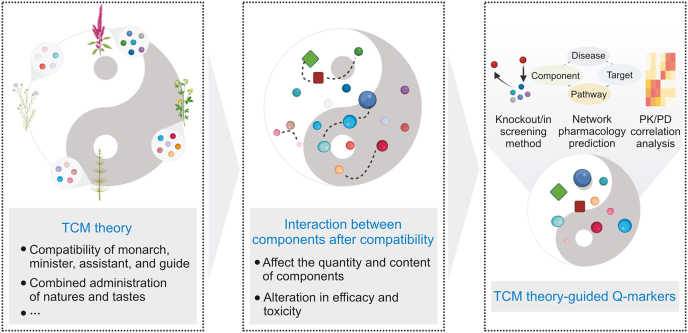
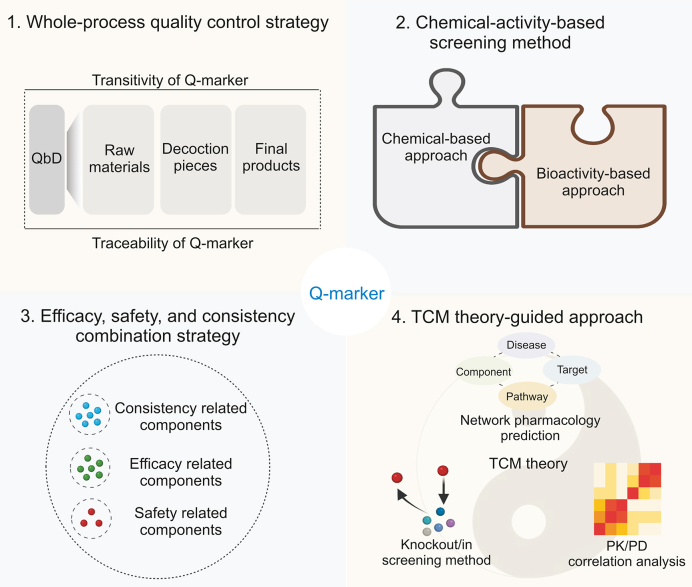
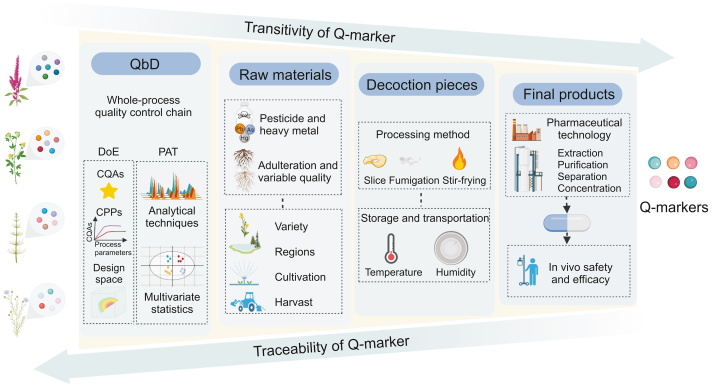
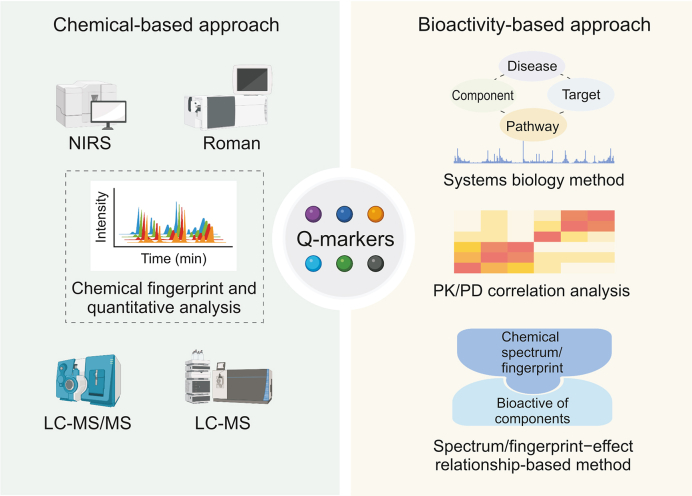
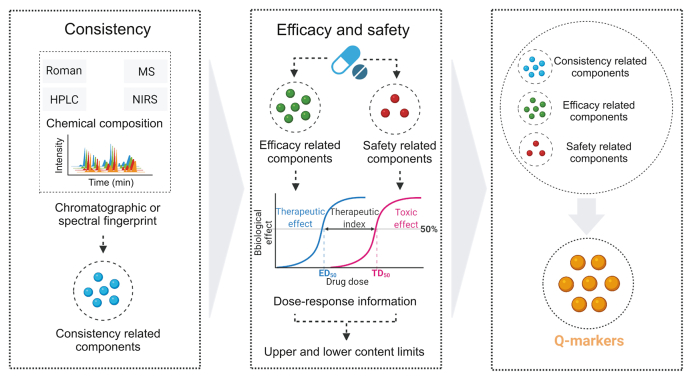
With the modernization and internationalization of traditional Chinese medicine (TCM), the requirement for quality control has increased. The quality marker (Q-marker) is an important standard in this field and has been implemented with remarkable success in recent years. However, the establishment of Q-markers remains fragmented and the process lacks systematicity, resulting in inconsistent quality control and insufficient correlation with clinical efficacy and safety of TCM. This review introduces four multimodal integrated approaches that contribute to the discovery of more comprehensive and accurate Q-markers, thus aiding in the establishment of new quality control patterns based on the characteristics and principles of TCM. These include the whole-process quality control strategy, chemical-activity-based screening method, efficacy, safety, and consistent combination strategy, and TCM theory-guided approach. Furthermore, methodologies and representative examples of these strategies are described, and important future directions and questions in this field are also proposed.
随着中医药的现代化和国际化,对质量控制的要求不断提高。质量标志物(Q-标志物)是该领域的一项重要标准,近年来已取得显著成效。然而,Q-标志物的建立仍较为零散,过程缺乏系统性,导致中医药质量控制不一致,且与临床疗效和安全性的相关性不足。本综述介绍了四种多模态综合方法,有助于发现更全面、准确的Q-标志物,从而基于中医药的特点和原则建立新的质量控制模式。这些方法包括全过程质量控制策略、基于化学活性的筛选方法、疗效、安全性和一致性组合策略以及中医药理论指导方法。此外,还描述了这些策略的方法和代表性实例,并提出了该领域未来的重要方向和问题。