Yamada Yasunori, Shinkawa Kaoru, Nemoto Miyuki, Ota Miho, Nemoto Kiyotaka, Arai Tetsuaki
Digital Health IBM Research Chuo-ku Tokyo Japan.
Department of Psychiatry Division of Clinical Medicine Faculty of Medicine University of Tsukuba Tsukuba Ibaraki Japan.
Alzheimers Dement (Amst). 2022 Oct 27;14(1):e12364. doi: 10.1002/dad2.12364. eCollection 2022.
Early differential diagnosis of Alzheimer's disease (AD) and dementia with Lewy bodies (DLB) is important, but it remains challenging. Different profiles of speech and language impairments between AD and DLB have been suggested, but direct comparisons have not been investigated.
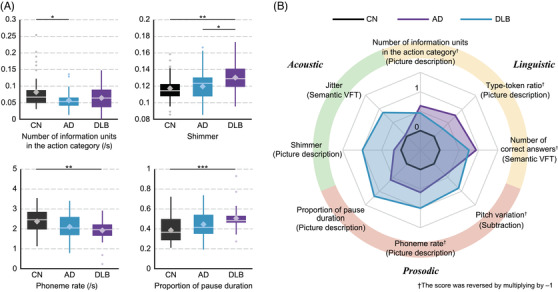
We collected speech responses from 121 older adults comprising AD, DLB, and cognitively normal (CN) groups and investigated their acoustic, prosodic, and linguistic features.
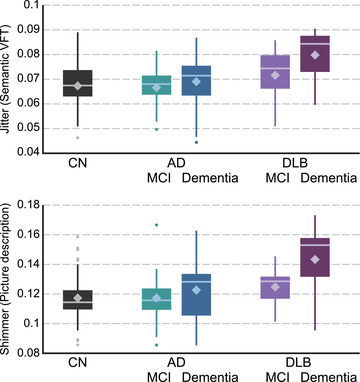
The AD group showed larger differences from the CN group than the DLB group in linguistic features, while the DLB group showed larger differences in prosodic and acoustic features. Machine-learning classifiers using these speech features achieved 87.0% accuracy for AD versus CN, 93.2% for DLB versus CN, and 87.4% for AD versus DLB.
Our findings indicate the discriminative differences in speech features in AD and DLB and the feasibility of using these features in combination as a screening tool for identifying/differentiating AD and DLB.
阿尔茨海默病(AD)和路易体痴呆(DLB)的早期鉴别诊断很重要,但仍然具有挑战性。已有研究表明AD和DLB在言语和语言障碍方面存在不同特征,但尚未进行直接比较。
我们收集了121名老年人的言语反应,这些老年人分为AD组、DLB组和认知正常(CN)组,并研究了他们的声学、韵律和语言特征。
在语言特征方面,AD组与CN组的差异比DLB组与CN组的差异更大,而DLB组在韵律和声学特征方面的差异更大。使用这些言语特征的机器学习分类器在AD与CN的分类中准确率达到87.0%,在DLB与CN的分类中准确率达到93.2%,在AD与DLB的分类中准确率达到87.4%。
我们的研究结果表明AD和DLB在言语特征上存在可区分的差异,并且将这些特征结合起来作为识别/区分AD和DLB的筛查工具具有可行性。