Stevens Benson W, Morris James K, Diazgranados Nancy, Ramchandani Vijay A
Human Psychopharmacology Laboratory, Division of Intramural Clinical and Biological Research, National Institute on Alcohol Abuse and Alcoholism, Bethesda, Maryland.
Office of the Clinical Director, National Institute on Alcohol Abuse and Alcoholism, Bethesda, Maryland.
Biol Psychiatry Glob Open Sci. 2021 Nov 27;2(4):421-431. doi: 10.1016/j.bpsgos.2021.11.010. eCollection 2022 Oct.
Though compulsive drinking is a hallmark of alcohol use disorder (AUD), little is known of the neural mechanisms driving this behavior. To further the understanding of the neural underpinnings of this compulsivity, a meta-analytic approach was used to examine gray matter (GM) volume differences related to AUD, and contrast these differences with GM volume differences in obsessive-compulsive disorder (OCD), to find common underlying regional brain differences.
We systematically meta-analyzed case-control studies investigating GM volume that used whole-brain voxel-based morphometry separately for AUD and OCD and then directly compared the results of both. Seed-based Mapping software was used to perform the meta-analyses.
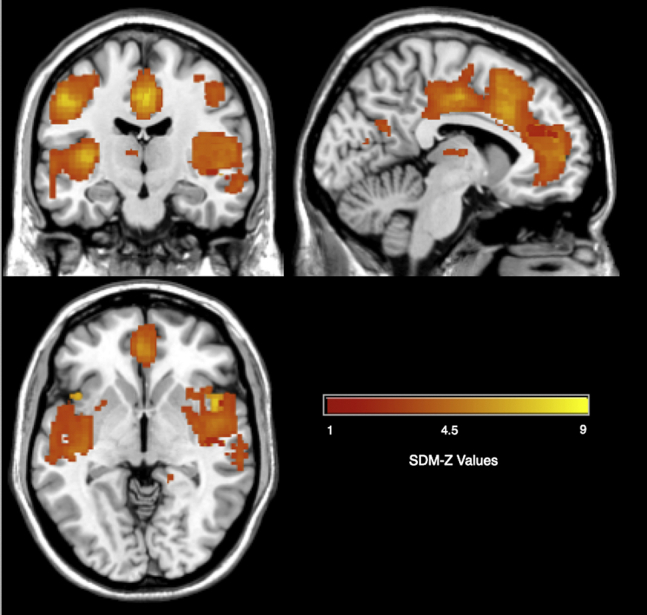
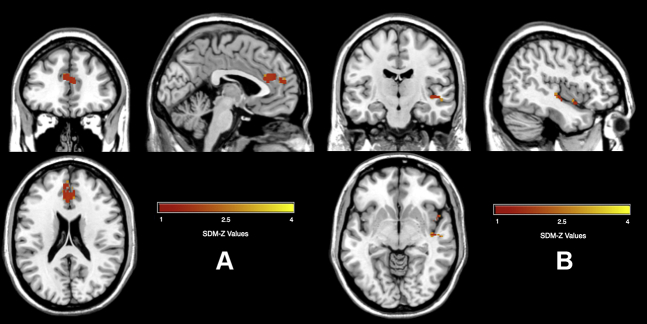
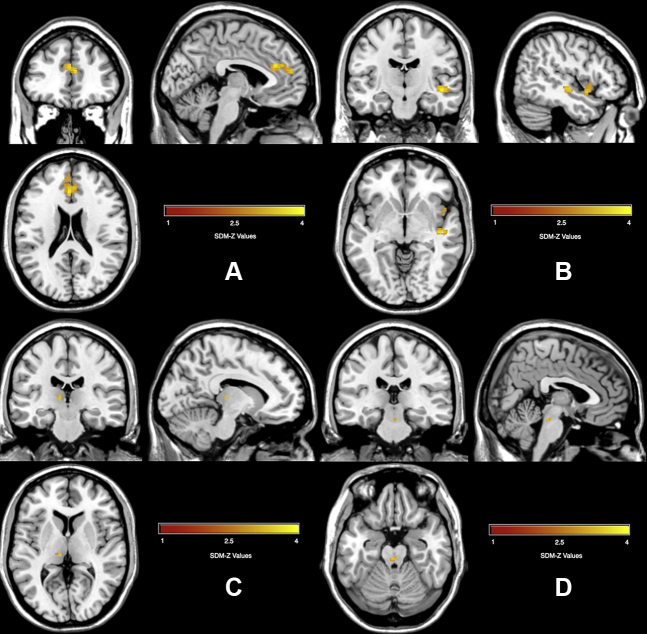
The AUD meta-analysis used 19 citations, with 736 individuals with AUD and 827 control individuals. The OCD meta-analysis had 25 citations, with 995 individuals with OCD and 1177 control individuals. The AUD group showed decreased GM in areas including frontal, limbic, temporal, and cerebellar regions. The OCD group had decreased GM in frontal and insular regions but increases in the hypothalamus and brainstem. Importantly, the main outcome showed that both groups had decreased GM overlapping in the anterior cingulate cortex and insula. Brain regions were .05 corrected.
Common brain regional differences in the anterior cingulate cortex and insula that overlap between AUD and OCD suggest that interventions targeting these regions could prove to be beneficial in treating compulsive drinking related to AUD. Further research into the functional role of these brain regions in the etiology of compulsive drinking in AUD is warranted.
尽管强迫性饮酒是酒精使用障碍(AUD)的一个标志,但对于驱动这种行为的神经机制知之甚少。为了进一步了解这种强迫行为的神经基础,采用了荟萃分析方法来研究与AUD相关的灰质(GM)体积差异,并将这些差异与强迫症(OCD)中的GM体积差异进行对比,以找出潜在的共同脑区差异。
我们系统地荟萃分析了调查GM体积的病例对照研究,这些研究分别对AUD和OCD使用基于全脑体素的形态测量法,然后直接比较两者的结果。使用基于种子的映射软件进行荟萃分析。
AUD的荟萃分析使用了19篇文献,其中有736名AUD患者和827名对照个体。OCD的荟萃分析有25篇文献,其中有995名OCD患者和1177名对照个体。AUD组在包括额叶、边缘叶、颞叶和小脑区域的GM减少。OCD组在额叶和岛叶区域的GM减少,但下丘脑和脑干增加。重要的是,主要结果表明两组在前扣带回皮质和岛叶的GM重叠减少。脑区经.05校正。
AUD和OCD之间在前扣带回皮质和岛叶存在的共同脑区差异表明,针对这些区域的干预措施可能对治疗与AUD相关的强迫性饮酒有益。有必要进一步研究这些脑区在AUD强迫性饮酒病因中的功能作用。