Gupta Mamta, Wong Matthew, Jawed Kamran, Gedeon Kamil, Barrett Hannah, Bassalo Marcelo, Morrison Clifford, Eqbal Danish, Yazdani Syed Shams, Gill Ryan T, Huang Jiaqi, Douaisi Marc, Dordick Jonathan, Belfort Georges, Koffas Mattheos A G
Howard P. Isermann Department of Chemical and Biological Engineering, Rensselaer Polytechnic Institute, Troy, NY, 12180, USA.
Department of Botany and Environmental Studies, DAV University, Jalandhar, 144 001, Punjab, India.
Metab Eng Commun. 2022 Oct 23;15:e00210. doi: 10.1016/j.mec.2022.e00210. eCollection 2022 Dec.
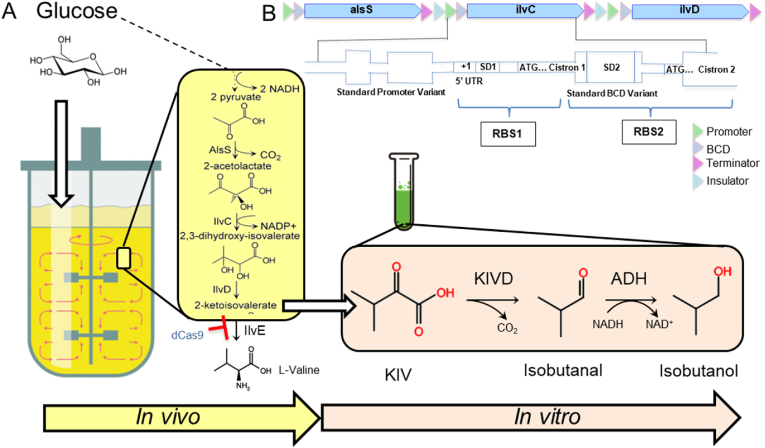
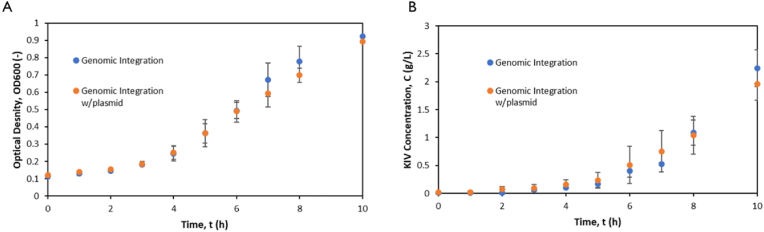
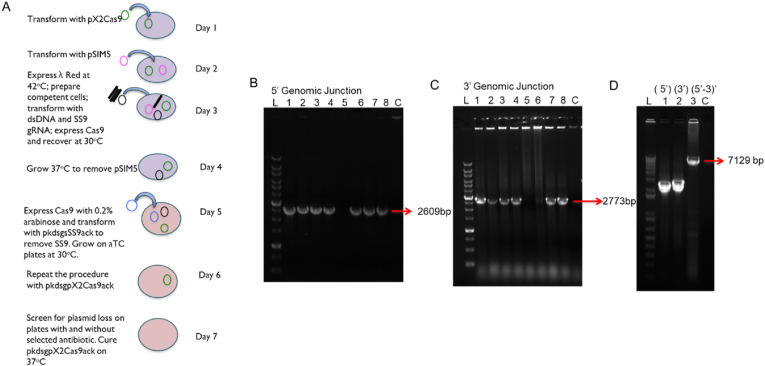
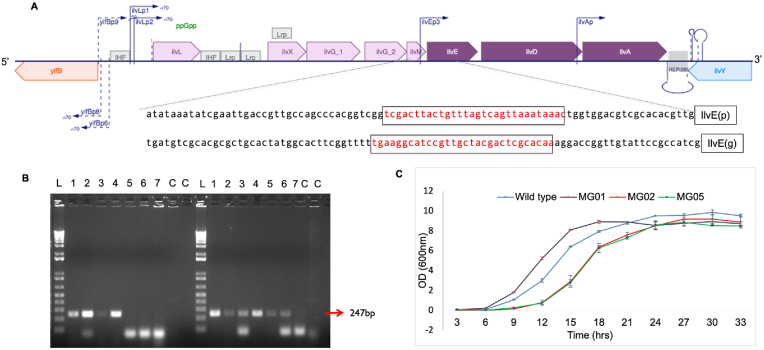
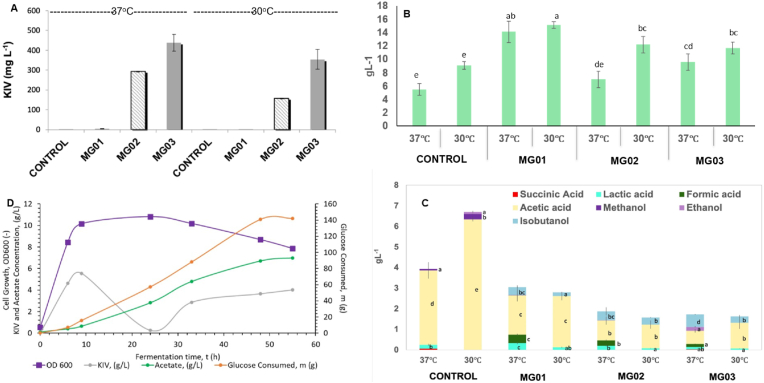
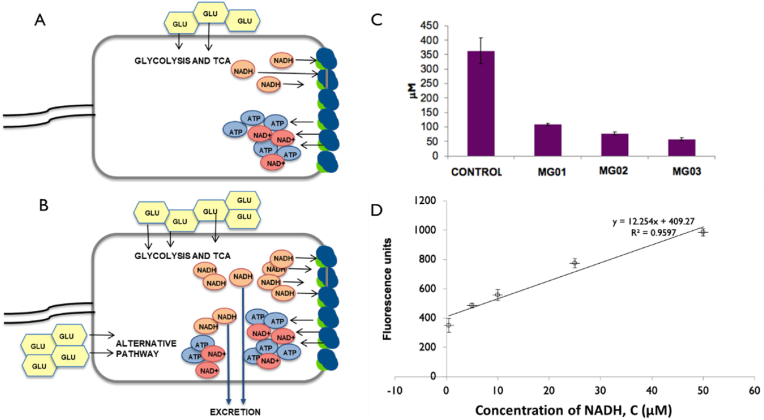
The production of the biofuel, isobutanol, in faces limitations due to alcohol toxicity, product inhibition, product recovery, and long-term industrial feasibility. Here we demonstrate an approach of combining both with metabolic engineering to produce isobutanol. The production of α-ketoisovalerate (KIV) was conducted through CRISPR mediated integration of the KIV pathway in bicistronic design (BCD) in and inhibition of competitive valine pathway using CRISPRi technology. The subsequent conversion to isobutanol was carried out with engineered enzymes for 2-ketoacid decarboxylase (KIVD) and alcohol dehydrogenase (ADH). For the production of KIV and subsequent production of isobutanol, this two-step serial approach resulted in yields of 56% and 93%, productivities of 0.62 and 0.074 g L h, and titers of 5.6 and 1.78 g L, respectively. Thus, this combined biosynthetic system can be used as a modular approach for producing important metabolites, like isobutanol, without the limitations associated with production using a consolidated bioprocess.
由于酒精毒性、产物抑制、产物回收以及长期工业可行性等问题,生物燃料异丁醇的生产面临诸多限制。在此,我们展示了一种将[具体内容1]与代谢工程相结合来生产异丁醇的方法。通过CRISPR介导的α-酮异戊酸(KIV)途径在[具体内容2]的双顺反子设计(BCD)中的整合以及利用CRISPRi技术抑制竞争性缬氨酸途径来进行KIV的生产。随后,使用工程化的2-酮酸脱羧酶(KIVD)和醇脱氢酶(ADH)将KIV转化为异丁醇。对于KIV的生产以及随后异丁醇的生产,这种两步串联方法的产率分别为56%和93%,生产率分别为0.62和0.074 g L h,滴度分别为5.6和1.78 g L。因此,这种组合的生物合成系统可作为一种模块化方法来生产重要代谢产物,如异丁醇,而不存在使用整合生物过程生产[具体内容3]所带来的限制。