Imai Shin-Ichiro
Department of Developmental Biology, Washington University School of Medicine, St Louis, MO, USA.
NPJ Syst Biol Appl. 2016 Aug 18;2:16018. doi: 10.1038/npjsba.2016.18. eCollection 2016.
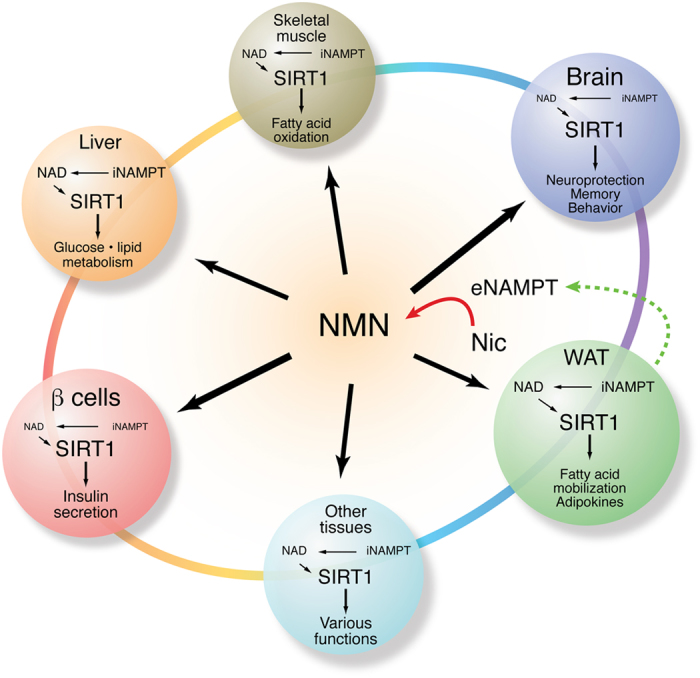
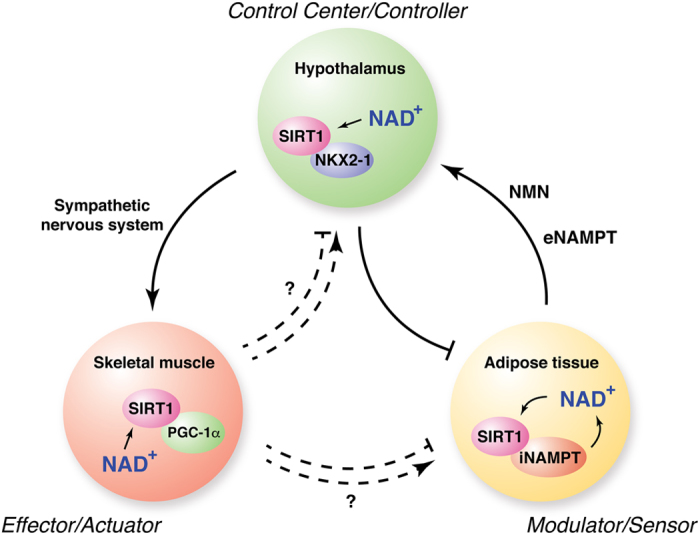
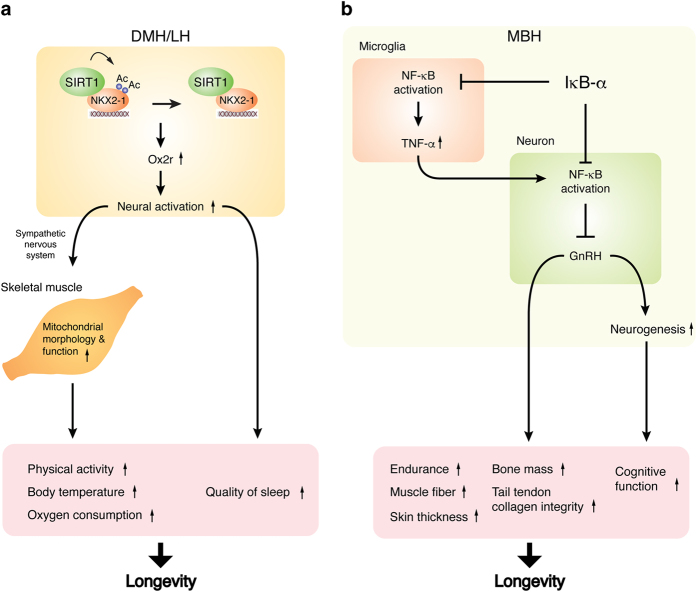
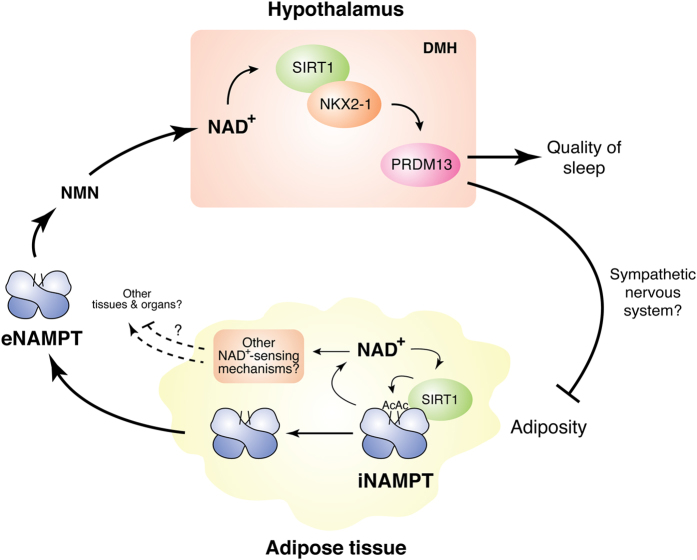
The original concept of the NAD World was proposed in 2009, providing a comprehensive framework to investigate critical issues of biological robustness and trade-offs in mammalian aging and longevity control. Significant progress has been made over the past 7 years, advancing our understanding of the mechanisms by which biological robustness is maintained, and providing extensive support to the concept of the NAD World. Three key organs and tissues have been identified as basic elements in this control system for mammalian aging and longevity: the hypothalamus as the control center of aging, skeletal muscle as an effector, and adipose tissue as a modulator. While the hypothalamus sends a signal to skeletal muscle through the sympathetic nervous system, adipose tissue remotely regulates hypothalamic function by coordinating NAD biosynthesis at a systemic level. Skeletal muscle might also communicate with other organs and tissues by secreting various myokines. The mammalian NAD-dependent protein deacetylase SIRT1 and the key NAD biosynthetic enzyme NAMPT mediate these inter-tissue communications. In this review, the function of each organ or tissue and their inter-tissue communications will be discussed in terms of understanding mammalian aging and longevity control. With such an emphasis on the system architecture, the concept is now reformulated as the NAD World 2.0, providing several important predictions. The concept of the NAD World 2.0 will provide a new foundation to understand a control system for mammalian aging and longevity and accelerate the development of an effective anti-aging intervention for humans.
NAD 世界的最初概念于 2009 年提出,为研究哺乳动物衰老和寿命控制中生物稳健性和权衡的关键问题提供了一个全面的框架。在过去 7 年里取得了重大进展,加深了我们对维持生物稳健性机制的理解,并为 NAD 世界的概念提供了广泛支持。已确定三个关键器官和组织是哺乳动物衰老和寿命控制系统的基本要素:下丘脑作为衰老的控制中心,骨骼肌作为效应器,脂肪组织作为调节器。下丘脑通过交感神经系统向骨骼肌发送信号,而脂肪组织则通过在系统水平协调 NAD 生物合成来远程调节下丘脑功能。骨骼肌也可能通过分泌各种肌动蛋白与其他器官和组织进行通信。哺乳动物依赖 NAD 的蛋白质脱乙酰酶 SIRT1 和关键的 NAD 生物合成酶 NAMPT 介导这些组织间通信。在本综述中,将从理解哺乳动物衰老和寿命控制的角度讨论每个器官或组织的功能及其组织间通信。鉴于如此强调系统架构,该概念现在被重新表述为 NAD 世界 2.0,提出了几个重要预测。NAD 世界 2.0 的概念将为理解哺乳动物衰老和寿命控制系统提供新的基础,并加速人类有效抗衰老干预措施的开发。