Faculty of Medicine, University of Tsukuba, Ibaraki, Japan.
Laboratory of Regenerative Medicine and Stem Cell Biology, University of Tsukuba, Ibaraki, Japan.
Front Public Health. 2022 Oct 18;10:946077. doi: 10.3389/fpubh.2022.946077. eCollection 2022.
The coronavirus disease 2019 (COVID-19) pandemic has influenced antibiotic consumption over a long period, with variability in trends among studies. We conducted this systematic review to explore and compare the effect of the pandemic on overall and individual antibiotic consumption in 2020 with that in 2019.
This systematic literature review was conducted using PubMed, EMBASE, and Web of Science databases. Data on antibiotic consumption in Japan was sourced from the Japan Surveillance of Antimicrobial Consumption.
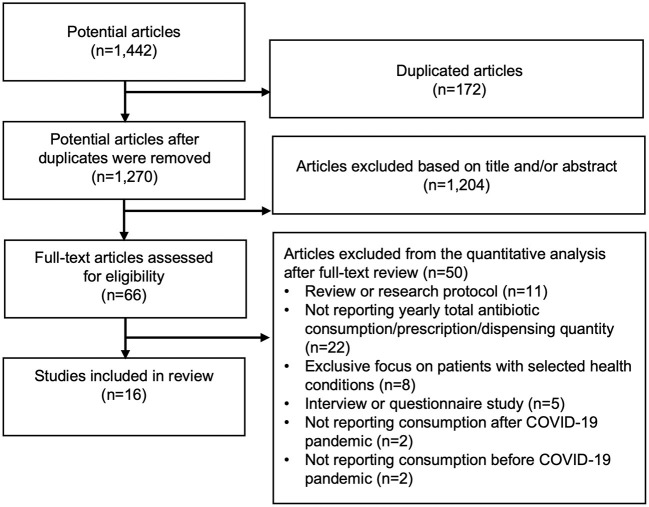
A total of 1,442 articles and reports were screened, and 16 eligible articles were reviewed. The included studies were conducted in Jordan, Australia, Canada, UK, Japan, Brazil, India, China, and the EU. There was no study from African and Southeast Asian Countries. Overall, antibiotic consumption in the community consistently reduced in 2020. Studies from Australia, Canada, Portugal, Spain, the UK, Japan, and the European Union reported both decreases in overall and selected individual antibiotics consumption. In contrast, hospital-based studies reported both increases and decreases. Hospital-based studies in Lebanon, Spain, Italy, India, and the UK reported an increase in antibiotic consumption in 2020. Studies reporting an interruption of antibiotic stewardship programs during the pandemic also reported increases in antibiotic consumption for hospitalized patients in 2020 compared with that in 2019.
Our results showed a different trend between communities and hospitals in antibiotic consumption during 2020 compared to 2019. The continuity of the antibiotic stewardship program might have influenced the antibiotic consumption trend variability among hospitals in 2020. Alongside this, the lack of information on antibiotic consumption from low-income countries and limited reports from middle-income countries revealed gaps that need to be urgently filled.
2019 年冠状病毒病(COVID-19)大流行长期以来影响了抗生素的使用,不同研究中的趋势存在差异。我们进行了这项系统评价,以探讨和比较大流行对 2020 年和 2019 年总体和个体抗生素使用的影响。
这项系统文献回顾使用了 PubMed、EMBASE 和 Web of Science 数据库。日本抗生素使用数据来自日本抗生素使用监测。
共筛选出 1442 篇文章和报告,其中 16 篇符合条件的文章进行了回顾。纳入的研究在约旦、澳大利亚、加拿大、英国、日本、巴西、印度、中国和欧盟进行。没有来自非洲和东南亚国家的研究。总体而言,2020 年社区抗生素使用持续减少。来自澳大利亚、加拿大、葡萄牙、西班牙、英国、日本和欧盟的研究报告称,总体和选定的个体抗生素使用均有所减少。相比之下,医院为基础的研究报告称既有增加也有减少。黎巴嫩、西班牙、意大利、印度和英国的医院为基础的研究报告称,2020 年抗生素使用增加。在大流行期间报告中断抗生素管理计划的研究也报告称,2020 年住院患者的抗生素使用量与 2019 年相比有所增加。
我们的结果显示,2020 年与 2019 年相比,社区和医院的抗生素使用趋势存在差异。抗生素管理计划的连续性可能影响了 2020 年医院抗生素使用趋势的变异性。此外,低收入国家缺乏抗生素使用信息和中等收入国家的报告有限,这揭示了需要紧急填补的空白。