Faculty of Physiotherapy, University of Vigo, Pontevedra, Spain.
SALBIS Research Group. Nursing and Physical Therapy Department, University of León. Astorga Ave, Ponferrada, Spain.
Ann Med. 2022 Dec;54(1):3107-3116. doi: 10.1080/07853890.2022.2140453.
Clinical practice guidelines emphasize the importance of the prevention and treatment of non-specific back pain through exercise therapy and health education. However, it has not yet been confirmed that the combination of exercise plus education is more effective than usual medical care.
The aim of this study was to determine if the combination of exercise plus education is more effective for the prevention of non-specific back pain than usual medical care.
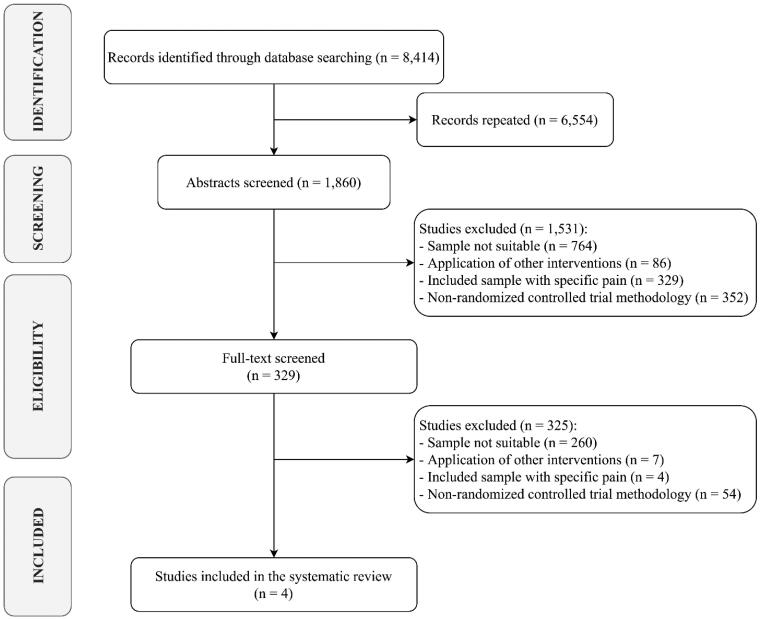
A systematic search in PubMed, Scopus, Web of Science and Medline was conducted with the terms Back Pain, Neck Pain, Musculoskeletal Pain, Exercise, Exercise Therapy, Health Education, Cognitive Behavioral Therapy, Primary Prevention, Secondary Prevention and Clinical Trial. The inclusion criteria were: articles published from 2016 to 2021, the intervention included exercise and education, and the sample consisted of non-specific back pain patients.
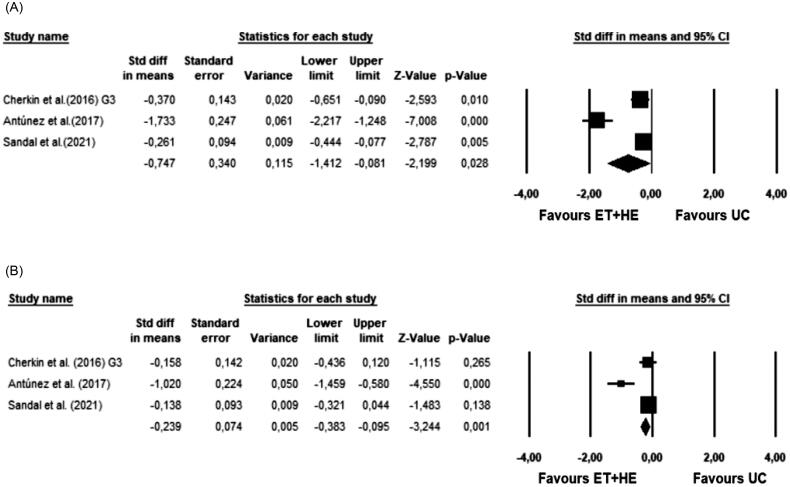
A total of 4 randomized controlled trials were selected (average PEDro score 6.5 points). The meta-analysis showed statistically significant differences in the pain intensity, standardized mean differences was found to be -0.75 (95% CI = -1.41 to -0.08; = 0.03); and in disability, standardized mean differences was found to be -0.24 (95% CI = -0.38 to -0.1; = 0.001).
Interventions combining exercise and education seem to have a greater preventive effect on non-specific back pain than usual medical care.Key messagesExercise therapy and health education combination prevent better non-specific back pain than usual care.Combining exercise with educational interventions has a higher improvement on disability and kinesophobia than usual care.
临床实践指南强调通过运动疗法和健康教育预防和治疗非特异性背痛的重要性。然而,运动加教育的组合是否比常规医疗更有效仍未得到证实。
本研究旨在确定运动加教育的组合是否比常规医疗更能预防非特异性背痛。
在 PubMed、Scopus、Web of Science 和 Medline 中使用“Back Pain”、“Neck Pain”、“Musculoskeletal Pain”、“Exercise”、“Exercise Therapy”、“Health Education”、“Cognitive Behavioral Therapy”、“Primary Prevention”、“Secondary Prevention”和“Clinical Trial”等术语进行系统搜索。纳入标准为:2016 年至 2021 年发表的文章,干预措施包括运动和教育,样本由非特异性背痛患者组成。
共选择了 4 项随机对照试验(平均 PEDro 评分 6.5 分)。荟萃分析显示,疼痛强度存在统计学显著差异,标准化均数差为-0.75(95%CI=-1.41 至-0.08;=0.03);残疾程度也存在统计学显著差异,标准化均数差为-0.24(95%CI=-0.38 至-0.1;=0.001)。
运动和教育相结合的干预措施似乎比常规医疗对非特异性背痛有更大的预防作用。
运动疗法和健康教育相结合预防非特异性背痛优于常规护理。与常规护理相比,将运动与教育干预相结合可更有效地改善残疾和运动恐惧。