Department of Mechanical Engineering, University College London, Gower Street, London, WC1E 6BT, UK.
UCL Centre for 3D Models of Health and Disease, Department of Targeted Intervention, Division of Surgery and Interventional Science, University College London, Charles Bell House, 43-45 Foley Street, London, W1W 7TS, UK.
Adv Healthc Mater. 2023 Jun;12(14):e2201749. doi: 10.1002/adhm.202201749. Epub 2022 Nov 20.
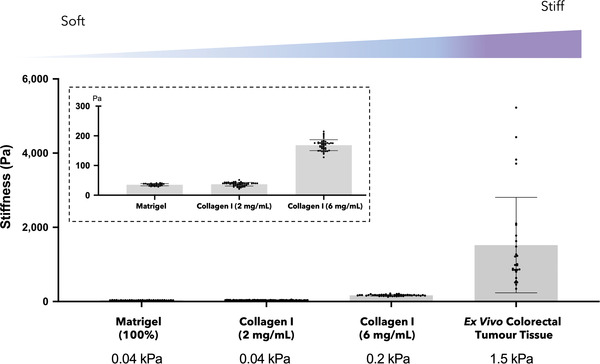
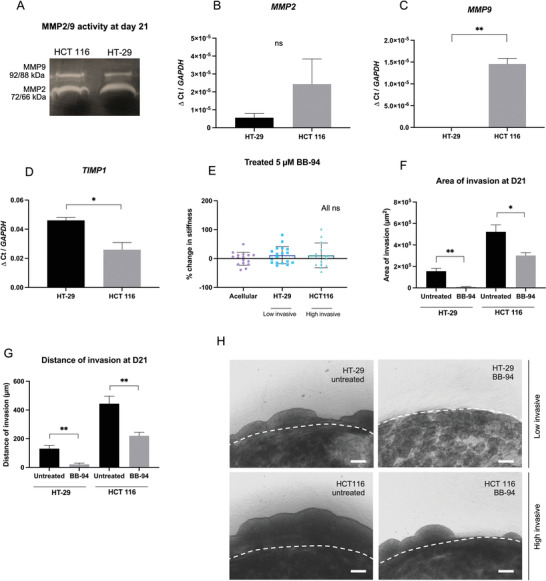
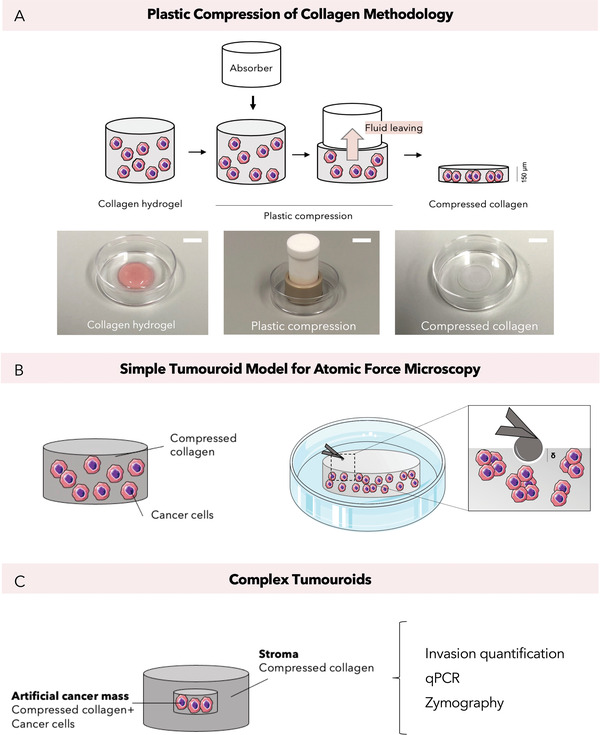
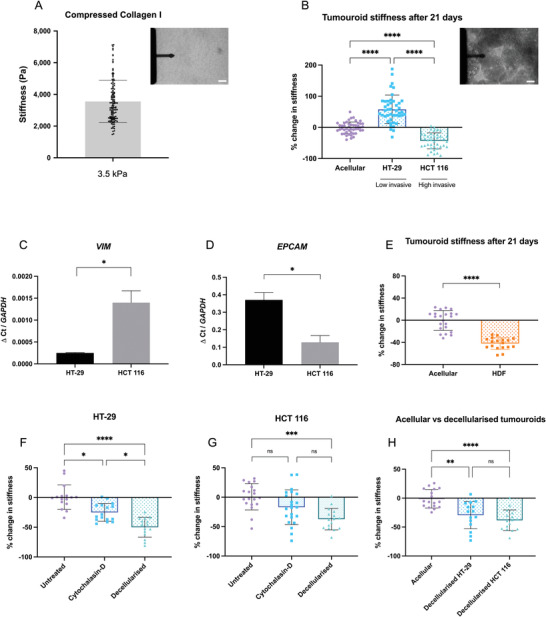
The stiffness of tumors and their host tissues is much higher than most hydrogels, which are conventionally used to study in vitro cancer progression. The tumoroid assay is an engineered 3D in vitro tumor model that allows investigation of cancer cell invasion in an environment that is biomimetic in terms of extracellular matrix (ECM) composition and stiffness. Using this model, the change in matrix stiffness by epithelial colorectal cancer cells is systematically characterized by atomic force microscopy indentation tests. Less invasive epithelial cancer cells stiffen the tumor microenvironment while highly aggressive epithelial cancer cells show significant softening of the tumor microenvironment. Changes in stiffness are attributed to both cell-generated active forces as well as ECM degradation and remodeling. The degradation is in part attributed to the enzymatic activity of matrix metalloproteinases (MMPs) as demonstrated by the significant expression of MMP-2 and MMP-9 at both gene and protein levels. Targeting MMP activity through broad-spectrum drug inhibition (BB-94) reverses the changes in stiffness and also decreases cancer cell invasion. These results promote the idea of using mechano-based cancer therapies such as MMP inhibition.
肿瘤及其宿主组织的硬度远高于传统上用于体外研究癌症进展的大多数水凝胶。类器官测定是一种工程化的 3D 体外肿瘤模型,可在细胞外基质 (ECM) 组成和硬度仿生的环境中研究癌细胞的侵袭。使用该模型,通过原子力显微镜压痕试验系统地描述了上皮结直肠癌细胞对基质硬度的改变。侵袭性较低的上皮癌细胞使肿瘤微环境变硬,而侵袭性较高的上皮癌细胞则显著软化肿瘤微环境。硬度的变化归因于细胞产生的主动力以及 ECM 的降解和重塑。降解部分归因于基质金属蛋白酶 (MMPs) 的酶活性,这在基因和蛋白质水平上 MMP-2 和 MMP-9 的显著表达得到了证明。通过广谱药物抑制(BB-94)靶向 MMP 活性可逆转硬度变化,并降低癌细胞侵袭。这些结果促进了使用基于力学的癌症疗法(如 MMP 抑制)的想法。