UFPR - Federal University of Paraná, Curitiba, Brazil.
DSM Nutritional Products, Sao Paulo, Brazil.
Poult Sci. 2022 Dec;101(12):102232. doi: 10.1016/j.psj.2022.102232. Epub 2022 Oct 8.
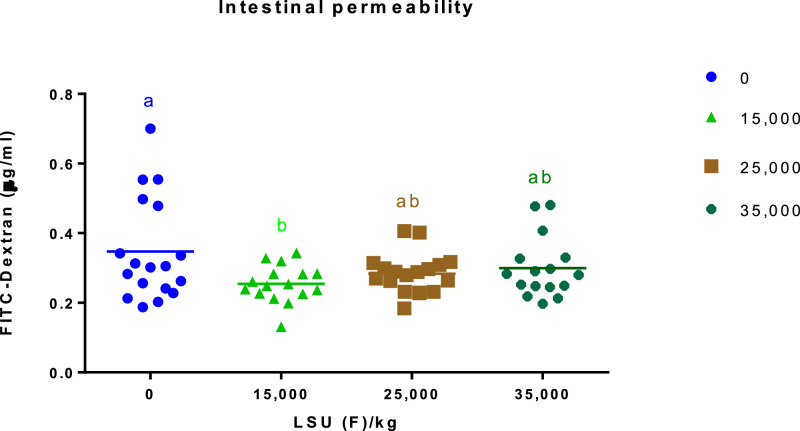
The objective of these studies was to evaluate the inclusion of a microbial muramidase (MUR) in the diets of broiler chickens on the growth performance, intestinal permeability (IP), total blood carotenoid content, apparent ileal digestibility (AID), and foot pad dermatitis (FPD). In Experiment 1, a total of 1,000 one-day-old chicks were placed in floor-pens with reused litter, and randomly distributed into 4 treatments with 10 replicates each. Treatments were a basal diet (control), or basal diet supplemented with 15,000; 25,000 or 35,000 LSU (F)/kg of MUR. Feed intake (FI), body weight gain (BWG), and feed conversion ratio (FCR) were evaluated at d 21 and 43. Intestinal permeability was evaluated on d 35 by FITC-d, and FPD and AID on d 43. In Experiment 2, a total of 800 one-day-old chicks were placed in floor-pens with fresh litter, and randomly distributed into 4 treatments with 8 replicates each. Treatments were a basal diet (control), or basal diet supplemented with 25,000 or 35,000 LSU (F)/kg of MUR, and a fourth group where the basal diet was supplemented with enramycin. The birds were induced to a mild intestinal challenge. Feed intake, BWG, and FCR were evaluated on d 21 and d 42, and total blood concentration of carotenoids was evaluated on d 28. In experiment 1, 35,000 LSU (F)/kg of MUR promoted the best FCR (P < 0.05). Muramidase supplementation linearly increased the AID of dry matter, ash, and fat (P < 0.01), and regardless of the dose, MUR decreased the IP (P < 0.05). In Experiment 2, the supplementation of 35,000 LSU (F)/kg of MUR improved BWG and FCR in the entire cycle (1-42 d) and increased the concentration of carotenoids in the blood on d 28 compared to the control group (P < 0.05). These studies show that MUR improves growth performance of broilers by improving intestinal permeability, digestibility of dry matter, ash and fat, absorption of carotenoids, and reducing FPD.
这些研究的目的是评估在肉鸡日粮中添加微生物 muramidase(MUR)对生长性能、肠道通透性(IP)、总血液类胡萝卜素含量、表观回肠消化率(AID)和脚垫皮炎(FPD)的影响。在试验 1 中,将 1000 只 1 日龄雏鸡放置在带有重复使用垫料的地板笼中,并随机分为 4 个处理组,每个处理组 10 个重复。处理组为基础日粮(对照组)或基础日粮中添加 15000、25000 或 35000 LSU(F)/kg MUR。在第 21 和 43 天评估饲料摄入量(FI)、体重增加(BWG)和饲料转化率(FCR)。在第 35 天通过 FITC-d 评估肠道通透性,在第 43 天评估 FPD 和 AID。在试验 2 中,将 800 只 1 日龄雏鸡放置在带有新鲜垫料的地板笼中,并随机分为 4 个处理组,每个处理组 8 个重复。处理组为基础日粮(对照组)或基础日粮中添加 25000 或 35000 LSU(F)/kg MUR,第四组在基础日粮中添加恩拉霉素。鸡只受到轻度肠道挑战。在第 21 和 42 天评估饲料摄入量、体重增加和饲料转化率,在第 28 天评估总血液类胡萝卜素浓度。在试验 1 中,35000 LSU(F)/kg MUR 促进最佳的 FCR(P<0.05)。MUR 线性增加干物质、灰分和脂肪的 AID(P<0.01),且无论剂量如何,MUR 均降低 IP(P<0.05)。在试验 2 中,与对照组相比,添加 35000 LSU(F)/kg MUR 在整个周期(1-42 天)提高了体重增加和饲料转化率,并增加了第 28 天血液中类胡萝卜素的浓度(P<0.05)。这些研究表明,MUR 通过改善肠道通透性、干物质、灰分和脂肪的消化率、类胡萝卜素的吸收以及减少 FPD 来提高肉鸡的生长性能。