Faculty of Dentistry, Alfonso X El Sabio University, Avenida de La Universidad 1, 28691, Villanueva de La Cañada, Spain.
Department of Dental Clinical Specialties, Faculty of Dentistry, Complutense University of Madrid, Plaza Ramón y Cajal s/n, 28040, Madrid, Spain.
BMC Oral Health. 2022 Nov 5;22(1):468. doi: 10.1186/s12903-022-02522-6.
The association between dental anomalies has been studied, giving rise to the concept of Dental Anomaly Pattern (DAP). Tooth agenesis has been associated with alterations such as molar infracclusion, taurodontism and delayed dental development. The aim of this study was to evaluate the dental development pattern in patients with non-syndromic dental agenesis, in comparison with a control group.
Dental and chronological age was analysed in a sample size of 204 orthopantomographs divided into a study group (n = 104) and a control group (n = 100) with the Demirjian Method. Intra and intergroup differences in chronological and dental age, and the correlation between them were calculated by statistical analysis with a 95% confidence level (p < 0.05).
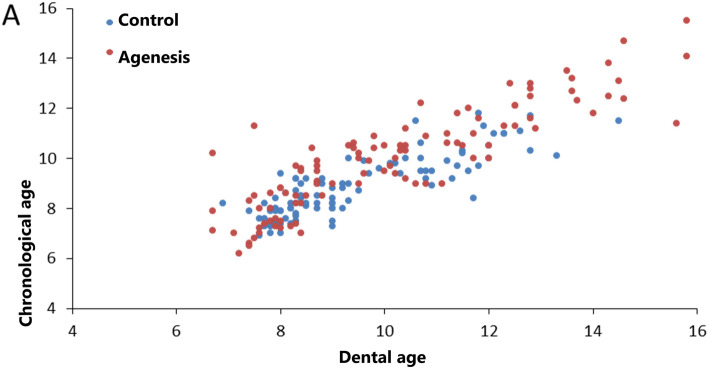
Dental age exceeded chronological age both in the control group and in the study group. Statistically significant differences (p = 0.004) were found when comparing the difference between chronological and dental age in the study (-0.16 ± 1.12) and control group (-0.58 ± 0.90). Regarding sex and age intergroup differences, the results were only statistically significant in the girls' group (p = 0.017), and the age over 8 years old (p < 0.05). There were no significant differences in tooth development depending on the number of missing teeth or the affected tooth group, but there was a delay in the development of the homologous tooth contralateral to the absent one in 14.9% of patients.
The difference between chronological and dental age in permanent dentition is significantly lower in Spanish children with non-syndromic agenesis compared to a control group, presenting a lower dental age than chronological age than children without non-syndromic agenesis.
人们研究了牙齿异常之间的关系,从而产生了牙齿异常模式(DAP)的概念。牙齿缺失与磨牙内倾、尖牙畸形和牙发育延迟等改变有关。本研究旨在评估非综合征性牙齿缺失患者的牙齿发育模式,并与对照组进行比较。
我们使用 Demirjian 方法分析了 204 张口腔全景片样本的牙齿和年龄,将其分为研究组(n=104)和对照组(n=100)。通过统计学分析计算了组内和组间的年龄和牙龄差异,以及它们之间的相关性,置信水平为 95%(p<0.05)。
无论是在对照组还是研究组,牙龄都超过了实际年龄。当比较研究组(-0.16±1.12)和对照组(-0.58±0.90)的实际年龄和牙龄之间的差异时,发现存在统计学差异(p=0.004)。在性别和年龄的组间差异方面,只有在女孩组(p=0.017)和年龄大于 8 岁时(p<0.05)才具有统计学意义。缺失牙的数量或受影响的牙组对牙齿发育没有显著影响,但在 14.9%的患者中,缺失牙对侧的同形牙发育延迟。
与对照组相比,西班牙非综合征性牙齿缺失儿童的恒牙实际年龄与牙龄之间的差异显著降低,牙龄比无非综合征性牙齿缺失的儿童更小。