Jebraeili Hashem, Davudizadeh Shabnam, Rezaee Roya
Health Psychology, Department of Psychology, School of Social and Educational Sciences, Razi University, Kermanshah, Iran. Email:
School of Social Sciences and Education, Razi University, Kermanshah, Iran.
J Inj Violence Res. 2022 Nov 6;15(1):11-20. doi: 10.5249/jivr.v15i1.1748.
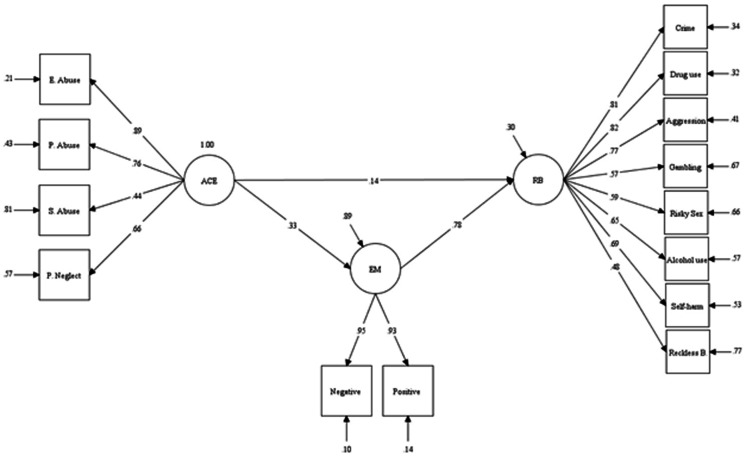
Although the impact of adverse childhood experiences (ACEs) on healthy behaviors of adulthood is largely investigated, the role of these adversities in a wide variety of impulsive and risky behaviors (RBs) as well as the role of mediating variables has been rarely studied. Therefore, the present study aimed to investigate the mediating role of positive-negative emotional motivations in the relationship between ACEs and RBs.
In a cross-sectional study, 401 adults of the general population of Kermanshah (201 individuals) and Kurdistan (200 individuals) were selected and they were assessed using the Risky, Impulsive, & Self-destructive behavior Questionnaire (RISQ) and the Childhood Trauma questionnaire (CTQ). Data were analyzed using latent profile analysis (LPA), the correlation tests and structural equation modeling.
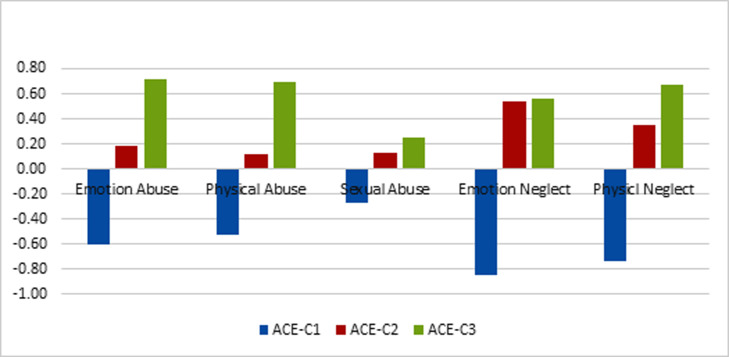
The prevalence of ACEs using LPA was estimated 37.7%. There was a significant correlation between all types of child abuse (not child neglect) and RBs. Emotional motivations played a mediating role in the relationship between ACEs and RBs (RMSEA=0.07, SRMR=0.05, CFI=0.92, TFI=0.90). The proposed model could explain about 11% of the variance of emotional motivations and around 70% of the variance of RBs.
Considering the impact of ACEs on emotional motivations and the impact of emotional motivations on RBs, intervention on emotional motivations may help to reduce RBs in people who suffer from ACEs.
尽管童年不良经历(ACEs)对成年期健康行为的影响已得到广泛研究,但这些逆境在各种冲动和危险行为(RBs)中的作用以及中介变量的作用却鲜有研究。因此,本研究旨在探讨正负性情绪动机在ACEs与RBs关系中的中介作用。
在一项横断面研究中,选取了克尔曼沙赫(201人)和库尔德斯坦(200人)普通人群中的401名成年人,并使用风险、冲动和自我毁灭行为问卷(RISQ)和童年创伤问卷(CTQ)对他们进行评估。数据采用潜在类别分析(LPA)、相关性检验和结构方程模型进行分析。
使用LPA估计ACEs的患病率为37.7%。所有类型的儿童虐待(不包括儿童忽视)与RBs之间均存在显著相关性。情绪动机在ACEs与RBs的关系中起中介作用(RMSEA = 0.07,SRMR = 0.05,CFI = 0.92,TFI = 0.90)。所提出的模型可以解释约11%的情绪动机方差和约70%的RBs方差。
考虑到ACEs对情绪动机的影响以及情绪动机对RBs的影响,对情绪动机进行干预可能有助于减少患有ACEs的人的RBs。